Ozaki Kenichiro, Tohara Haruka, Baba Mikoto, Teranaka Satoshi, Kawai Yosuke, Komatsumoto Satoru
Department of Physical Medicine and Rehabilitation, Ashikaga Red Cross Hospital, Ashikaga, Tochigi, Japan.
Dysphagia Rehabilitation, Graduate School of Medical and Dental Sciences, Tokyo Medical and Dental University, Bunkyo, Tokyo, Japan.
J Multidiscip Healthc. 2023 Sep 29;16:2937-2945. doi: 10.2147/JMDH.S415572. eCollection 2023.
Our facility's dental team consists of a full-time dentists and dental hygienists who work exclusively in the wards to implement best practices in oral healthcare. We executed the dental care system (DCS) that includes lectures and practical training for nurses conducted by dentists and dental hygienists, the introduction to oral assessment, standardization of oral care procedures, a process for nurses to request the dental team, and early bedside oral screening conducted by the dental team. This study investigated the DCS's effects on the incidence of stroke-associated pneumonia (SAP).
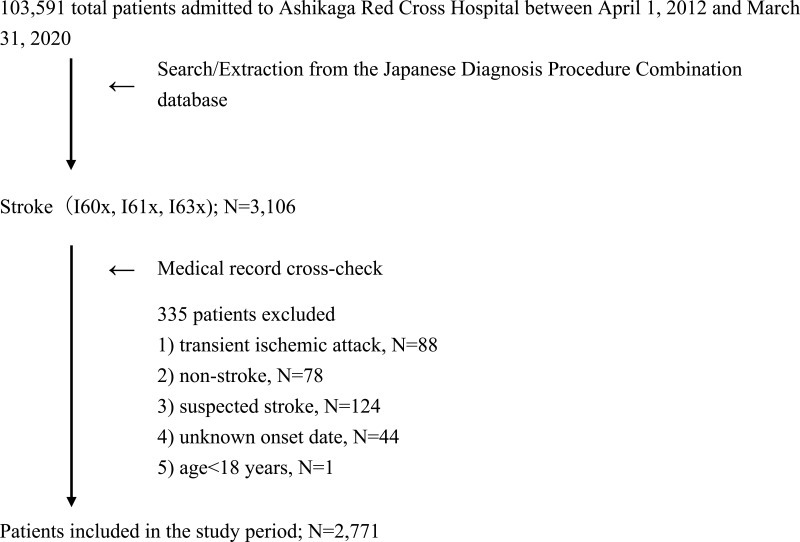
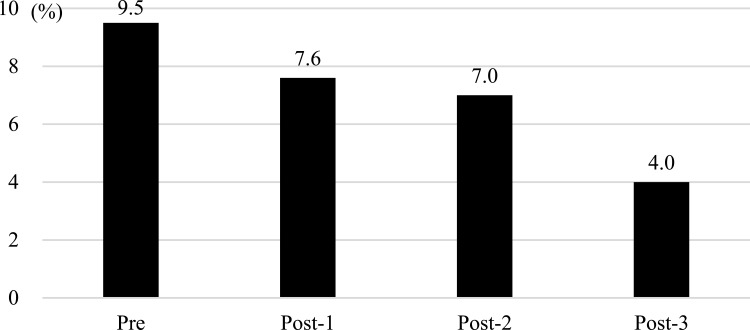
This single-center retrospective cohort study included 2,771 acute stroke patients who were newly hospitalized between April 1, 2012, and March 31, 2020. The 8-year period was divided into four phases at two-year intervals as follows: Pre (N=632), Post-1 (N=642), Post-2 (N=716), and Post-3 (N=781). Pre was prior to DCS practice. Post-1 was an early introduction to DCS. Post-2 simplified dental team requests from nurses, and Post-3 added bedside oral screening within 72 hours of admission by the dental team. Statistical analysis was performed using the Cochran-Armitage trend test, followed by multivariate logistic regression.
A decrease in SAP rates was observed across the four groups (P<0.0001). Logistic regression analysis revealed a significant difference for respiratory disease (odds ratio 7.74, 95% confidence interval 5.49-10.90), hypertension (2.28, 1.39-3.73), cardiac failure (1.72, 1.04-2.85), and diabetes (1.59, 1.11-2.26), 3-digit code on the Japan coma scale (3.57, 2.53-5.05 [reference ≤2-digit code]), age ≥90 years (2.34, 1.15-4.77 [reference 18-59 years]), male (1.86, 1.31-2.67), and the Post-1 (0.49, 0.31-0.76 [reference Pre]), Post-2 (0.38, 0.25-0.61 [reference Pre]), and Post-3 (0.24, 0.15-0.40 [reference Pre]) periods.
The suppression of SAP is effectively achieved through early intervention and education of nurses by dental professionals.
我们机构的牙科团队由全职牙医和口腔保健员组成,他们专门在病房工作,以实施口腔保健的最佳实践。我们实施了牙科护理系统(DCS),其中包括由牙医和口腔保健员为护士举办的讲座和实践培训、口腔评估的介绍、口腔护理程序的标准化、护士向牙科团队请求服务的流程,以及牙科团队在床边进行的早期口腔筛查。本研究调查了DCS对卒中相关性肺炎(SAP)发病率的影响。
这项单中心回顾性队列研究纳入了2771例2012年4月1日至2020年3月31日期间新入院的急性卒中患者。这8年期间以两年为间隔分为四个阶段,如下:术前(N = 632)、术后1期(N = 642)、术后2期(N = 716)和术后3期(N = 781)。术前是在DCS实施之前。术后1期是DCS的早期引入阶段。术后2期简化了护士向牙科团队的请求流程,术后3期增加了牙科团队在入院72小时内进行的床边口腔筛查。使用 Cochr an - Armitage趋势检验进行统计分析,随后进行多变量逻辑回归分析。
在四组中均观察到SAP发生率下降(P < 0.0001)。逻辑回归分析显示,呼吸系统疾病(优势比7.74,95%置信区间5.49 - 10.90)、高血压(2.28,1.39 - 3.73)、心力衰竭(1.72,1.04 - 2.85)、糖尿病(1.59,1.11 - 2.26)、日本昏迷量表上的三位数代码(3.57,2.53 - 5.05 [参照≤两位数代码])、年龄≥90岁(2.34,1.15 - 4.77 [参照18 - 59岁])、男性(1.86,1.31 - 2.67),以及术后1期(0.49,0.31 - 0.76 [参照术前])、术后2期(0.38,0.25 - 0.61 [参照术前])和术后3期(0.24,0.15 - 0.40 [参照术前])期间存在显著差异。
通过牙科专业人员对护士的早期干预和教育,可有效实现对SAP的抑制。