Faculty of Health Science, Dentistry of Department, Brasilia University, Brasilia, Brazil.
PLoS One. 2023 Oct 5;18(10):e0292063. doi: 10.1371/journal.pone.0292063. eCollection 2023.
In comparison to conventional medical imaging diagnostic modalities, the aim of this overview article is to analyze the accuracy of the application of Artificial Intelligence (AI) techniques in the identification and diagnosis of malignant tumors in adult patients.
The acronym PIRDs was used and a comprehensive literature search was conducted on PubMed, Cochrane, Scopus, Web of Science, LILACS, Embase, Scielo, EBSCOhost, and grey literature through Proquest, Google Scholar, and JSTOR for systematic reviews of AI as a diagnostic model and/or detection tool for any cancer type in adult patients, compared to the traditional diagnostic radiographic imaging model. There were no limits on publishing status, publication time, or language. For study selection and risk of bias evaluation, pairs of reviewers worked separately.
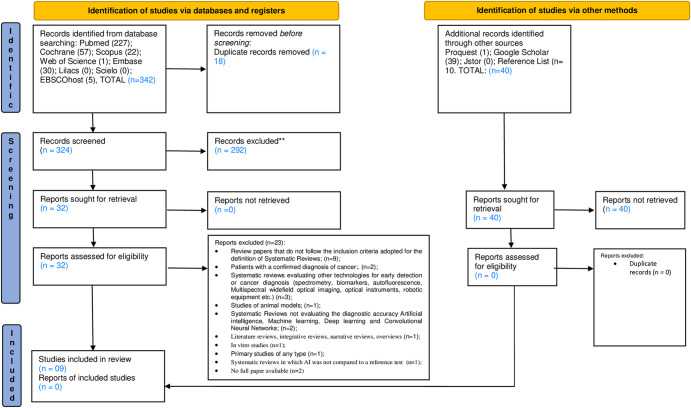
In total, 382 records were retrieved in the databases, 364 after removing duplicates, 32 satisfied the full-text reading criterion, and 09 papers were considered for qualitative synthesis. Although there was heterogeneity in terms of methodological aspects, patient differences, and techniques used, the studies found that several AI approaches are promising in terms of specificity, sensitivity, and diagnostic accuracy in the detection and diagnosis of malignant tumors. When compared to other machine learning algorithms, the Super Vector Machine method performed better in cancer detection and diagnosis. Computer-assisted detection (CAD) has shown promising in terms of aiding cancer detection, when compared to the traditional method of diagnosis.
The detection and diagnosis of malignant tumors with the help of AI seems to be feasible and accurate with the use of different technologies, such as CAD systems, deep and machine learning algorithms and radiomic analysis when compared with the traditional model, although these technologies are not capable of to replace the professional radiologist in the analysis of medical images. Although there are limitations regarding the generalization for all types of cancer, these AI tools might aid professionals, serving as an auxiliary and teaching tool, especially for less trained professionals. Therefore, further longitudinal studies with a longer follow-up duration are required for a better understanding of the clinical application of these artificial intelligence systems.
Systematic review registration. Prospero registration number: CRD42022307403.
与传统医学影像学诊断模式相比,本文旨在分析人工智能(AI)技术在识别和诊断成年患者恶性肿瘤中的应用准确性。
使用了 PIRDs 首字母缩略词,并在 PubMed、Cochrane、Scopus、Web of Science、LILACS、Embase、Scielo、EBSCOhost 和 Proquest、Google Scholar 和 JSTOR 等灰色文献中进行了全面的文献检索,检索内容为 AI 作为诊断模型和/或成年患者任何癌症类型的检测工具的系统评价,与传统诊断放射影像学模型相比。研究选择和偏倚风险评估采用了双人合作的方式。
在数据库中共检索到 382 条记录,去除重复项后为 364 条,满足全文阅读标准的有 32 条,最终有 09 篇论文被纳入定性综合分析。尽管在方法学方面、患者差异和使用的技术方面存在异质性,但研究发现,几种 AI 方法在恶性肿瘤的检测和诊断方面具有较高的特异性、敏感性和诊断准确性。与其他机器学习算法相比,超级向量机方法在癌症检测和诊断方面表现更好。与传统诊断方法相比,计算机辅助检测(CAD)在癌症检测方面显示出了较好的辅助作用。
使用不同技术(如 CAD 系统、深度学习和机器学习算法以及放射组学分析),在与传统模型相比,AI 辅助恶性肿瘤的检测和诊断似乎是可行和准确的,尽管这些技术还不能替代专业放射科医生对医学图像的分析。尽管这些 AI 工具在所有类型的癌症的推广应用上存在局限性,但它们可能有助于专业人士,作为辅助和教学工具,特别是对于培训较少的专业人士。因此,需要进行更多具有更长随访时间的纵向研究,以更好地理解这些人工智能系统的临床应用。
系统评价注册。Prospero 注册号:CRD42022307403。