Oral Biology Department, Faculty of Dentistry, Mansoura University, Mansoura, Egypt.
Oral Pathology Department, Faculty of Dentistry, Mansoura University, Mansoura, Egypt.
BMC Oral Health. 2023 Oct 5;23(1):720. doi: 10.1186/s12903-023-03466-1.
Temporomandibular joint (TMJ) arthritis is a debilitating, challenging condition and different methods have been implicated for its treatment. This study aimed to test the therapeutic potentials of low-level laser therapy (LLLT) associated with adipose derived stem cells (ADSC) or their derived secretome on a murine model induced arthritis.
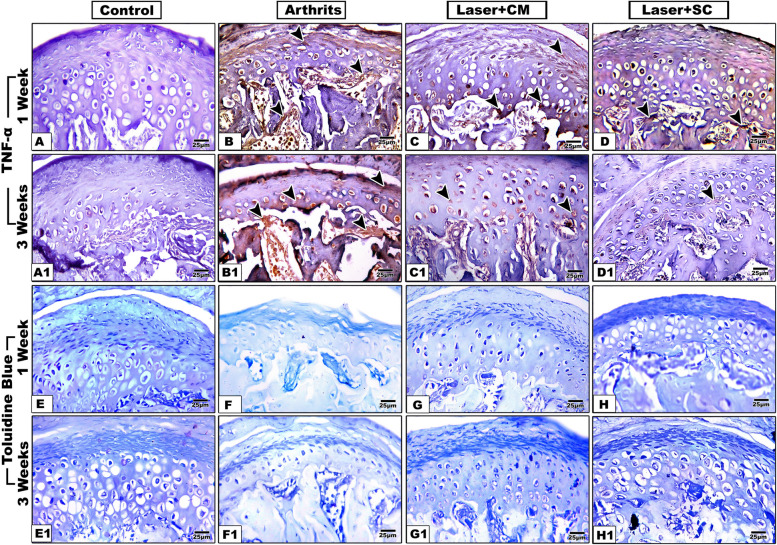
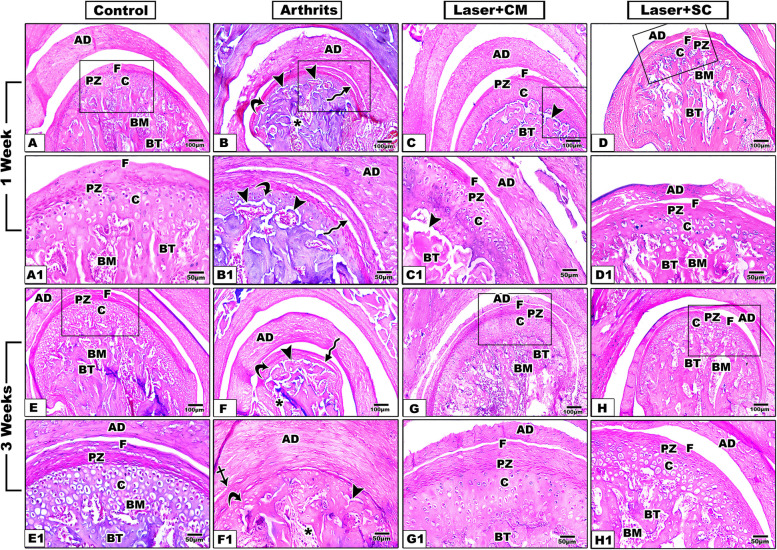
Forty eight rats were divided into four groups where group I was the sham control, the rest of animals were subjected to arthritis induction using complete Freund's adjuvant, then divided as follows: group II received phosphate buffered saline (PBS) intraarticular injection and irradiation of 0 j/cm2, group III received ADSCs derived secretome and irradiation of 38 j/cm2, and group IV received ADSCs and irradiation of 38 j/cm2 as well. One and three weeks after treatment, animals were euthanized, and paraffin blocks were processed for histological assessment by hematoxylin and eosin stain with histomorphometrical analysis. Histochemical evaluation of joint proteoglycan content was performed through toluidine blue stain, and immunohistochemical staining by the proinflammatory marker tumor necrosis factor-α (TNF-α) was performed followed by the relevant statistical tests.
The arthritis group showed histological signs of joint injury including cartilage atrophy, articular disc fibrosis, irregular osteochondral interface, and condylar bone resorption together with high inflammatory reaction and defective proteoglycan content. In contrast, the treated groups III and IV showed much restoration of the joint structure with normal cartilage and disc thickness. The inflammation process was significantly suppressed especially after three weeks as confirmed by the significant reduction in TNF-α positive immunostaining compared to the arthritic group, and the cartilage proteoglycan content also showed significant increase relative to the arthritic group. However, no significant difference between the results of the two treated groups was detected.
LLLT conjugated with ADSCs or ADSCs derived secretome can efficiently enhance the healing of arthritic TMJs. Stem cell secretome can be applied as a safe, potent therapy. However, further investigations are required to unravel its mechanism of action and pave its way as a safe, novel, cell free therapy.
颞下颌关节(TMJ)关节炎是一种使人衰弱且具有挑战性的疾病,已经有多种方法被用于其治疗。本研究旨在通过建立关节炎鼠模型来检测低水平激光治疗(LLLT)联合脂肪来源干细胞(ADSCs)或其分泌组治疗关节炎的疗效。
将 48 只大鼠分为四组,其中 I 组为假手术对照组,其余大鼠采用完全弗氏佐剂诱导关节炎,然后分为以下几组:II 组关节内注射磷酸盐缓冲液(PBS)并接受 0J/cm2 的激光照射,III 组接受 ADSC 分泌组治疗并接受 38J/cm2 的激光照射,IV 组同时接受 ADSC 治疗和 38J/cm2 的激光照射。治疗后 1 周和 3 周时,处死动物,用苏木精-伊红染色对石蜡块进行组织学评估,并进行组织形态计量学分析。通过甲苯胺蓝染色对关节中蛋白聚糖含量进行组织化学评价,通过肿瘤坏死因子-α(TNF-α)的免疫组织化学染色进行炎症标志物的检测,然后进行相应的统计学分析。
关节炎组显示出关节损伤的组织学特征,包括软骨萎缩、关节盘纤维化、骨软骨界面不规则和髁突骨吸收,同时伴有强烈的炎症反应和蛋白聚糖含量缺陷。相比之下,治疗组 III 和 IV 组的关节结构恢复良好,软骨和关节盘厚度正常。炎症过程在治疗后 3 周时明显受到抑制,TNF-α阳性免疫染色的显著减少证实了这一点,与关节炎组相比,软骨蛋白聚糖含量也显著增加。然而,两个治疗组之间的结果没有发现显著差异。
LLLT 联合 ADSCs 或 ADSCs 分泌组可有效促进关节炎 TMJ 的愈合。干细胞分泌组可作为一种安全、有效的治疗方法。然而,还需要进一步研究来揭示其作用机制,并为其作为一种安全、新颖、无细胞的治疗方法铺平道路。