Zhou Ran, Yang Gaoxia, Zhang Yan, Wang Yuan
Department of Neurosurgery, State Key Laboratory of Biotherapy and Cancer Center, West China Hospital, Sichuan University, Chengdu, 610041, China.
National Clinical Research Center for Geriatrics, West China Hospital, Sichuan University, Chengdu, 610041, Sichuan, China.
Mol Biomed. 2023 Oct 9;4(1):32. doi: 10.1186/s43556-023-00144-0.
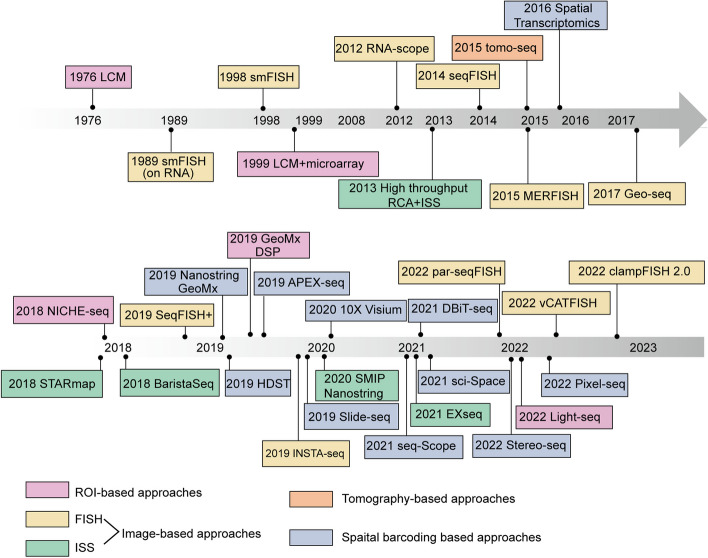
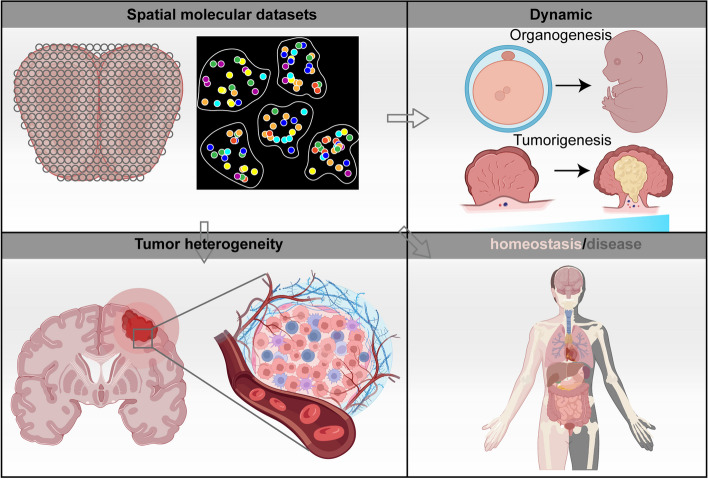
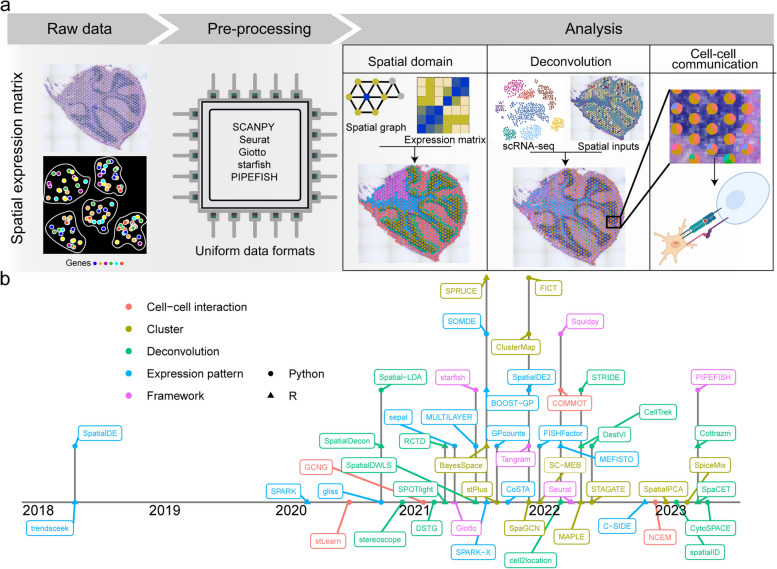
The proper functioning of diverse biological systems depends on the spatial organization of their cells, a critical factor for biological processes like shaping intricate tissue functions and precisely determining cell fate. Nonetheless, conventional bulk or single-cell RNA sequencing methods were incapable of simultaneously capturing both gene expression profiles and the spatial locations of cells. Hence, a multitude of spatially resolved technologies have emerged, offering a novel dimension for investigating regional gene expression, spatial domains, and interactions between cells. Spatial transcriptomics (ST) is a method that maps gene expression in tissue while preserving spatial information. It can reveal cellular heterogeneity, spatial organization and functional interactions in complex biological systems. ST can also complement and integrate with other omics methods to provide a more comprehensive and holistic view of biological systems at multiple levels of resolution. Since the advent of ST, new methods offering higher throughput and resolution have become available, holding significant potential to expedite fresh insights into comprehending biological complexity. Consequently, a rapid increase in associated research has occurred, using these technologies to unravel the spatial complexity during developmental processes or disease conditions. In this review, we summarize the recent advancement of ST in historical, technical, and application contexts. We compare different types of ST methods based on their principles and workflows, and present the bioinformatics tools for analyzing and integrating ST data with other modalities. We also highlight the applications of ST in various domains of biomedical research, especially development and diseases. Finally, we discuss the current limitations and challenges in the field, and propose the future directions of ST.
多种生物系统的正常运作取决于其细胞的空间组织,这是塑造复杂组织功能和精确决定细胞命运等生物过程的关键因素。然而,传统的批量或单细胞RNA测序方法无法同时捕获基因表达谱和细胞的空间位置。因此,出现了多种空间分辨技术,为研究区域基因表达、空间域以及细胞间相互作用提供了一个新的维度。空间转录组学(ST)是一种在保留空间信息的同时绘制组织中基因表达图谱的方法。它可以揭示复杂生物系统中的细胞异质性、空间组织和功能相互作用。ST还可以与其他组学方法互补和整合,以在多个分辨率水平上提供对生物系统更全面和整体的看法。自ST出现以来,具有更高通量和分辨率的新方法已经问世,在加快对生物复杂性理解的新见解方面具有巨大潜力。因此,相关研究迅速增加,利用这些技术来揭示发育过程或疾病状态下的空间复杂性。在这篇综述中,我们从历史、技术和应用背景方面总结了ST的最新进展。我们根据不同类型ST方法的原理和工作流程进行比较,并介绍用于分析ST数据并将其与其他模式整合的生物信息学工具。我们还强调了ST在生物医学研究各个领域的应用,特别是发育和疾病方面。最后,我们讨论了该领域当前的局限性和挑战,并提出了ST的未来发展方向。