
肿瘤微环境激活的纳米复合材料用于自扩增化学动力学/饥饿疗法增强 IDO 封锁肿瘤免疫治疗。
Tumor Microenvironment-Activated Nanocomposite for Self-Amplifying Chemodynamic/Starvation Therapy Enhanced IDO-Blockade Tumor Immunotherapy.
机构信息
State Key Laboratory of Rare Earth Resource Utilization, Changchun Institute of Applied Chemistry, Chinese Academy of Sciences, Changchun, 130022, China.
School of Applied Chemistry and Engineering, University of Science and Technology of China, Hefei, 230026, China.
出版信息
Adv Sci (Weinh). 2023 Dec;10(34):e2303580. doi: 10.1002/advs.202303580. Epub 2023 Oct 9.
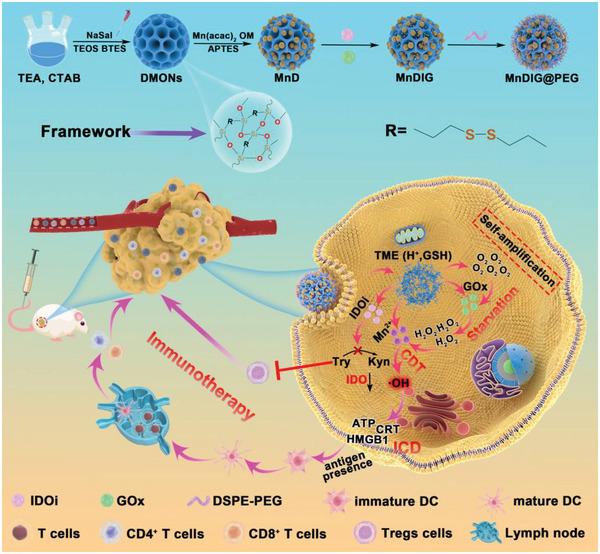
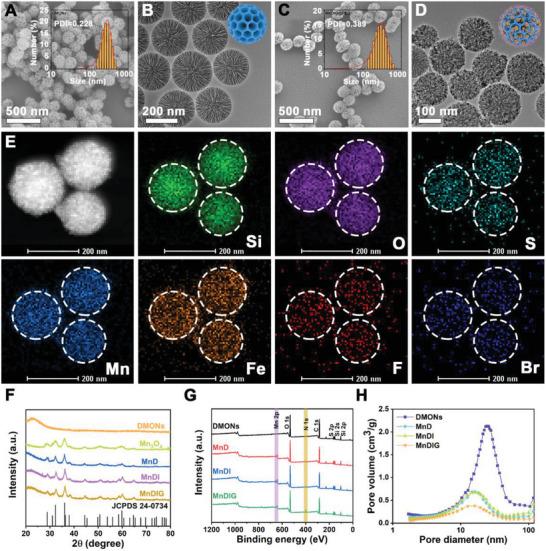
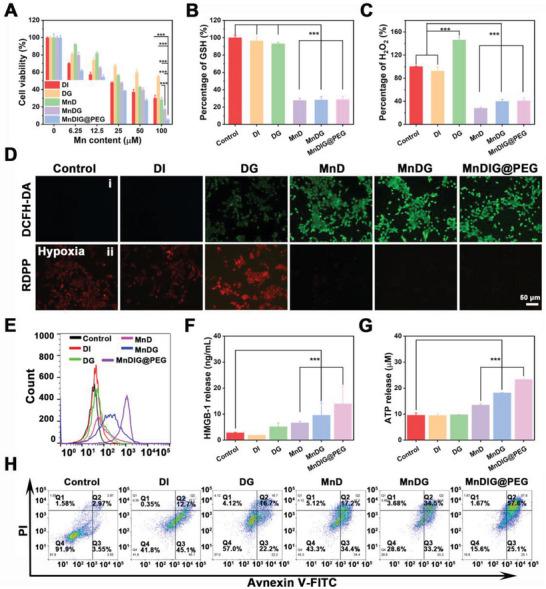
Disrupting intracellular redox homeostasis combined with immune checkpoint blockade therapy is considered as an effective way to accelerate tumor cell death. However, suppressed tumor immune microenvironment and lower cargo delivery restrict the efficiency of tumor therapy. In this study, a multifunctional tumor microenvironment (TME)-responsive nanocomposite is constructed using manganese tetroxide (Mn O )-decorated disulfide-bond-incorporated dendritic mesoporous organosilica nanoparticles (DMONs) to co-deliver indoleamine 2,3-dioxygenase (IDO) inhibitor Epacadostat (IDOi) and glucose oxidase (GOx) following modification with polyethylene glycol. Owing to the responsiveness of Mn O -decorated DMONs to the mildly acidic and glutathione (GSH) overexpressed TME, the nanocomposite can rapidly decompose and release inner contents, thus substantially improving the cargo release ability. Mn O can effectively catalyze hydrogen peroxide (H O ) decomposition to generate oxygen, enhance the ability of GOx to consume glucose to produce H O , and further promote the generation of hydroxyl radicals (•OH) by Mn . Furthermore, Mn -mediated GSH depletion and the production of •OH can disrupt intracellular redox homeostasis, contributing to immunogenic cell death. Simultaneously, IDOi can inhibit IDO to reverse inhibited immune response. The results show that self-amplifying chemodynamic/starvation therapy combined IDO-blockade immunotherapy synergistically inhibits tumor growth and metastasis in vivo.
扰乱细胞内氧化还原稳态并结合免疫检查点阻断治疗被认为是加速肿瘤细胞死亡的有效方法。然而,肿瘤免疫微环境的抑制和较低的货物输送限制了肿瘤治疗的效率。在这项研究中,使用锰四氧化物 (MnO) 修饰的含二硫键的树枝状介孔有机硅纳米粒子 (DMONs) 构建了一种多功能肿瘤微环境 (TME) 响应性纳米复合材料,以共递送吲哚胺 2,3-双加氧酶 (IDO) 抑制剂 Epacadostat (IDOi) 和葡萄糖氧化酶 (GOx),随后用聚乙二醇进行修饰。由于 MnO 修饰的 DMONs 对微酸性和谷胱甘肽 (GSH) 过表达的 TME 的响应性,纳米复合材料可以迅速分解并释放内部内容物,从而大大提高了货物释放能力。MnO 可以有效地催化过氧化氢 (H2O2) 分解生成氧气,增强 GOx 消耗葡萄糖产生 H2O2 的能力,并进一步通过 Mn 促进羟基自由基 (•OH) 的生成。此外,Mn 介导的 GSH 耗竭和 •OH 的产生可以破坏细胞内氧化还原稳态,导致免疫原性细胞死亡。同时,IDOi 可以抑制 IDO 以逆转抑制的免疫反应。结果表明,自增强化学动力学/饥饿治疗联合 IDO 阻断免疫治疗在体内协同抑制肿瘤生长和转移。



 Zotero 插件