Tafesse Nebiyou, Porcelli Massimiliano, Hirpessa Belachew Bacha, Gasana Janvier, Padhi R K, Robele Sirak, Ambelu Argaw
Department of Water and Public Health, Ethiopian Institute of Water Resources, Addis Ababa University, P.O. Box: 56402, Addis Ababa, Ethiopia.
Menelik II Medical and Health Sciences College, Addis Ababa Health Bureau, Addis Ababa, Ethiopia.
Heliyon. 2023 Aug 28;9(9):e19446. doi: 10.1016/j.heliyon.2023.e19446. eCollection 2023 Sep.
Trihalomethanes (THMs) are the most dominant fraction of all the byproducts formed during chlorination of water. Disinfection by product (DBP) formation in water is a function of numerous factors, including pH, temperature, residual chlorine, source water characteristics, and organic matter. No study has determined the THM level in the drinking water supply of Addis Ababa, Ethiopia.
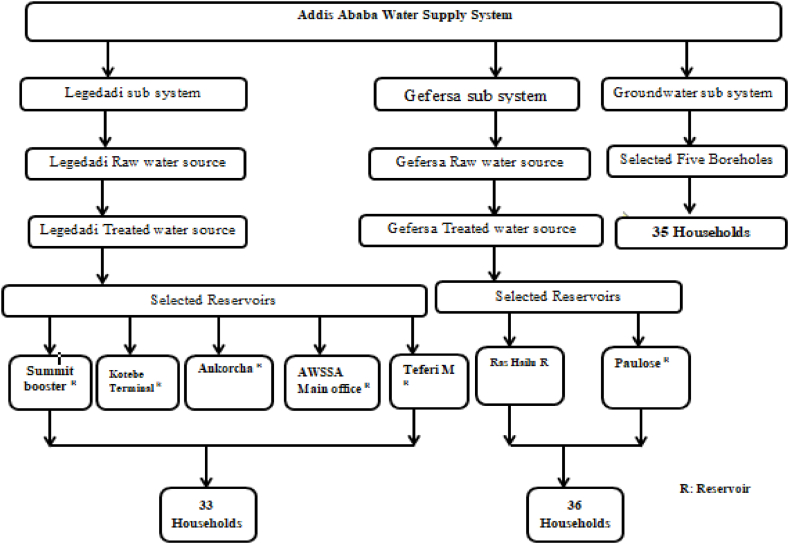
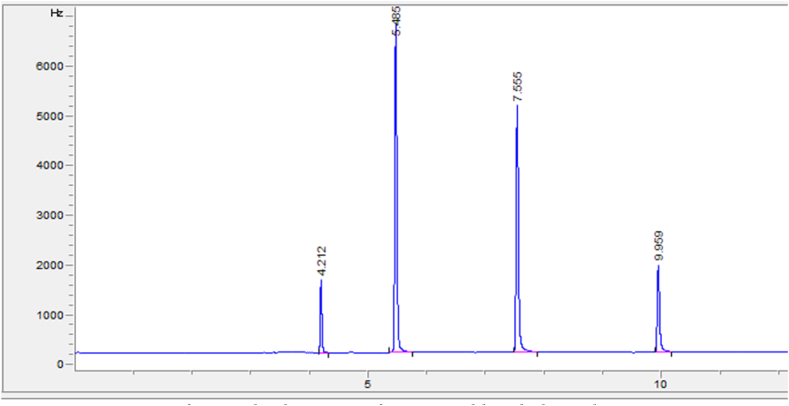
A cross-sectional design was conducted to collect water samples in the water supply distribution networks of Addis Ababa, Ethiopia. Twenty-one (21) sampling stations yielded a total of one hundred twenty (120) samples of drinking water. The sample handling and collection procedures were carried out in accordance with USEPA guidelines. A DB-5 capillary column was used to separate the THMs, which were detected using GC-ECD (gas chromatography-electron capture detector). Spectrophotometric and in situ methods were used for physicochemical parameters. Redundancy analysis (RDA) was used for data analysis of trihalomethanes and environmental variables using CANOCO 4.5.
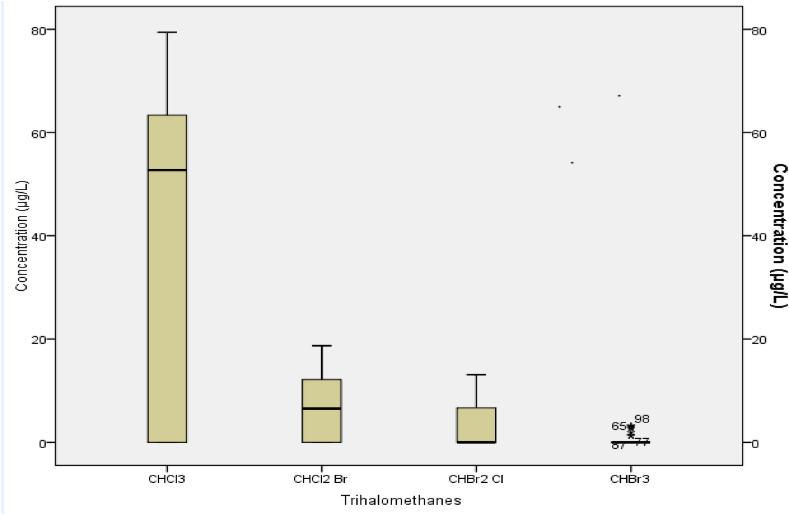
The mean concentration of total trihalomethanes in drinking water in Addis Ababa was 76.3 μg/L. The concentration of chloroform in the drinking water supply in Addis Ababa, Ethiopia, ranged between 4.03 and 79.4 μg/L. The mean total THMs in the Legedadi and Gefersa water supply systems were 77.4 μg/L and 69.66 μg/L, respectively. The residual chlorine, phosphates, UV absorbance at 254 nm, and combined chlorine had positive correlations with THM formation. However, electron conductivity had a negative correlation with THM formation.
Chloroform contributed the most to TTHMs in nearly all samples. The residual chlorine, UV absorbance, phosphate and hardness as calcium, and electron conductivity were found to be the main predictors determining the abundance and distribution of trihalomethanes. The monitoring and regulation of the THMs is required on a regular basis to analyse trends and guide the water treatment and distribution system.
三卤甲烷(THMs)是水氯化过程中形成的所有副产物中最主要的部分。水中消毒副产物(DBP)的形成是众多因素的函数,包括pH值、温度、余氯、水源水特征和有机物。尚无研究确定埃塞俄比亚亚的斯亚贝巴饮用水供应中的三卤甲烷水平。
采用横断面设计在埃塞俄比亚亚的斯亚贝巴的供水分配网络中采集水样。21个采样站共采集了120份饮用水样本。样本处理和采集程序按照美国环境保护局(USEPA)指南进行。使用DB - 5毛细管柱分离三卤甲烷,通过气相色谱 - 电子捕获检测器(GC - ECD)进行检测。采用分光光度法和原位方法测定理化参数。使用CANOCO 4.5软件通过冗余分析(RDA)对三卤甲烷和环境变量进行数据分析。
亚的斯亚贝巴饮用水中总三卤甲烷的平均浓度为76.3μg/L。埃塞俄比亚亚的斯亚贝巴饮用水供应中氯仿的浓度在4.03至79.4μg/L之间。莱格达迪和盖费尔萨供水系统中总三卤甲烷的平均浓度分别为77.4μg/L和69.66μg/L。余氯、磷酸盐、254nm处的紫外线吸光度和化合氯与三卤甲烷的形成呈正相关。然而,电导率与三卤甲烷的形成呈负相关。
在几乎所有样本中,氯仿对总三卤甲烷的贡献最大。发现余氯、紫外线吸光度、磷酸盐和以钙计的硬度以及电导率是决定三卤甲烷丰度和分布的主要预测因素。需要定期对三卤甲烷进行监测和监管,以分析趋势并指导水处理和分配系统。