Khairunisa Siti Qamariyah, Maharani Aussie Tahta, Utomo Budi, Mei Yuana Dia Bitari, Hidayati Afif Nurul, Amarullah Ilham Harlan
Doctoral Program, Faculty of Medicine, Universitas Airlangga, Surabaya, 60132, East Java, Indonesia.
Institute of Tropical Disease, Universitas Airlangga, Surabaya, 60115, East Java, Indonesia.
Heliyon. 2023 Aug 25;9(9):e19528. doi: 10.1016/j.heliyon.2023.e19528. eCollection 2023 Sep.
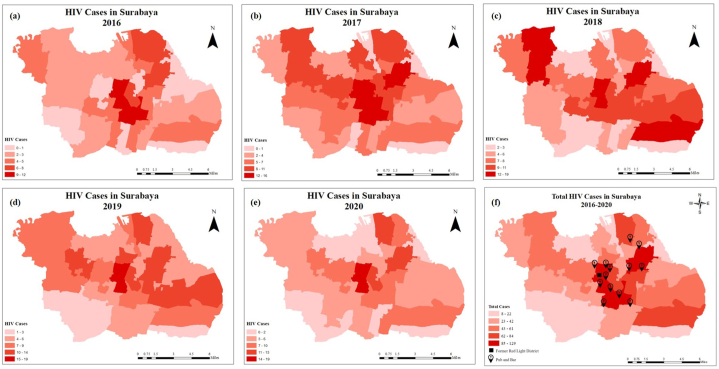
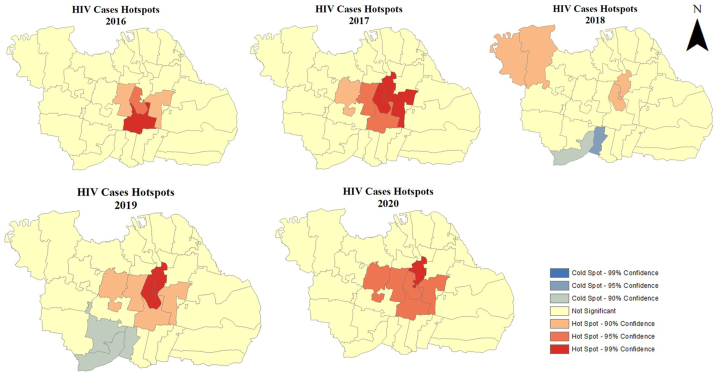
The high prevalence of human immunodeficiency virus (HIV) infections has become a devastating public health problem in Indonesia. In response, the government has taken measures to reduce the transmission of HIV and the number of deaths from HIV/acquired immunodeficiency syndrome (AIDS). However, these efforts have not successfully reduced the spread of HIV in Surabaya. In this study, we analyzed the factors that could influence the spread of HIV in Surabaya using a Geographic Information System. We conducted a spatial analysis of HIV/AIDS clusters in Surabaya from 2016 to 2020. Spatial autocorrelation and spatiotemporal analysis were used to identify local HIV clustering. In addition, the Global Moran's index was applied to detect HIV clustering at the sub-district level. The results showed that HIV mostly occurred among males (683/969; 70.3%) in the economic age group (20-35 years) and that the infection was transmitted mostly through sexual intercourse (942/969; 97.2%). The hotspots were located in Central and Southern Surabaya, including the Genteng, Tegal Sari, Gubeng, and Sawahan sub-sub-districts. Western Surabaya (Benowo and Pakal) was the only hot spot in 2018. In conclusion, the spatial and temporal analysis of HIV, coupled with an assessment of the factors that drive the epidemic, can assist the government to formulate policies and design targeted interventions to prevent and control the epidemic in Surabaya, Indonesia.
人类免疫缺陷病毒(HIV)感染的高流行率已成为印度尼西亚一个极具破坏性的公共卫生问题。作为应对措施,政府已采取措施减少HIV的传播以及HIV/获得性免疫缺陷综合征(AIDS)导致的死亡人数。然而,这些努力并未成功减少泗水市HIV的传播。在本研究中,我们使用地理信息系统分析了可能影响泗水市HIV传播的因素。我们对2016年至2020年泗水市的HIV/AIDS聚集区进行了空间分析。利用空间自相关和时空分析来识别局部HIV聚集情况。此外,应用全局莫兰指数来检测分区层面的HIV聚集情况。结果显示,HIV主要发生在经济活跃年龄组(20 - 35岁)的男性中(683/969;70.3%),且感染主要通过性行为传播(942/969;97.2%)。热点地区位于泗水市的中部和南部,包括根滕、特加尔萨里、古本和萨瓦汉次分区。泗水市西部(贝诺沃和帕卡尔)是2018年唯一的热点地区。总之,对HIV进行时空分析,并评估推动该流行病传播的因素,有助于政府制定政策并设计有针对性的干预措施,以预防和控制印度尼西亚泗水市的该流行病。