Department of Medicine, Division of Pulmonary, Allergy, and Critical Care Medicine, Duke University School of Medicine, Durham, North Carolina, USA.
Duke Clinical Research Institute, Durham, North Carolina, USA.
Clin Infect Dis. 2024 Mar 20;78(3):775-784. doi: 10.1093/cid/ciad599.
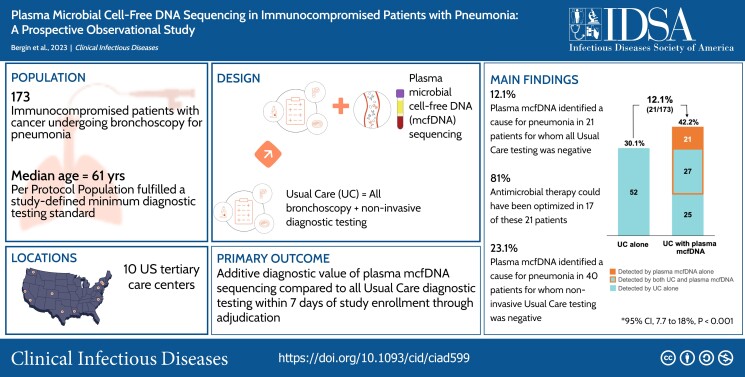
Pneumonia is a common cause of morbidity and mortality, yet a causative pathogen is identified in a minority of cases. Plasma microbial cell-free DNA sequencing may improve diagnostic yield in immunocompromised patients with pneumonia.
In this prospective, multicenter, observational study of immunocompromised adults undergoing bronchoscopy to establish a pneumonia etiology, plasma microbial cell-free DNA sequencing was compared to standardized usual care testing. Pneumonia etiology was adjudicated by a blinded independent committee. The primary outcome, additive diagnostic value, was assessed in the Per Protocol population (patients with complete testing results and no major protocol deviations) and defined as the percent of patients with an etiology of pneumonia exclusively identified by plasma microbial cell-free DNA sequencing. Clinical additive diagnostic value was assessed in the Per Protocol subgroup with negative usual care testing.
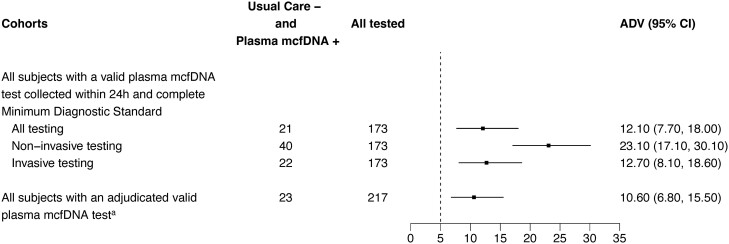
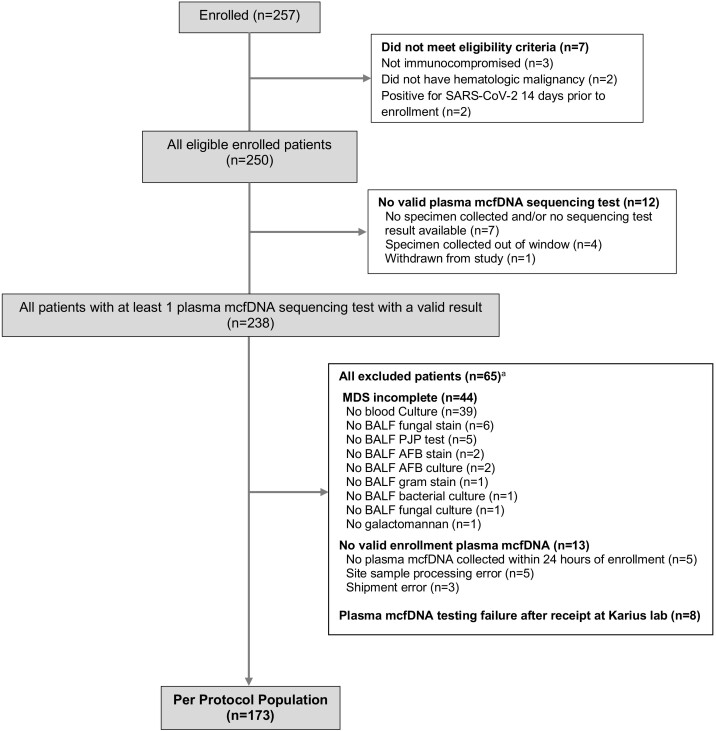
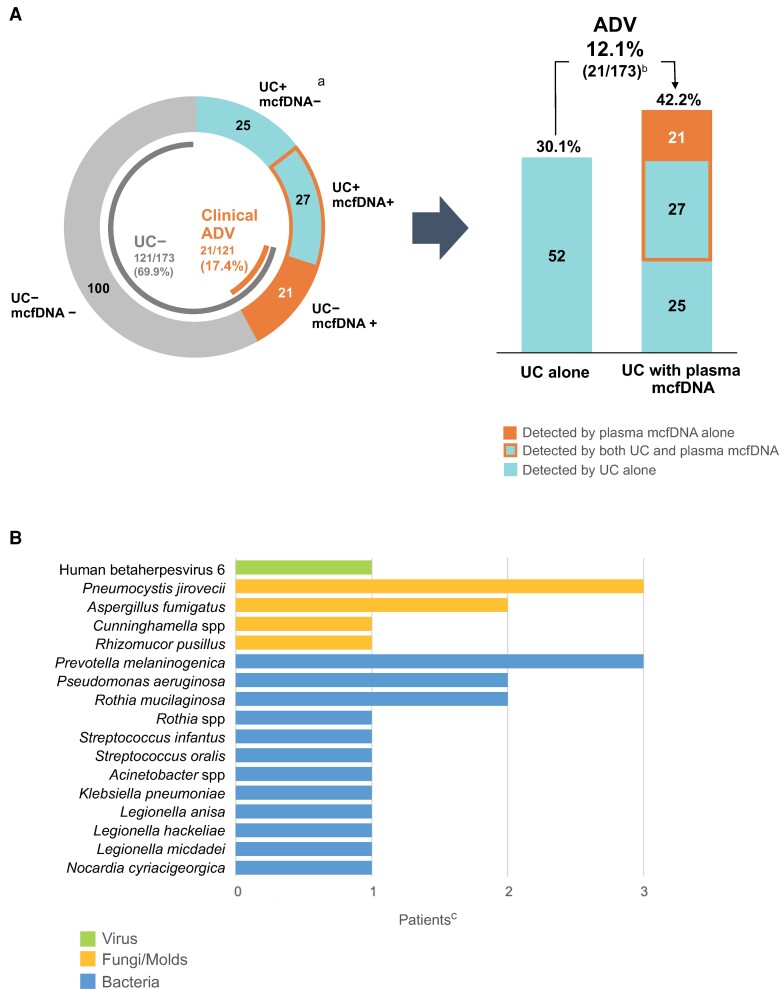
Of 257 patients, 173 met Per Protocol criteria. A pneumonia etiology was identified by usual care in 52/173 (30.1%), plasma microbial cell-free DNA sequencing in 49/173 (28.3%) and the combination of both in 73/173 (42.2%) patients. Plasma microbial cell-free DNA sequencing exclusively identified an etiology of pneumonia in 21/173 patients (additive diagnostic value 12.1%, 95% confidence interval [CI], 7.7% to 18.0%, P < .001). In the Per Protocol subgroup with negative usual care testing, plasma microbial cell-free DNA sequencing identified a pneumonia etiology in 21/121 patients (clinical additive diagnostic value 17.4%, 95% CI, 11.1% to 25.3%).
Non-invasive plasma microbial cell-free DNA sequencing significantly increased diagnostic yield in immunocompromised patients with pneumonia undergoing bronchoscopy and extensive microbiologic and molecular testing.
NCT04047719.
肺炎是发病率和死亡率的常见原因,但在少数情况下可确定病因。血浆微生物游离 DNA 测序可能会提高免疫功能低下并发肺炎患者的诊断率。
在这项对接受支气管镜检查以确定肺炎病因的免疫功能低下成人进行的前瞻性、多中心、观察性研究中,与标准的常规护理检测相比,对血浆微生物游离 DNA 测序进行了比较。肺炎病因由一个盲法独立委员会进行裁决。主要结局,即附加诊断价值,在符合方案人群(完成了所有检测且无主要方案偏差的患者)中进行评估,并定义为仅通过血浆微生物游离 DNA 测序确定肺炎病因的患者比例。在常规护理检测阴性的符合方案亚组中评估临床附加诊断价值。
在 257 例患者中,173 例符合符合方案标准。52/173(30.1%)例患者通过常规护理检测确定了肺炎病因,49/173(28.3%)例患者通过血浆微生物游离 DNA 测序确定了肺炎病因,73/173(42.2%)例患者通过两者联合确定了肺炎病因。21/173(12.1%,95%置信区间[CI],7.7%至 18.0%,P<.001)例患者仅通过血浆微生物游离 DNA 测序确定了肺炎病因。在常规护理检测阴性的符合方案亚组中,21/121(17.4%,95%CI,11.1%至 25.3%)例患者通过血浆微生物游离 DNA 测序确定了肺炎病因。
在接受支气管镜检查和广泛的微生物学及分子检测的免疫功能低下并发肺炎患者中,非侵入性血浆微生物游离 DNA 测序显著提高了诊断率。
NCT04047719。