Chen Yongye, Qin Siyuan, Zhao Weili, Wang Qizheng, Liu Ke, Xin Peijin, Yuan Huishu, Zhuang Hongqing, Lang Ning
Department of Radiology, Peking University Third Hospital, 49 North Garden Road, Haidian District, Beijing, 100191, People's Republic of China.
Department of radiotherapy, Peking University Third Hospital, 49 North Garden Road, Haidian District, Beijing, 100191, People's Republic of China.
Insights Imaging. 2023 Oct 10;14(1):169. doi: 10.1186/s13244-023-01523-5.
This study aimed to extract radiomics features from MRI using machine learning (ML) algorithms and integrate them with clinical features to build response prediction models for patients with spinal metastases undergoing stereotactic body radiotherapy (SBRT).
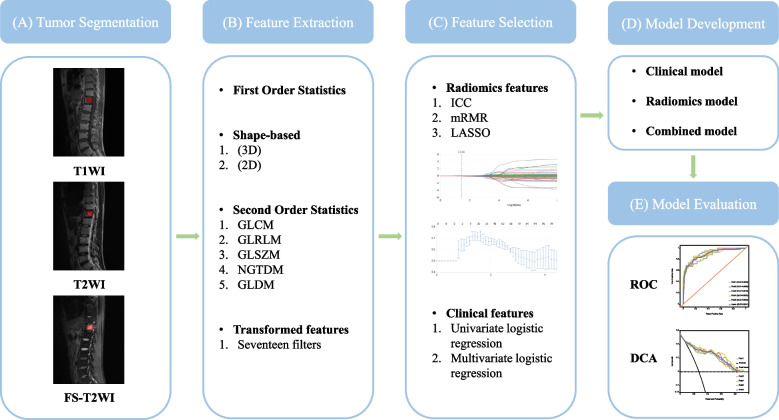
Patients with spinal metastases who were treated using SBRT at our hospital between July 2018 and April 2023 were recruited. We assessed their response to treatment using the revised Response Evaluation Criteria in Solid Tumors (version 1.1). The lesions were categorized into progressive disease (PD) and non-PD groups. Radiomics features were extracted from T1-weighted image (T1WI), T2-weighted image (T2WI), and fat-suppression T2WI sequences. Feature selection involved intraclass correlation coefficients, minimal-redundancy-maximal-relevance, and least absolute shrinkage and selection operator methods. Thirteen ML algorithms were employed to construct the radiomics prediction models. Clinical, conventional imaging, and radiomics features were integrated to develop combined models. Model performance was evaluated using receiver operating characteristic (ROC) curve analysis, and the clinical value was assessed using decision curve analysis.
We included 194 patients with 142 (73.2%) lesions in the non-PD group and 52 (26.8%) in the PD group. Each region of interest generated 2264 features. The clinical model exhibited a moderate predictive value (area under the ROC curve, AUC = 0.733), while the radiomics models demonstrated better performance (AUC = 0.745-0.825). The combined model achieved the best performance (AUC = 0.828).
The MRI-based radiomics models exhibited valuable predictive capability for treatment outcomes in patients with spinal metastases undergoing SBRT.
Radiomics prediction models have the potential to contribute to clinical decision-making and improve the prognosis of patients with spinal metastases undergoing SBRT.
• Stereotactic body radiotherapy effectively delivers high doses of radiation to treat spinal metastases. • Accurate prediction of treatment outcomes has crucial clinical significance. • MRI-based radiomics models demonstrated good performance to predict treatment outcomes.
本研究旨在利用机器学习(ML)算法从磁共振成像(MRI)中提取影像组学特征,并将其与临床特征相结合,为接受立体定向体部放疗(SBRT)的脊柱转移瘤患者建立反应预测模型。
招募2018年7月至2023年4月期间在我院接受SBRT治疗的脊柱转移瘤患者。我们使用修订后的实体瘤疗效评价标准(1.1版)评估他们对治疗的反应。病变分为疾病进展(PD)组和非PD组。从T1加权图像(T1WI)、T2加权图像(T2WI)和脂肪抑制T2WI序列中提取影像组学特征。特征选择涉及组内相关系数、最小冗余最大相关和最小绝对收缩和选择算子方法。采用13种ML算法构建影像组学预测模型。整合临床、传统影像和影像组学特征以开发联合模型。使用受试者操作特征(ROC)曲线分析评估模型性能,并使用决策曲线分析评估临床价值。
我们纳入了194例患者,其中非PD组有142个(73.2%)病灶,PD组有52个(26.8%)病灶。每个感兴趣区域产生2264个特征。临床模型表现出中等预测价值(ROC曲线下面积,AUC = 0.733),而影像组学模型表现出更好的性能(AUC = 0.745 - 0.825)。联合模型实现了最佳性能(AUC = 0.828)。
基于MRI的影像组学模型对接受SBRT的脊柱转移瘤患者的治疗结果具有有价值的预测能力。
影像组学预测模型有可能有助于临床决策,并改善接受SBRT的脊柱转移瘤患者的预后。
• 立体定向体部放疗有效地给予高剂量辐射以治疗脊柱转移瘤。• 准确预测治疗结果具有至关重要的临床意义。• 基于MRI的影像组学模型在预测治疗结果方面表现出良好性能。