College of Nursing, The Research Institute of Nursing Science, Seoul National University, Seoul, Republic of Korea.
Department of Nursing, College of Life Science and Nano Technology, Hannam University, Daejeon, Republic of Korea.
BMC Cardiovasc Disord. 2023 Oct 10;23(1):498. doi: 10.1186/s12872-023-03527-x.
The prevalence of heart failure (HF) is expected to rise due to increased survivorship and life expectancy of patients with acute heart conditions. Patients with HF and other multiple comorbid conditions are likely to have poor health outcomes. This study aimed to assimilate the current body of knowledge and to provide the pooled effect of HF patients' comorbid conditions on health outcomes.
A systematic search was performed using MEDLINE, EMBASE and CINAHL databases. Observational studies evaluating the relationship between comorbid conditions and the health outcomes of HF were included. The pooled effect sizes of comorbidity on the identified health outcomes were calculated using a random effects model, and the heterogeneity was evaluated using I statistics.
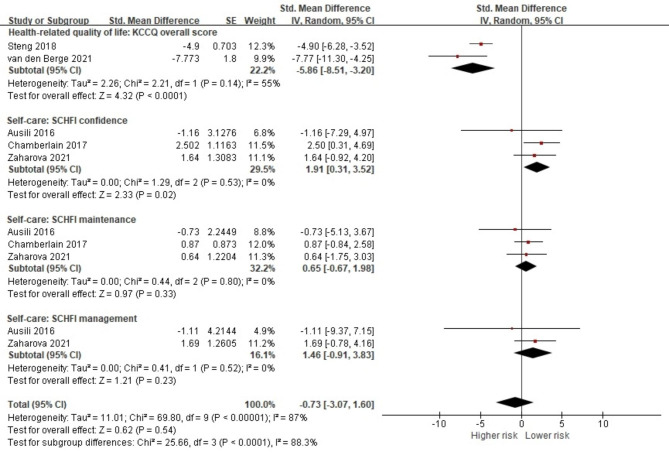
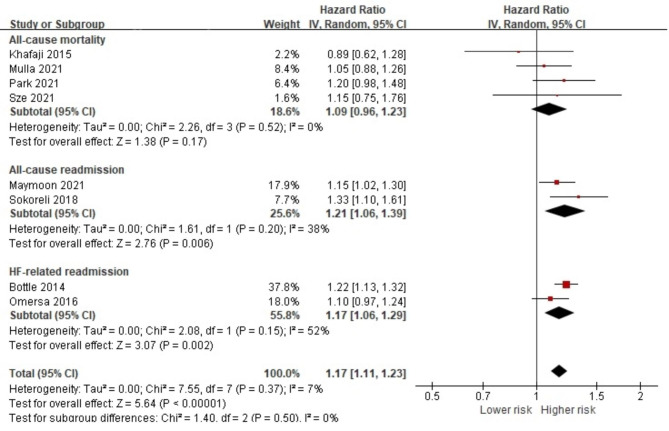
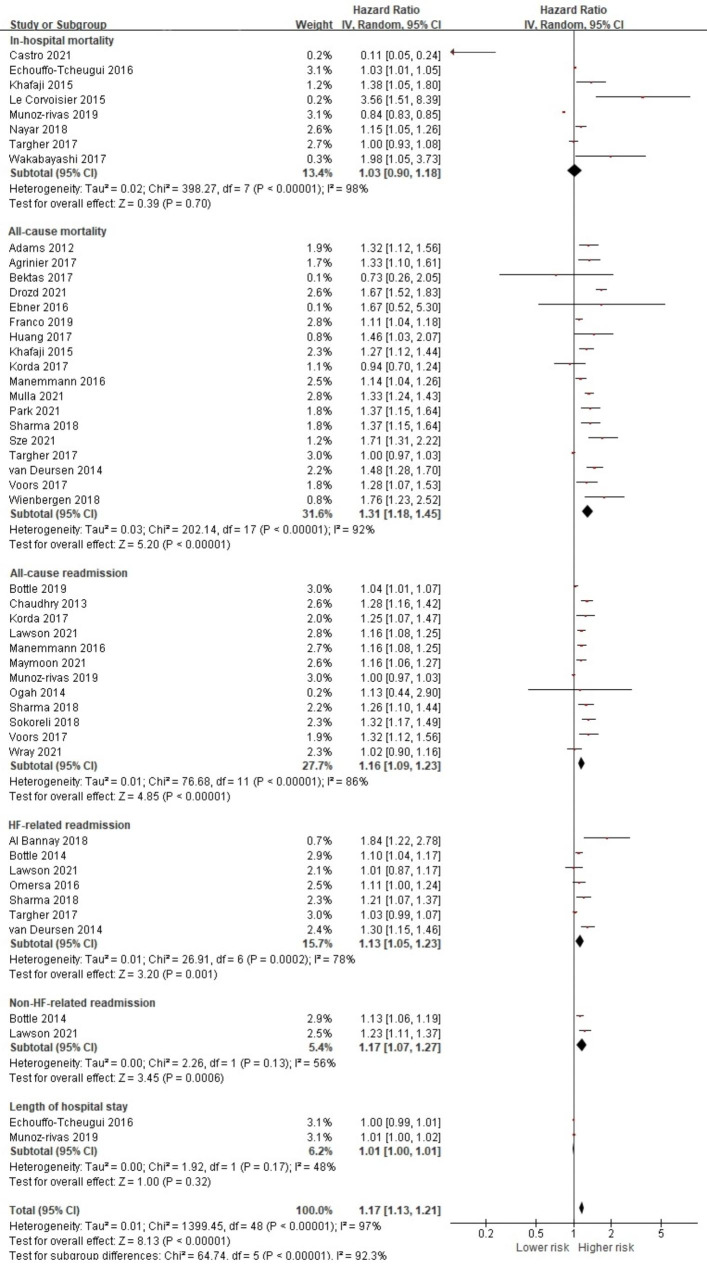
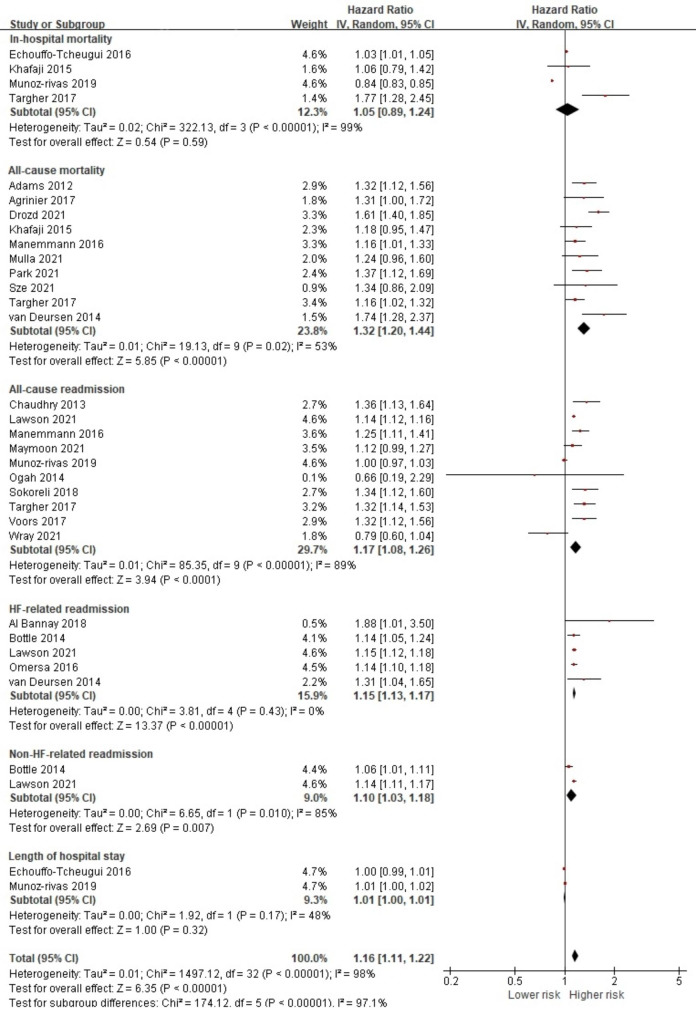
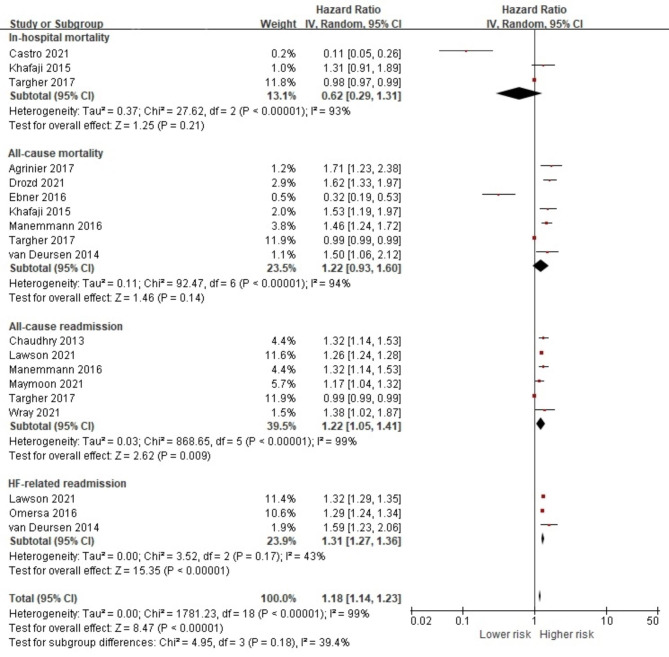
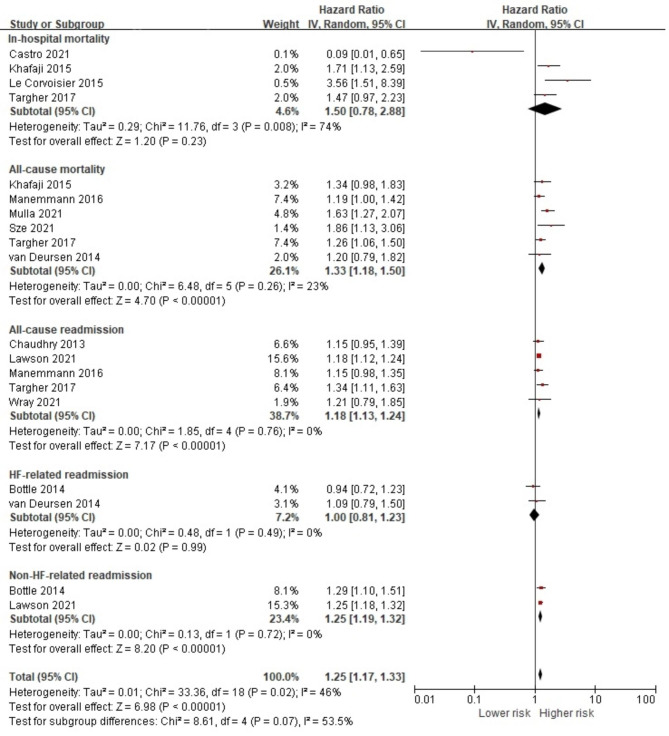
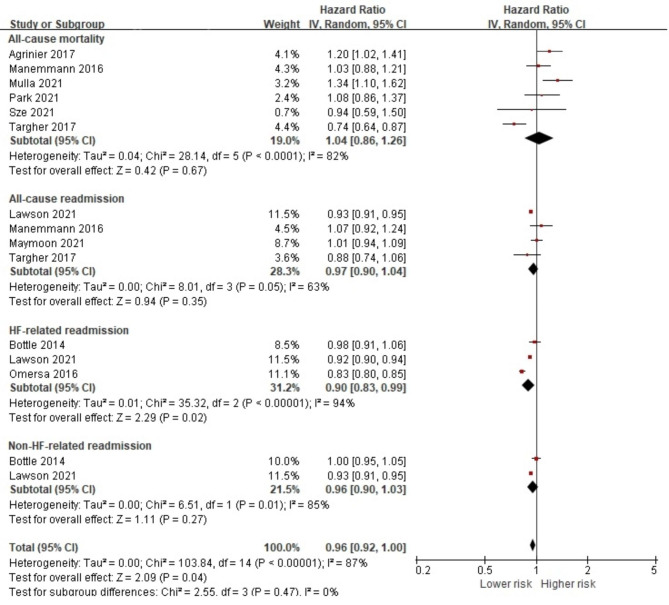
A total of 42 studies were included in this review, and a meta-analysis was performed using the results of 39 studies. In the pooled analysis, the presence of a comorbid condition showed a significant pooled effect size in relation to the prognostic health outcomes: all-cause mortality (HR 1.31; 95% CI 1.18, 1.45), all-cause readmission (HR 1.16; 95% CI 1.09, 1.23), HF-related readmission (HR 1.13; 95% CI 1.05, 1.23), and non-HF-related readmission (HR 1.17; 95% CI 1.07, 1.27). Also, comorbidity was significantly associated with health-related quality of life and self-care confidence. Furthermore, we identified a total of 32 comorbid conditions from included studies. From these, 16 individual conditions were included in the meta-analyses, and we identified 10 comorbid conditions to have negative effects on overall prognostic outcomes: DM (HR 1.16, 95% CI 1.11, 1.22), COPD (HR 1.31, 95% CI 1.23, 1.39), CKD (HR 1.18, 95% CI 1.14, 1.23, stroke (HR 1.25, 95% CI 1.17, 1.31), IHD (HR 1.17, 95% CI 1.11, 1.23), anemia (HR 1.42, 95% CI 1.14, 1.78), cancer (HR 1.17, 95% CI 1.04, 1.32), atrial fibrillation (HR 1.25, 95% CI 1.01, 1.54), dementia (HR 1.19, 95% CI 1.03, 1.36) and depression (HR 1.17, 95% CI 1.04, 1.31).
Comorbid conditions have significantly negative pooled effects on HF patient health outcomes, especially in regard to the prognostic health outcomes. Clinicians should carefully identify and manage these conditions when implementing HF interventions to improve prognostic outcomes.
由于急性心脏疾病患者的存活率和预期寿命增加,心力衰竭(HF)的患病率预计将会上升。HF 患者和其他多种合并症患者可能健康状况不佳。本研究旨在综合现有知识,并提供 HF 患者合并症对健康结果的汇总影响。
使用 MEDLINE、EMBASE 和 CINAHL 数据库进行系统检索。纳入评估合并症与 HF 患者健康结果之间关系的观察性研究。使用随机效应模型计算合并症对确定的健康结果的汇总效应大小,并使用 I 统计评估异质性。
本综述共纳入 42 项研究,其中 39 项研究的结果进行了荟萃分析。在汇总分析中,合并症的存在与预后健康结果显著相关:全因死亡率(HR 1.31;95%CI 1.18,1.45)、全因再入院(HR 1.16;95%CI 1.09,1.23)、HF 相关再入院(HR 1.13;95%CI 1.05,1.23)和非 HF 相关再入院(HR 1.17;95%CI 1.07,1.27)。此外,合并症与健康相关生活质量和自我护理信心显著相关。此外,我们从纳入的研究中总共确定了 32 种合并症。其中,16 种单独的疾病被纳入荟萃分析,我们确定了 10 种对整体预后结局有负面影响的合并症:糖尿病(HR 1.16,95%CI 1.11,1.22)、COPD(HR 1.31,95%CI 1.23,1.39)、CKD(HR 1.18,95%CI 1.14,1.23)、中风(HR 1.25,95%CI 1.17,1.31)、IHD(HR 1.17,95%CI 1.11,1.23)、贫血(HR 1.42,95%CI 1.14,1.78)、癌症(HR 1.17,95%CI 1.04,1.32)、心房颤动(HR 1.25,95%CI 1.01,1.54)、痴呆(HR 1.19,95%CI 1.03,1.36)和抑郁(HR 1.17,95%CI 1.04,1.31)。
合并症对 HF 患者的健康结果有显著的负面影响,尤其是在预后健康结果方面。临床医生在实施 HF 干预措施以改善预后结果时,应仔细识别和管理这些合并症。