Kaczmarczyk Robert, Lasser Tobias, Biedermann Tilo, Ring Johannes, Zink Alexander
Technical University of Munich, School of Medicine, Department of Dermatology and Allergy, Munich, Germany.
Technical University of Munich, School of Computation, Information and Technology, Department of Informatics, Munich Institute of Biomedical Engineering, Munich, Germany.
World Allergy Organ J. 2023 Sep 30;16(10):100820. doi: 10.1016/j.waojou.2023.100820. eCollection 2023 Oct.
Immunoglobulin E (IgE) blood tests are used to detect sensitizations and potential allergies. Recent studies suggest that specific IgE sensitization patterns due to molecular interactions affect an individual's risk of developing allergic symptoms.
The aim of this study was to reveal specific IgE sensitization patterns and investigate their clinical implications in Hymenoptera venom allergy.
In this cross-sectional study, 257 hunters or fishers with self-filled surveys on previous Hymenoptera stings were analyzed. Blood samples were taken to determine Hymenoptera IgE sensitization levels. Using dimensionality reduction and clustering, specific IgE for 10 Hymenoptera venom allergens were evaluated for clinical relevance.
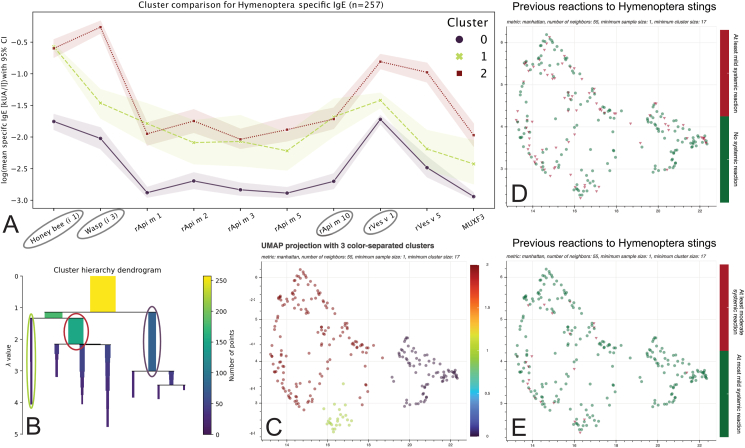
Three clusters were unmasked using novel dimensionality reduction and clustering methods solely based on specific IgE levels to Hymenoptera venom allergens. These clusters show different characteristics regarding previous systemic reactions to Hymenoptera stings.
Our study was able to unmask non-linear sensitization patterns for specific IgE tests in Hymenoptera venom allergy. We were able to derive risk clusters for anaphylactic reactions following hymenoptera stings and pinpoint relevant allergens (rApi m 10, rVes v 1, whole bee, and wasp venom) for clustering.
免疫球蛋白E(IgE)血液检测用于检测致敏反应和潜在过敏。最近的研究表明,由于分子相互作用导致的特异性IgE致敏模式会影响个体出现过敏症状的风险。
本研究旨在揭示特异性IgE致敏模式,并研究其在膜翅目毒液过敏中的临床意义。
在这项横断面研究中,对257名填写了既往膜翅目叮咬情况自我调查问卷的猎人或渔民进行了分析。采集血样以确定膜翅目IgE致敏水平。使用降维和聚类方法,评估了10种膜翅目毒液过敏原的特异性IgE的临床相关性。
仅基于针对膜翅目毒液过敏原的特异性IgE水平,使用新型降维和聚类方法揭示了三个聚类。这些聚类在既往对膜翅目叮咬的全身反应方面表现出不同特征。
我们的研究能够揭示膜翅目毒液过敏中特异性IgE检测的非线性致敏模式。我们能够得出膜翅目叮咬后过敏反应的风险聚类,并确定用于聚类的相关过敏原(rApi m 10、rVes v 1、全蜂毒和黄蜂毒液)。