• 文献检索
  • 文档翻译
  • 深度研究
  • 学术资讯
  • Suppr Zotero 插件Zotero 插件
  • 邀请有礼
  • 套餐&价格
  • 历史记录
应用&插件
Suppr Zotero 插件Zotero 插件浏览器插件Mac 客户端Windows 客户端微信小程序
定价
高级版会员购买积分包购买API积分包
服务
文献检索文档翻译深度研究API 文档MCP 服务
关于我们
关于 Suppr公司介绍联系我们用户协议隐私条款
关注我们

Suppr 超能文献

核心技术专利:CN118964589B侵权必究
粤ICP备2023148730 号-1Suppr @ 2026

文献检索

告别复杂PubMed语法,用中文像聊天一样搜索,搜遍4000万医学文献。AI智能推荐,让科研检索更轻松。

立即免费搜索

文件翻译

保留排版,准确专业,支持PDF/Word/PPT等文件格式,支持 12+语言互译。

免费翻译文档

深度研究

AI帮你快速写综述,25分钟生成高质量综述,智能提取关键信息,辅助科研写作。

立即免费体验

膜翅目昆虫毒液过敏的诊断与治疗:德国变态反应与临床免疫学会(DGAKI)与职业与环境皮肤病学会(ABD)、德国变态反应科医生协会(AeDA)、德国皮肤病学会(DDG)、德国耳鼻咽喉头颈外科学会(DGHNOKC)、德国儿科学与青少年医学学会(DGKJ)、儿童变态反应与环境医学学会(GPA)、德国呼吸学会(DGP)以及奥地利变态反应与免疫学会(ÖGAI)联合发布的S2k指南

Diagnosis and treatment of Hymenoptera venom allergy: S2k Guideline of the German Society of Allergology and Clinical Immunology (DGAKI) in collaboration with the Arbeitsgemeinschaft für Berufs- und Umweltdermatologie e.V. (ABD), the Medical Association of German Allergologists (AeDA), the German Society of Dermatology (DDG), the German Society of Oto-Rhino-Laryngology, Head and Neck Surgery (DGHNOKC), the German Society of Pediatrics and Adolescent Medicine (DGKJ), the Society for Pediatric Allergy and Environmental Medicine (GPA), German Respiratory Society (DGP), and the Austrian Society for Allergy and Immunology (ÖGAI).

作者信息

Ruëff Franziska, Bauer Andrea, Becker Sven, Brehler Randolf, Brockow Knut, Chaker Adam M, Darsow Ulf, Fischer Jörg, Fuchs Thomas, Gerstlauer Michael, Gernert Sunhild, Hamelmann Eckard, Hötzenecker Wolfram, Klimek Ludger, Lange Lars, Merk Hans, Mülleneisen Norbert K, Neustädter Irena, Pfützner Wolfgang, Sieber Wolfgang, Sitter Helmut, Skudlik Christoph, Treudler Regina, Wedi Bettina, Wöhrl Stefan, Worm Margitta, Jakob Thilo

机构信息

Department of Dermatology and Allergy, LMU University Hospital, Munich.

Department of Dermatology, University Hospital Carl Gustav Carus, Technical University Dresden, Dresden.

出版信息

Allergol Select. 2023 Oct 2;7:154-190. doi: 10.5414/ALX02430E. eCollection 2023.

DOI:10.5414/ALX02430E
PMID:37854067
原文链接:https://pmc.ncbi.nlm.nih.gov/articles/PMC10580978/
Abstract

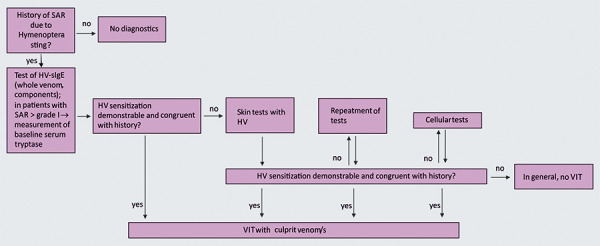
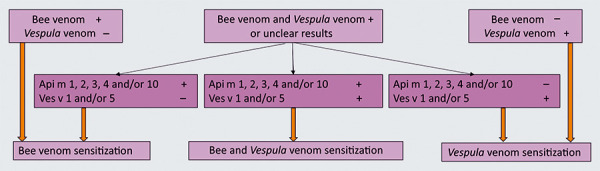
Hymenoptera venom (HV) is injected into the skin during a sting by Hymenoptera such as bees or wasps. Some components of HV are potential allergens and can cause large local and/or systemic allergic reactions (SAR) in sensitized individuals. During their lifetime, ~ 3% of the general population will develop SAR following a Hymenoptera sting. This guideline presents the diagnostic and therapeutic approach to SAR following Hymenoptera stings. Symptomatic therapy is usually required after a severe local reaction, but specific diagnosis or allergen immunotherapy (AIT) with HV (VIT) is not necessary. When taking a patient's medical history after SAR, clinicians should discuss possible risk factors for more frequent stings and more severe anaphylactic reactions. The most important risk factors for more severe SAR are mast cell disease and, especially in children, uncontrolled asthma. Therefore, if the SAR extends beyond the skin (according to the Ring and Messmer classification: grade > I), the baseline serum tryptase concentration shall be measured and the skin shall be examined for possible mastocytosis. The medical history should also include questions specific to asthma symptoms. To demonstrate sensitization to HV, allergists shall determine concentrations of specific IgE antibodies (sIgE) to bee and/or vespid venoms, their constituents and other venoms as appropriate. If the results are negative less than 2 weeks after the sting, the tests shall be repeated (at least 4 - 6 weeks after the sting). If only sIgE to the total venom extracts have been determined, if there is double sensitization, or if the results are implausible, allergists shall determine sIgE to the different venom components. Skin testing may be omitted if in-vitro methods have provided a definitive diagnosis. If neither laboratory diagnosis nor skin testing has led to conclusive results, additional cellular testing can be performed. Therapy for HV allergy includes prophylaxis of reexposure, patient self treatment measures (including use of rescue medication) in the event of re-stings, and VIT. Following a grade I SAR and in the absence of other risk factors for repeated sting exposure or more severe anaphylaxis, it is not necessary to prescribe an adrenaline auto-injector (AAI) or to administer VIT. Under certain conditions, VIT can be administered even in the presence of previous grade I anaphylaxis, e.g., if there are additional risk factors or if quality of life would be reduced without VIT. Physicians should be aware of the contraindications to VIT, although they can be overridden in justified individual cases after weighing benefits and risks. The use of β-blockers and ACE inhibitors is not a contraindication to VIT. Patients should be informed about possible interactions. For VIT, the venom extract shall be used that, according to the patient's history and the results of the allergy diagnostics, was the trigger of the disease. If, in the case of double sensitization and an unclear history regarding the trigger, it is not possible to determine the culprit venom even with additional diagnostic procedures, VIT shall be performed with both venom extracts. The standard maintenance dose of VIT is 100 µg HV. In adult patients with bee venom allergy and an increased risk of sting exposure or particularly severe anaphylaxis, a maintenance dose of 200 µg can be considered from the start of VIT. Administration of a non-sedating H1-blocking antihistamine can be considered to reduce side effects. The maintenance dose should be given at 4-weekly intervals during the first year and, following the manufacturer's instructions, every 5 - 6 weeks from the second year, depending on the preparation used; if a depot preparation is used, the interval can be extended to 8 weeks from the third year onwards. If significant recurrent systemic reactions occur during VIT, clinicians shall identify and as possible eliminate co-factors that promote these reactions. If this is not possible or if there are no such co-factors, if prophylactic administration of an H1-blocking antihistamine is not effective, and if a higher dose of VIT has not led to tolerability of VIT, physicians should should consider additional treatment with an anti IgE antibody such as omalizumab as off lable use. For practical reasons, only a small number of patients are able to undergo sting challenge tests to check the success of the therapy, which requires in-hospital monitoring and emergency standby. To perform such a provocation test, patients must have tolerated VIT at the planned maintenance dose. In the event of treatment failure while on treatment with an ACE inhibitor, physicians should consider discontinuing the ACE inhibitor. In the absence of tolerance induction, physicians shall increase the maintenance dose (200 µg to a maximum of 400 µg in adults, maximum of 200 µg HV in children). If increasing the maintenance dose does not provide adequate protection and there are risk factors for a severe anaphylactic reaction, physicians should consider a co-medication based on an anti-IgE antibody (omalizumab; off-label use) during the insect flight season. In patients without specific risk factors, VIT can be discontinued after 3 - 5 years if maintenance therapy has been tolerated without recurrent anaphylactic events. Prolonged or permanent VIT can be considered in patients with mastocytosis, a history of cardiovascular or respiratory arrest due to Hymenoptera sting (severity grade IV), or other specific constellations associated with an increased individual risk of recurrent and/or severe SAR (e.g., hereditary α-tryptasemia). In cases of strongly increased, unavoidable insect exposure, adults may receive VIT until the end of intense contact. The prescription of an AAI can be omitted in patients with a history of SAR grade I and II when the maintenance dose of VIT has been reached and tolerated, provided that there are no additional risk factors. The same holds true once the VIT has been terminated after the regular treatment period. Patients with a history of SAR grade ≥ III reaction, or grade II reaction combined with additional factors that increase the risk of non response or repeated severe sting reactions, should carry an emergency kit, including an AAI, during VIT and after regular termination of the VIT.

摘要

膜翅目昆虫毒液(HV)在蜜蜂或黄蜂等膜翅目昆虫蜇刺时注入皮肤。HV的某些成分是潜在的过敏原,可在致敏个体中引起严重的局部和/或全身过敏反应(SAR)。在其一生中,约3%的普通人群在被膜翅目昆虫蜇刺后会发生SAR。本指南介绍了膜翅目昆虫蜇刺后SAR的诊断和治疗方法。严重局部反应后通常需要对症治疗,但无需进行特异性诊断或HV过敏原免疫疗法(AIT)(VIT)。在SAR后采集患者病史时,临床医生应讨论更频繁蜇刺和更严重过敏反应的可能危险因素。更严重SAR的最重要危险因素是肥大细胞疾病,尤其是在儿童中,还有未控制的哮喘。因此,如果SAR超出皮肤范围(根据Ring和Messmer分类:分级> I),应测量基线血清类胰蛋白酶浓度,并检查皮肤是否可能存在肥大细胞增多症。病史还应包括针对哮喘症状的特定问题。为证明对HV过敏,过敏症专科医生应酌情测定针对蜜蜂和/或黄蜂毒液、其成分及其他毒液的特异性IgE抗体(sIgE)浓度。如果蜇刺后不到2周结果为阴性,应重复检测(至少在蜇刺后4 - 6周)。如果仅测定了针对总毒液提取物的sIgE,存在双重致敏,或结果不可信,过敏症专科医生应测定针对不同毒液成分的sIgE。如果体外方法已提供明确诊断,可省略皮肤试验。如果实验室诊断和皮肤试验均未得出确凿结果,可进行额外的细胞检测。HV过敏的治疗包括预防再次接触、患者在再次蜇刺时的自我治疗措施(包括使用急救药物)以及VIT。对于I级SAR且不存在其他重复蜇刺暴露或更严重过敏反应危险因素的情况,无需开具肾上腺素自动注射器(AAI)或给予VIT。在某些情况下,即使既往有I级过敏反应,也可给予VIT,例如存在其他危险因素或不进行VIT会降低生活质量。医生应了解VIT的禁忌证,尽管在权衡利弊后个别合理情况下可予以 override。使用β受体阻滞剂和ACE抑制剂并非VIT的禁忌证。应告知患者可能的相互作用。对于VIT,应根据患者病史和过敏诊断结果使用引发疾病的毒液提取物。如果存在双重致敏且触发因素病史不明确,即使采用额外的诊断程序也无法确定罪魁祸首毒液,应使用两种毒液提取物进行VIT。VIT的标准维持剂量为100 μg HV。对于有蜜蜂毒液过敏且蜇刺暴露风险增加或过敏反应特别严重的成年患者,可从VIT开始时就考虑给予200 μg的维持剂量。可考虑给予非镇静性H1受体阻断抗组胺药以减少副作用。维持剂量应在第一年每4周给药一次,从第二年起,根据所用制剂,按照制造商说明每5 - 6周给药一次;如果使用长效制剂,从第三年起间隔可延长至8周。如果在VIT期间发生显著的复发性全身反应,临床医生应识别并尽可能消除促进这些反应的协同因素。如果无法做到这一点或不存在此类协同因素,如果预防性给予H1受体阻断抗组胺药无效,且更高剂量的VIT未导致VIT耐受,医生应考虑使用抗IgE抗体(如奥马珠单抗)进行额外治疗,作为非标签使用。出于实际原因,只有少数患者能够接受蜇刺激发试验以检查治疗效果,这需要住院监测和应急待命。要进行此类激发试验,患者必须耐受计划的维持剂量的VIT。在用ACE抑制剂治疗时如果治疗失败,医生应考虑停用ACE抑制剂。在未诱导耐受的情况下,医生应增加维持剂量(成人从200 μg增加至最大400 μg,儿童最大200 μg HV)。如果增加维持剂量不能提供足够的保护且存在严重过敏反应的危险因素,医生应考虑在昆虫活动季节联合使用基于抗IgE抗体(奥马珠单抗;非标签使用)的药物。对于无特定危险因素的患者,如果维持治疗已耐受且无复发性过敏事件,3 - 5年后可停用VIT。对于肥大细胞增多症患者、因膜翅目昆虫蜇刺导致心血管或呼吸骤停病史(严重程度IV级)或与复发性和/或严重SAR个体风险增加相关的其他特定情况(如遗传性α - 类胰蛋白酶血症),可考虑延长或永久进行VIT。在昆虫暴露强烈且不可避免增加的情况下,成人可接受VIT直至密切接触结束。对于有I级和II级SAR病史的患者,当达到并耐受VIT的维持剂量时,如果不存在其他危险因素,可省略AAI的处方。在常规治疗期后VIT终止后同样如此。有≥ III级反应病史的患者,或II级反应合并增加无反应或重复严重蜇刺反应风险的其他因素的患者,在VIT期间及VIT常规终止后应携带急救包,包括AAI。
https://cdn.ncbi.nlm.nih.gov/pmc/blobs/c466/10580978/da01e3139bf5/allergologieselect-7-154-10.jpg
https://cdn.ncbi.nlm.nih.gov/pmc/blobs/c466/10580978/8da6002a5257/allergologieselect-7-154-01.jpg
https://cdn.ncbi.nlm.nih.gov/pmc/blobs/c466/10580978/6433a523c155/allergologieselect-7-154-02.jpg
https://cdn.ncbi.nlm.nih.gov/pmc/blobs/c466/10580978/ebb895388543/allergologieselect-7-154-03.jpg
https://cdn.ncbi.nlm.nih.gov/pmc/blobs/c466/10580978/e11d46d3c57d/allergologieselect-7-154-04.jpg
https://cdn.ncbi.nlm.nih.gov/pmc/blobs/c466/10580978/532e17a90818/allergologieselect-7-154-05.jpg
https://cdn.ncbi.nlm.nih.gov/pmc/blobs/c466/10580978/02fe4efbb082/allergologieselect-7-154-06.jpg
https://cdn.ncbi.nlm.nih.gov/pmc/blobs/c466/10580978/15f18f570bdb/allergologieselect-7-154-07.jpg
https://cdn.ncbi.nlm.nih.gov/pmc/blobs/c466/10580978/9bb904dec711/allergologieselect-7-154-08.jpg
https://cdn.ncbi.nlm.nih.gov/pmc/blobs/c466/10580978/7cfa39a48ad4/allergologieselect-7-154-09.jpg
https://cdn.ncbi.nlm.nih.gov/pmc/blobs/c466/10580978/da01e3139bf5/allergologieselect-7-154-10.jpg
https://cdn.ncbi.nlm.nih.gov/pmc/blobs/c466/10580978/8da6002a5257/allergologieselect-7-154-01.jpg
https://cdn.ncbi.nlm.nih.gov/pmc/blobs/c466/10580978/6433a523c155/allergologieselect-7-154-02.jpg
https://cdn.ncbi.nlm.nih.gov/pmc/blobs/c466/10580978/ebb895388543/allergologieselect-7-154-03.jpg
https://cdn.ncbi.nlm.nih.gov/pmc/blobs/c466/10580978/e11d46d3c57d/allergologieselect-7-154-04.jpg
https://cdn.ncbi.nlm.nih.gov/pmc/blobs/c466/10580978/532e17a90818/allergologieselect-7-154-05.jpg
https://cdn.ncbi.nlm.nih.gov/pmc/blobs/c466/10580978/02fe4efbb082/allergologieselect-7-154-06.jpg
https://cdn.ncbi.nlm.nih.gov/pmc/blobs/c466/10580978/15f18f570bdb/allergologieselect-7-154-07.jpg
https://cdn.ncbi.nlm.nih.gov/pmc/blobs/c466/10580978/9bb904dec711/allergologieselect-7-154-08.jpg
https://cdn.ncbi.nlm.nih.gov/pmc/blobs/c466/10580978/7cfa39a48ad4/allergologieselect-7-154-09.jpg
https://cdn.ncbi.nlm.nih.gov/pmc/blobs/c466/10580978/da01e3139bf5/allergologieselect-7-154-10.jpg

相似文献

1
Diagnosis and treatment of Hymenoptera venom allergy: S2k Guideline of the German Society of Allergology and Clinical Immunology (DGAKI) in collaboration with the Arbeitsgemeinschaft für Berufs- und Umweltdermatologie e.V. (ABD), the Medical Association of German Allergologists (AeDA), the German Society of Dermatology (DDG), the German Society of Oto-Rhino-Laryngology, Head and Neck Surgery (DGHNOKC), the German Society of Pediatrics and Adolescent Medicine (DGKJ), the Society for Pediatric Allergy and Environmental Medicine (GPA), German Respiratory Society (DGP), and the Austrian Society for Allergy and Immunology (ÖGAI).膜翅目昆虫毒液过敏的诊断与治疗:德国变态反应与临床免疫学会(DGAKI)与职业与环境皮肤病学会(ABD)、德国变态反应科医生协会(AeDA)、德国皮肤病学会(DDG)、德国耳鼻咽喉头颈外科学会(DGHNOKC)、德国儿科学与青少年医学学会(DGKJ)、儿童变态反应与环境医学学会(GPA)、德国呼吸学会(DGP)以及奥地利变态反应与免疫学会(ÖGAI)联合发布的S2k指南
Allergol Select. 2023 Oct 2;7:154-190. doi: 10.5414/ALX02430E. eCollection 2023.
2
Guideline on allergen-specific immunotherapy in IgE-mediated allergic diseases: S2k Guideline of the German Society for Allergology and Clinical Immunology (DGAKI), the Society for Pediatric Allergy and Environmental Medicine (GPA), the Medical Association of German Allergologists (AeDA), the Austrian Society for Allergy and Immunology (ÖGAI), the Swiss Society for Allergy and Immunology (SGAI), the German Society of Dermatology (DDG), the German Society of Oto- Rhino-Laryngology, Head and Neck Surgery (DGHNO-KHC), the German Society of Pediatrics and Adolescent Medicine (DGKJ), the Society for Pediatric Pneumology (GPP), the German Respiratory Society (DGP), the German Association of ENT Surgeons (BV-HNO), the Professional Federation of Paediatricians and Youth Doctors (BVKJ), the Federal Association of Pulmonologists (BDP) and the German Dermatologists Association (BVDD).IgE介导的过敏性疾病中变应原特异性免疫治疗指南:德国变态反应学与临床免疫学会(DGAKI)、儿科变态反应与环境医学学会(GPA)、德国变态反应科医生医学协会(AeDA)、奥地利变态反应与免疫学会(ÖGAI)、瑞士变态反应与免疫学会(SGAI)、德国皮肤病学会(DDG)、德国耳鼻咽喉头颈外科学会(DGHNO-KHC)、德国儿科学与青少年医学学会(DGKJ)、儿科肺病学会(GPP)、德国呼吸学会(DGP)、德国耳鼻喉外科医生协会(BV-HNO)、儿科医生与青年医生专业联合会(BVKJ)、肺科医生联邦协会(BDP)以及德国皮肤科医生协会(BVDD)的S2k指南
Allergo J Int. 2014;23(8):282-319. doi: 10.1007/s40629-014-0032-2.
3
[Standard technical specifications for methacholine chloride (Methacholine) bronchial challenge test (2023)].[氯化乙酰甲胆碱支气管激发试验标准技术规范(2023年)]
Zhonghua Jie He He Hu Xi Za Zhi. 2024 Feb 12;47(2):101-119. doi: 10.3760/cma.j.cn112147-20231019-00247.
4
A systematic review of the clinical effectiveness and cost-effectiveness of Pharmalgen® for the treatment of bee and wasp venom allergy.Phamalgen® 治疗蜂和黄蜂毒液过敏的临床疗效和成本效益的系统评价。
Health Technol Assess. 2012;16(12):III-IV, 1-110. doi: 10.3310/hta16120.
5
Hymenoptera venom allergy.膜翅目毒液过敏。
J Dtsch Dermatol Ges. 2010 Feb;8(2):114-27; quiz 128-30. doi: 10.1111/j.1610-0387.2009.07125.x. Epub 2009 Sep 14.
6
Diagnosis of Hymenoptera venom allergy.膜翅目昆虫毒液过敏的诊断
Allergy. 2005 Nov;60(11):1339-49. doi: 10.1111/j.1398-9995.2005.00963.x.
7
Patients still reacting to a sting challenge while receiving conventional Hymenoptera venom immunotherapy are protected by increased venom doses.在接受常规膜翅目毒液免疫治疗时仍对叮咬激发试验有反应的患者,通过增加毒液剂量得到保护。
J Allergy Clin Immunol. 2001 Dec;108(6):1027-32. doi: 10.1067/mai.2001.119154.
8
Guideline on allergen immunotherapy in IgE-mediated allergic diseases: S2K Guideline of the German Society of Allergology and Clinical Immunology (DGAKI), Society of Pediatric Allergology and Environmental Medicine (GPA), Medical Association of German Allergologists (AeDA), Austrian Society of Allergology and Immunology (ÖGAI), Swiss Society for Allergology and Immunology (SSAI), German Dermatological Society (DDG), German Society of Oto-Rhino-Laryngology, Head and Neck Surgery (DGHNO-KHC), German Society of Pediatrics and Adolescent Medicine (DGKJ), Society of Pediatric Pulmonology (GPP), German Respiratory Society (DGP), German Professional Association of Otolaryngologists (BVHNO), German Association of Paediatric and Adolescent Care Specialists (BVKJ), Federal Association of Pneumologists, Sleep and Respiratory Physicians (BdP), Professional Association of German Dermatologists (BVDD).IgE介导的过敏性疾病变应原免疫治疗指南:德国变态反应与临床免疫学会(DGAKI)、儿科变态反应与环境医学学会(GPA)、德国变态反应学家医学协会(AeDA)、奥地利变态反应与免疫学会(ÖGAI)、瑞士变态反应与免疫学会(SSAI)、德国皮肤病学会(DDG)、德国耳鼻咽喉头颈外科学会(DGHNO-KHC)、德国儿科学与青少年医学学会(DGKJ)、儿科肺病学会(GPP)、德国呼吸学会(DGP)、德国耳鼻喉科医生专业协会(BVHNO)、德国儿科与青少年护理专家协会(BVKJ)、联邦肺病学家、睡眠与呼吸内科医生协会(BdP)、德国皮肤科医生专业协会(BVDD)的S2K指南
Allergol Select. 2022 Sep 6;6:167-232. doi: 10.5414/ALX02331E. eCollection 2022.
9
Guideline for the diagnosis of drug hypersensitivity reactions: S2K-Guideline of the German Society for Allergology and Clinical Immunology (DGAKI) and the German Dermatological Society (DDG) in collaboration with the Association of German Allergologists (AeDA), the German Society for Pediatric Allergology and Environmental Medicine (GPA), the German Contact Dermatitis Research Group (DKG), the Swiss Society for Allergy and Immunology (SGAI), the Austrian Society for Allergology and Immunology (ÖGAI), the German Academy of Allergology and Environmental Medicine (DAAU), the German Center for Documentation of Severe Skin Reactions and the German Federal Institute for Drugs and Medical Products (BfArM).药物超敏反应诊断指南:德国变态反应学与临床免疫学会(DGAKI)和德国皮肤病学会(DDG)与德国变态反应学家协会(AeDA)、德国儿童变态反应学与环境医学学会(GPA)、德国接触性皮炎研究小组(DKG)、瑞士变态反应与免疫学会(SGAI)、奥地利变态反应学与免疫学会(ÖGAI)、德国变态反应学与环境医学科学院(DAAU)、德国严重皮肤反应文献中心以及德国联邦药品与医疗器械研究所(BfArM)合作制定的S2K指南
Allergo J Int. 2015;24(3):94-105. doi: 10.1007/s40629-015-0052-6.
10
Abridged version of the AWMF guideline for the medical clinical diagnostics of indoor mould exposure: S2K Guideline of the German Society of Hygiene, Environmental Medicine and Preventive Medicine (GHUP) in collaboration with the German Association of Allergists (AeDA), the German Society of Dermatology (DDG), the German Society for Allergology and Clinical Immunology (DGAKI), the German Society for Occupational and Environmental Medicine (DGAUM), the German Society for Hospital Hygiene (DGKH), the German Society for Pneumology and Respiratory Medicine (DGP), the German Mycological Society (DMykG), the Society for Pediatric Allergology and Environmental Medicine (GPA), the German Federal Association of Pediatric Pneumology (BAPP), and the Austrian Society for Medical Mycology (ÖGMM).德国卫生、环境医学与预防医学协会(GHUP)联合德国过敏症专科医生协会(AeDA)、德国皮肤病学会(DDG)、德国变态反应学与临床免疫学学会(DGAKI)、德国职业与环境医学学会(DGAUM)、德国医院卫生学会(DGKH)、德国肺病与呼吸医学学会(DGP)、德国真菌学会(DMykG)、儿科过敏症与环境医学学会(GPA)、德国联邦儿科学会(BAPP)以及奥地利医学真菌学会(ÖGMM)发布的室内霉菌暴露医学临床诊断AWMF指南简版:S2K指南
Allergo J Int. 2017;26(5):168-193. doi: 10.1007/s40629-017-0013-3. Epub 2017 Feb 28.

引用本文的文献

1
The usefulness of the basophil activation test for monitoring the effectiveness of wasp venom immunotherapy in different age groups.嗜碱性粒细胞活化试验在监测不同年龄组黄蜂毒液免疫疗法有效性方面的作用。
Clin Transl Allergy. 2025 Aug;15(8):e70073. doi: 10.1002/clt2.70073.
2
From sting to STING: role of inflammation in wasp sting induced AKI - a narrative review.从蜇伤到干扰素基因刺激蛋白(STING):炎症在黄蜂蜇伤所致急性肾损伤中的作用——一篇综述
BMC Nephrol. 2025 Aug 19;26(1):471. doi: 10.1186/s12882-025-04403-w.
3
Hyaluronidase: structure, mechanism of action, diseases and therapeutic targets.

本文引用的文献

1
Guideline on allergen immunotherapy in IgE-mediated allergic diseases: S2K Guideline of the German Society of Allergology and Clinical Immunology (DGAKI), Society of Pediatric Allergology and Environmental Medicine (GPA), Medical Association of German Allergologists (AeDA), Austrian Society of Allergology and Immunology (ÖGAI), Swiss Society for Allergology and Immunology (SSAI), German Dermatological Society (DDG), German Society of Oto-Rhino-Laryngology, Head and Neck Surgery (DGHNO-KHC), German Society of Pediatrics and Adolescent Medicine (DGKJ), Society of Pediatric Pulmonology (GPP), German Respiratory Society (DGP), German Professional Association of Otolaryngologists (BVHNO), German Association of Paediatric and Adolescent Care Specialists (BVKJ), Federal Association of Pneumologists, Sleep and Respiratory Physicians (BdP), Professional Association of German Dermatologists (BVDD).IgE介导的过敏性疾病变应原免疫治疗指南:德国变态反应与临床免疫学会(DGAKI)、儿科变态反应与环境医学学会(GPA)、德国变态反应学家医学协会(AeDA)、奥地利变态反应与免疫学会(ÖGAI)、瑞士变态反应与免疫学会(SSAI)、德国皮肤病学会(DDG)、德国耳鼻咽喉头颈外科学会(DGHNO-KHC)、德国儿科学与青少年医学学会(DGKJ)、儿科肺病学会(GPP)、德国呼吸学会(DGP)、德国耳鼻喉科医生专业协会(BVHNO)、德国儿科与青少年护理专家协会(BVKJ)、联邦肺病学家、睡眠与呼吸内科医生协会(BdP)、德国皮肤科医生专业协会(BVDD)的S2K指南
Allergol Select. 2022 Sep 6;6:167-232. doi: 10.5414/ALX02331E. eCollection 2022.
2
2021 ESC Guidelines for the diagnosis and treatment of acute and chronic heart failure: Developed by the Task Force for the diagnosis and treatment of acute and chronic heart failure of the European Society of Cardiology (ESC). With the special contribution of the Heart Failure Association (HFA) of the ESC.
透明质酸酶:结构、作用机制、疾病及治疗靶点
Mol Biomed. 2025 Jul 12;6(1):50. doi: 10.1186/s43556-025-00299-y.
4
Tumor necrosis factor receptor 2 in allergen tolerance: a perspective view.变应原耐受中的肿瘤坏死因子受体2:前瞻性观点
Front Immunol. 2025 Jun 19;16:1613719. doi: 10.3389/fimmu.2025.1613719. eCollection 2025.
5
Clinical Management of Wasp Stings Using Large Language Models: Cross-Sectional Evaluation Study.使用大语言模型对黄蜂蜇伤进行临床管理:横断面评估研究
J Med Internet Res. 2025 Jun 4;27:e67489. doi: 10.2196/67489.
6
Case Report: An unusual case of cardiac anaphylaxis in the maintenance phase of venom immunotherapy.病例报告:毒液免疫疗法维持阶段发生的一例罕见的心脏过敏反应。
Front Allergy. 2025 Apr 23;6:1583909. doi: 10.3389/falgy.2025.1583909. eCollection 2025.
7
Significant handling errors and education gaps regarding the use of the emergency kit among adult patients with Hymenoptera venom allergy.成年膜翅目毒液过敏患者在使用急救包方面存在重大操作失误和知识缺口。
Allergol Select. 2025 Jan 22;9:1-7. doi: 10.5414/ALX02476E. eCollection 2025.
8
Biomarkers for the Molecular Diagnosis of IgE-Mediated Hymenoptera Venom Allergy in Clinical Practice.临床实践中用于IgE介导的膜翅目毒液过敏分子诊断的生物标志物。
Int J Mol Sci. 2024 Dec 31;26(1):270. doi: 10.3390/ijms26010270.
9
Exploring Beekeepers' Experiences and Perceptions of Anaphylaxis Risks: A Qualitative Study to Inform Targeted Health Education Programs.探索养蜂人对过敏反应风险的经历与认知:一项为针对性健康教育项目提供信息的定性研究。
Healthcare (Basel). 2024 Dec 20;12(24):2569. doi: 10.3390/healthcare12242569.
10
Occupational anaphylaxis: A Position Paper of the German Society of Allergology and Clinical Immunology (DGAKI).职业性过敏反应:德国过敏与临床免疫学会(DGAKI)立场文件
Allergol Select. 2024 Nov 28;8:407-424. doi: 10.5414/ALX02543E. eCollection 2024.
2021 ESC 急性和慢性心力衰竭诊断和治疗指南:由欧洲心脏病学会(ESC)急性和慢性心力衰竭诊断和治疗工作组制定。特别感谢欧洲心脏病学会心力衰竭协会(HFA)的贡献。
Eur J Heart Fail. 2022 Jan;24(1):4-131. doi: 10.1002/ejhf.2333.
3
The effect of allergy and asthma as a comorbidity on the susceptibility and outcomes of COVID-19.过敏和哮喘作为合并症对 COVID-19 的易感性和结局的影响。
Int Immunol. 2022 Mar 25;34(4):177-188. doi: 10.1093/intimm/dxab107.
4
Short-Term Subcutaneous Allergy Immunotherapy and Dupilumab are Well Tolerated in Allergic Rhinitis: A Randomized Trial.短期皮下过敏免疫疗法和度普利尤单抗在过敏性鼻炎中耐受性良好:一项随机试验。
J Asthma Allergy. 2021 Aug 16;14:1045-1063. doi: 10.2147/JAA.S318892. eCollection 2021.
5
[Allergen immunotherapy: FAQs and facts].[变应原免疫疗法:常见问题与事实]
Hautarzt. 2021 Sep;72(9):760-769. doi: 10.1007/s00105-021-04872-8. Epub 2021 Aug 17.
6
Case Report: "Killer Bee" Swarm Attacks in French Guiana: The Importance of Prompt Care.病例报告:法属圭亚那的“杀人蜂”群袭击:及时护理的重要性。
Am J Trop Med Hyg. 2021 Jul 7;105(1):225-229. doi: 10.4269/ajtmh.20-1432.
7
Impact of specific immunotherapy and sting challenge on the quality of life in patients with hymenoptera venom allergy.特异性免疫疗法和蜂蜇激发试验对膜翅目毒液过敏患者生活质量的影响。
World Allergy Organ J. 2021 Apr 21;14(5):100536. doi: 10.1016/j.waojou.2021.100536. eCollection 2021 May.
8
Case Report: Acute Kidney Failure due to Massive Envenomation of a Two-Year-Old Child Caused by Killer Bee Stings.病例报告:两岁儿童被杀人蜂大量蜇伤导致急性肾衰竭。
Am J Trop Med Hyg. 2021 May 10;105(1):222-224. doi: 10.4269/ajtmh.20-1276.
9
Use of biologics in allergen immunotherapy.生物制剂在变应原免疫治疗中的应用。
Allergol Select. 2021 Feb 19;5:108-118. doi: 10.5414/ALX02206E. eCollection 2021.
10
β-blockers and ACE inhibitors are not a risk factor for severe systemic sting reactions and adverse events during venom immunotherapy.β受体阻滞剂和血管紧张素转换酶抑制剂不是严重全身性蜂蜇反应和变应原免疫治疗期间不良事件的危险因素。
Allergy. 2021 Jul;76(7):2166-2176. doi: 10.1111/all.14785. Epub 2021 Mar 11.