Department of Rehabilitation, Kaikoukai Josai Hospital, Nagoya, Japan.
Department of Physical Therapy, School of Rehabilitation Sciences, Seirei Christopher University, Hamamatsu, Japan.
Nagoya J Med Sci. 2023 Aug;85(3):490-503. doi: 10.18999/nagjms.85.3.490.
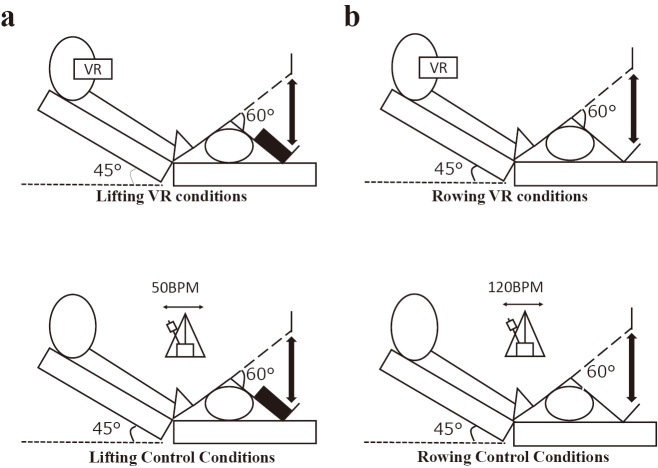
This study aimed to investigate the basic data on the effectiveness and safety of the system in healthy subjects using an immersive virtual reality (VR) exercise system specialized for therapeutic exercise therapy during dialysis or hospital use. A total of 15 healthy adult subjects performed four exercises, namely lifting and rowing exercises using VR and each movement exercise without VR (control). The simulator sickness questionnaire (SSQ) was administered pre- and post-operatively to assess for VR sickness. Blood pressure, heart rate (HR), rating of perceived exhaustion, Profile of Mood States 2nd Edition Japanese version, and muscle activity (iEMG) were measured using electromyography. The correlation between changes in mood states and HR or iEMG results was examined. The SSQ measured post-VR exercise was 11.2 (18.7-7.5) and 11.2 (7.5-29.9) points in the lifting and rowing VR, respectively. The HR in lifting (VR, 82.5 12.7 vs control, 71.6 10.6 bpm, <0.05) and rowing (VR, 94.2 13.1 vs control, 83.5 12.0, <0.05) with VR exercise was significantly higher than in control. No significant differences were observed between the other variables. There was a positive correlation between HR and negative mood in the lifting VR condition (r=0.64, <0.05), but not in the control group. Contrastingly, there was a positive correlation between iEMG and negative mood in rowing control (r=0.56), but not VR. Safety was confirmed, with no VR sickness or discontinuation of the system. Exercise therapy using VR resulted in a higher exercise load. This VR system has the potential for additional effective intradialytic exercises and hospital use.
本研究旨在调查在健康受试者中使用专门用于透析或医院治疗性运动疗法的沉浸式虚拟现实(VR)运动系统的有效性和安全性的基本数据。共有 15 名健康成年受试者进行了四项运动,即使用 VR 进行举重和划船运动以及不使用 VR(对照)的每项运动。在手术前后使用模拟器疾病问卷(SSQ)评估 VR 疾病。使用肌电图测量血压、心率(HR)、感知疲劳程度评分、状态-特质焦虑问卷第二版日本版和肌肉活动(iEMG)。检查情绪状态变化与 HR 或 iEMG 结果之间的相关性。VR 运动后的 SSQ 测量值分别为举重(VR,11.2(18.7-7.5)和 11.2(7.5-29.9)点)和划船(VR,94.2(13.1-13.1)和 83.5(12.0-12.0),与 VR 运动相比,控制组明显更高(<0.05)。其他变量之间没有观察到显著差异。在 VR 举重条件下,HR 与负性情绪之间存在正相关(r=0.64,<0.05),但在对照组中则不存在。相反,在划船对照组中,iEMG 与负性情绪之间存在正相关(r=0.56),但在 VR 中则不存在。确认了安全性,没有 VR 疾病或系统中断。使用 VR 的运动疗法导致运动负荷增加。这种 VR 系统有可能用于额外的有效透析内运动和医院使用。