• 文献检索
  • 文档翻译
  • 深度研究
  • 学术资讯
  • Suppr Zotero 插件Zotero 插件
  • 邀请有礼
  • 套餐&价格
  • 历史记录
应用&插件
Suppr Zotero 插件Zotero 插件浏览器插件Mac 客户端Windows 客户端微信小程序
定价
高级版会员购买积分包购买API积分包
服务
文献检索文档翻译深度研究API 文档MCP 服务
关于我们
关于 Suppr公司介绍联系我们用户协议隐私条款
关注我们

Suppr 超能文献

核心技术专利:CN118964589B侵权必究
粤ICP备2023148730 号-1Suppr @ 2026

文献检索

告别复杂PubMed语法,用中文像聊天一样搜索,搜遍4000万医学文献。AI智能推荐,让科研检索更轻松。

立即免费搜索

文件翻译

保留排版,准确专业,支持PDF/Word/PPT等文件格式,支持 12+语言互译。

免费翻译文档

深度研究

AI帮你快速写综述,25分钟生成高质量综述,智能提取关键信息,辅助科研写作。

立即免费体验

多变量线性混合模型预测热性惊厥风险和复发:一项前瞻性病例对照研究。

Multivariate linear mixture models for the prediction of febrile seizure risk and recurrence: a prospective case-control study.

机构信息

Department of Pediatrics, Faculty of Medicine and University Hospital, Masaryk University, Brno, Czech Republic.

Department of Pediatric Neurology, Faculty of Medicine and University Hospital, Masaryk University, Černopolní 9, Brno, 612 00, Czech Republic.

出版信息

Sci Rep. 2023 Oct 13;13(1):17372. doi: 10.1038/s41598-023-43599-5.

DOI:10.1038/s41598-023-43599-5
PMID:37833343
原文链接:https://pmc.ncbi.nlm.nih.gov/articles/PMC10576023/
Abstract

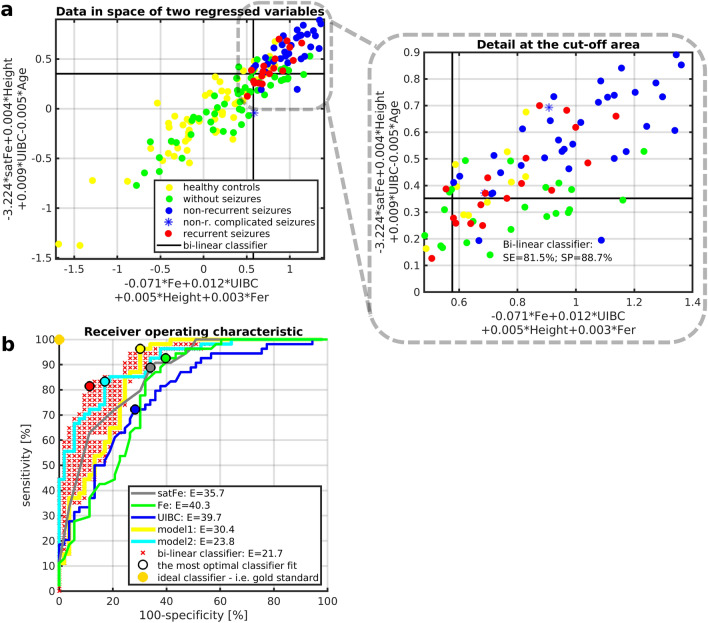
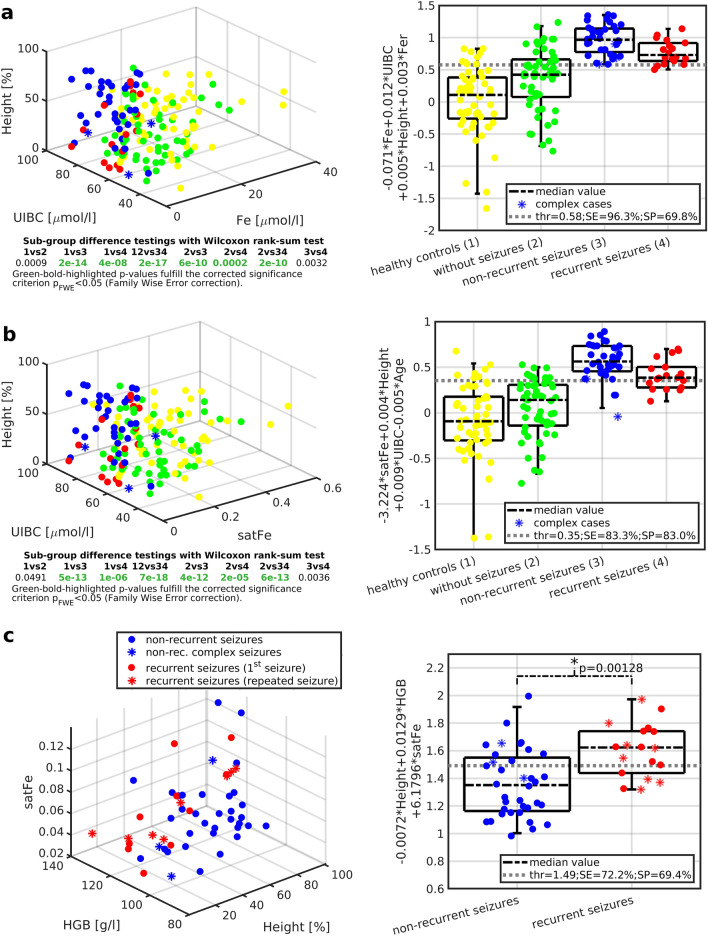
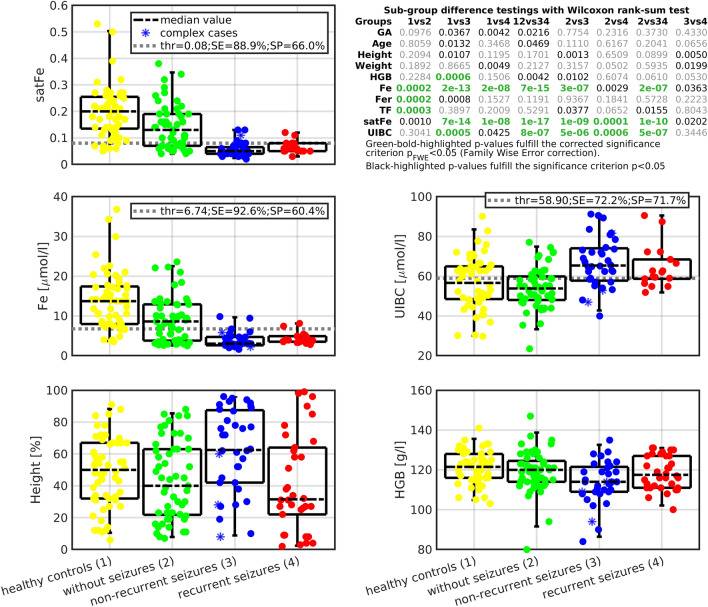
Our goal was to identify highly accurate empirical models for the prediction of the risk of febrile seizure (FS) and FS recurrence. In a prospective, three-arm, case-control study, we enrolled 162 children (age 25.8 ± 17.1 months old, 71 females). Participants formed one case group (patients with FS) and two control groups (febrile patients without seizures and healthy controls). The impact of blood iron status, peak body temperature, and participants' demographics on FS risk and recurrence was investigated with univariate and multivariate statistics. Serum iron concentration, iron saturation, and unsaturated iron-binding capacity differed between the three investigated groups (p < 0.05). These serum analytes were key variables in the design of novel multivariate linear mixture models. The models classified FS risk with higher accuracy than univariate approaches. The designed bi-linear classifier achieved a sensitivity/specificity of 82%/89% and was closest to the gold-standard classifier. A multivariate model assessing FS recurrence provided a difference (p < 0.05) with a separating sensitivity/specificity of 72%/69%. Iron deficiency, height percentile, and age were significant FS risk factors. In addition, height percentile and hemoglobin concentration were linked to FS recurrence. Novel multivariate models utilizing blood iron status and demographic variables predicted FS risk and recurrence among infants and young children with fever.

摘要

我们的目标是确定预测热性惊厥 (FS) 风险和 FS 复发的高度准确的经验模型。在一项前瞻性、三臂、病例对照研究中,我们招募了 162 名儿童(年龄 25.8 ± 17.1 个月,71 名女性)。参与者形成了一个病例组(FS 患者)和两个对照组(无惊厥发热患者和健康对照组)。使用单变量和多变量统计方法研究了血液铁状态、体温峰值和参与者人口统计学特征对 FS 风险和复发的影响。三组之间的血清铁浓度、铁饱和度和未饱和铁结合能力存在差异(p<0.05)。这些血清分析物是设计新型多元线性混合模型的关键变量。这些模型对 FS 风险的分类准确性高于单变量方法。设计的双线性分类器的灵敏度/特异性为 82%/89%,与金标准分类器最接近。评估 FS 复发的多元模型提供了差异(p<0.05),其分离灵敏度/特异性为 72%/69%。缺铁、身高百分位数和年龄是 FS 的重要危险因素。此外,身高百分位数和血红蛋白浓度与 FS 复发有关。利用血液铁状态和人口统计学变量的新型多元模型预测了发热婴儿和幼儿的 FS 风险和复发。
https://cdn.ncbi.nlm.nih.gov/pmc/blobs/614c/10576023/4cb5afd07415/41598_2023_43599_Fig4_HTML.jpg
https://cdn.ncbi.nlm.nih.gov/pmc/blobs/614c/10576023/c746dab92bfb/41598_2023_43599_Fig1_HTML.jpg
https://cdn.ncbi.nlm.nih.gov/pmc/blobs/614c/10576023/03000ecb8753/41598_2023_43599_Fig2_HTML.jpg
https://cdn.ncbi.nlm.nih.gov/pmc/blobs/614c/10576023/aad47765b2b8/41598_2023_43599_Fig3_HTML.jpg
https://cdn.ncbi.nlm.nih.gov/pmc/blobs/614c/10576023/4cb5afd07415/41598_2023_43599_Fig4_HTML.jpg
https://cdn.ncbi.nlm.nih.gov/pmc/blobs/614c/10576023/c746dab92bfb/41598_2023_43599_Fig1_HTML.jpg
https://cdn.ncbi.nlm.nih.gov/pmc/blobs/614c/10576023/03000ecb8753/41598_2023_43599_Fig2_HTML.jpg
https://cdn.ncbi.nlm.nih.gov/pmc/blobs/614c/10576023/aad47765b2b8/41598_2023_43599_Fig3_HTML.jpg
https://cdn.ncbi.nlm.nih.gov/pmc/blobs/614c/10576023/4cb5afd07415/41598_2023_43599_Fig4_HTML.jpg

相似文献

1
Multivariate linear mixture models for the prediction of febrile seizure risk and recurrence: a prospective case-control study.多变量线性混合模型预测热性惊厥风险和复发:一项前瞻性病例对照研究。
Sci Rep. 2023 Oct 13;13(1):17372. doi: 10.1038/s41598-023-43599-5.
2
Association between iron deficiency and febrile seizures.缺铁与热性惊厥之间的关联。
Eur J Paediatr Neurol. 2015 Sep;19(5):591-6. doi: 10.1016/j.ejpn.2015.05.009. Epub 2015 Jun 12.
3
The Relationship Between Iron Deficiency and Febrile Convulsion: A Case-Control Study.缺铁与热性惊厥之间的关系:一项病例对照研究。
Glob J Health Sci. 2015 Jun 25;8(2):185-9. doi: 10.5539/gjhs.v8n2p185.
4
Risk factors and predictors of recurrence of febrile seizures in children in Nantong, China: a retrospective cohort study.中国南通儿童热性惊厥复发的危险因素和预测因素:一项回顾性队列研究。
BMC Pediatr. 2024 Jul 1;24(1):420. doi: 10.1186/s12887-024-04895-9.
5
[Evaluating a child after a febrile seizure: Insights on three important issues].[热性惊厥后评估儿童:关于三个重要问题的见解]
Arch Pediatr. 2017 Nov;24(11):1137-1146. doi: 10.1016/j.arcped.2017.08.018. Epub 2017 Sep 29.
6
Risk factors for subsequent febrile seizures in the FEBSTAT study.FEBSTAT研究中后续热性惊厥的危险因素。
Epilepsia. 2016 Jul;57(7):1042-7. doi: 10.1111/epi.13418. Epub 2016 Jun 6.
7
Prospective case control study of iron deficiency and the risk of febrile seizures in children in South Korea.韩国前瞻性病例对照研究缺铁与儿童热性惊厥风险。
BMC Pediatr. 2019 Sep 4;19(1):309. doi: 10.1186/s12887-019-1675-4.
8
The role of Mean Platelet Volume/platelet count Ratio and Neutrophil to Lymphocyte Ratio on the risk of Febrile Seizure.血小板平均体积/血小板计数比值和中性粒细胞与淋巴细胞比值与热性惊厥风险的关系。
Sci Rep. 2018 Oct 11;8(1):15123. doi: 10.1038/s41598-018-33373-3.
9
Which factors determine febrile seizure recurrence? A prospective study.哪些因素决定热性惊厥复发?一项前瞻性研究。
Brain Dev. 2008 Jan;30(1):7-13. doi: 10.1016/j.braindev.2007.05.001. Epub 2007 Jun 21.
10
Frequency of fever episodes related to febrile seizure recurrence.与热性惊厥复发相关的发热发作频率。
Acta Paediatr. 1999 Jan;88(1):52-5. doi: 10.1080/08035259950170600.

引用本文的文献

1
Novel serum biomarker for powerfully predicting pediatric simple febrile seizures.用于强力预测小儿单纯性热性惊厥的新型血清生物标志物。
Front Pediatr. 2025 Aug 14;13:1646261. doi: 10.3389/fped.2025.1646261. eCollection 2025.

本文引用的文献

1
Cytokine-chemokine profiles in the hippocampus of patients with mesial temporal lobe epilepsy and hippocampal sclerosis.内侧颞叶癫痫伴海马硬化患者海马区细胞因子-趋化因子谱。
Epilepsy Res. 2022 Feb;180:106858. doi: 10.1016/j.eplepsyres.2022.106858. Epub 2022 Jan 10.
2
Neurodevelopmental problems in children with febrile seizures followed to young school age: A prospective longitudinal community-based study in Sweden.儿童热性惊厥随访至学龄期的神经发育问题:瑞典一项前瞻性纵向社区研究。
Acta Paediatr. 2022 Mar;111(3):586-592. doi: 10.1111/apa.16171. Epub 2021 Nov 23.
3
Predictors of recurrent febrile seizures during the same febrile illness in children with febrile seizures.
热性惊厥患儿在同一次发热性疾病期间复发性热性惊厥的预测因素。
J Neurol Sci. 2020 Apr 15;411:116682. doi: 10.1016/j.jns.2020.116682. Epub 2020 Jan 13.
4
Prospective case control study of iron deficiency and the risk of febrile seizures in children in South Korea.韩国前瞻性病例对照研究缺铁与儿童热性惊厥风险。
BMC Pediatr. 2019 Sep 4;19(1):309. doi: 10.1186/s12887-019-1675-4.
5
Childhood seizures and risk of psychiatric disorders in adolescence and early adulthood: a Danish nationwide cohort study.儿童期癫痫发作与青少年和成年早期精神障碍风险:一项丹麦全国队列研究。
Lancet Child Adolesc Health. 2019 Feb;3(2):99-108. doi: 10.1016/S2352-4642(18)30351-1. Epub 2018 Dec 7.
6
Iron assessment to protect the developing brain.评估铁含量以保护发育中的大脑。
Am J Clin Nutr. 2017 Dec;106(Suppl 6):1588S-1593S. doi: 10.3945/ajcn.117.155846. Epub 2017 Oct 25.
7
Relationship between iron deficiency anemia and febrile seizures in children: A systematic review and meta-analysis.缺铁性贫血与儿童热性惊厥的关系:系统评价和荟萃分析。
Seizure. 2017 Nov;52:27-34. doi: 10.1016/j.seizure.2017.09.009. Epub 2017 Sep 15.
8
Iron status, body size, and growth in the first 2 years of life.铁状态、体型和生长在生命的头 2 年。
Matern Child Nutr. 2018 Jan;14(1). doi: 10.1111/mcn.12458. Epub 2017 Apr 27.
9
Epilepsy After Febrile Seizures: Twins Suggest Genetic Influence.热性惊厥后的癫痫:双胞胎提示遗传影响。
Pediatr Neurol. 2016 Feb;55:14-6. doi: 10.1016/j.pediatrneurol.2015.10.008. Epub 2015 Oct 31.
10
Febrile seizures: emergency medicine perspective.热性惊厥:急诊医学视角
Curr Opin Pediatr. 2015 Jun;27(3):292-7. doi: 10.1097/MOP.0000000000000220.