Paulino Maria Carolina, Conceição Catarina, Silvestre Joana, Lopes Maria Inês, Gonçalves Hernâni, Dias Cláudia Camila, Serafim Rodrigo, Salluh Jorge I F, Póvoa Pedro
NOVA Medical School, New University of Lisbon, 1150-082 Lisbon, Portugal.
Department of Intensive Care, Hospital de São Francisco Xavier, Centro Hospitalar de Lisboa Ocidental, 1150-199 Lisbon, Portugal.
J Clin Med. 2023 Oct 4;12(19):6363. doi: 10.3390/jcm12196363.
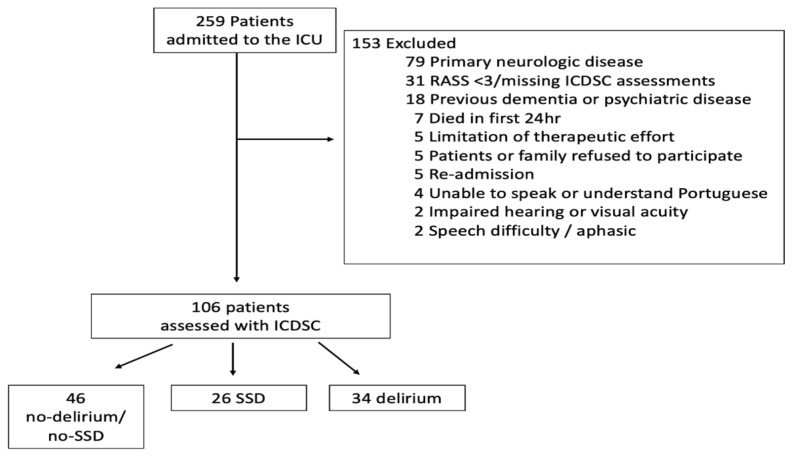
Subsyndromal delirium (SSD) in the Intensive Care Unit (ICU) is associated with an increased morbidity with unknown post-discharge functional and cognitive outcomes. We performed a prospective multicenter study to analyze the mental status of patients during their first 72 h after ICU admission and its trajectory, with follow-ups at 3 and 6 months after hospital discharge. Amongst the 106 included patients, SSD occurred in 24.5% (n = 26) and was associated with the duration of mechanical ventilation ( = 0.003) and the length of the ICU stay ( = 0.002). After the initial 72 h, most of the SSD patients (30.8%) improved and no longer had SSD; 19.2% continued to experience SSD and one patient (3.8%) progressed to delirium. The post-hospital discharge survival rate for the SSD patients was 100% at 3 months and 87.5% at 6 months. At admission, 96.2% of the SSD patients were fully independent in daily living activities, 66.7% at 3-month follow-up, and 100% at 6-month follow-up. Most SSD patients demonstrated a cognitive decline from admission to 3-month follow-up and improved at 6 months (IQCODE-SF: admission 3.13, < 0.001; 3 months 3.41, = 0.019; 6 months 3.19, = 0.194). We concluded that early SSD is associated with worse outcomes, mainly a transitory cognitive decline after hospital discharge at 3 months, with an improvement at 6 months. This highlights the need to prevent and identify this condition during ICU stays.
重症监护病房(ICU)中的亚综合征谵妄(SSD)与发病率增加相关,出院后的功能和认知结局尚不清楚。我们进行了一项前瞻性多中心研究,以分析患者在ICU入院后最初72小时内的精神状态及其变化轨迹,并在出院后3个月和6个月进行随访。在纳入的106例患者中,SSD发生率为24.5%(n = 26),与机械通气时间(P = 0.003)和ICU住院时间(P = 0.002)相关。在最初的72小时后,大多数SSD患者(30.8%)病情改善,不再患有SSD;19.2%的患者继续经历SSD,1例患者(3.8%)进展为谵妄。SSD患者出院后的3个月生存率为100%,6个月生存率为87.5%。入院时,96.2%的SSD患者在日常生活活动中完全独立,3个月随访时为66.7%,6个月随访时为100%。大多数SSD患者从入院到3个月随访时表现出认知下降,6个月时有所改善(IQCODE-SF:入院时3.13,P < 0.001;3个月时3.41,P = 0.019;6个月时3.19,P = 0.194)。我们得出结论,早期SSD与更差的结局相关,主要是出院后3个月时短暂的认知下降,6个月时有所改善。这凸显了在ICU住院期间预防和识别这种情况的必要性。