Department of Electrical and Information Engineering, Polytechnic University of Bari, 70125 Bari, Italy.
Sensors (Basel). 2023 Oct 9;23(19):8342. doi: 10.3390/s23198342.
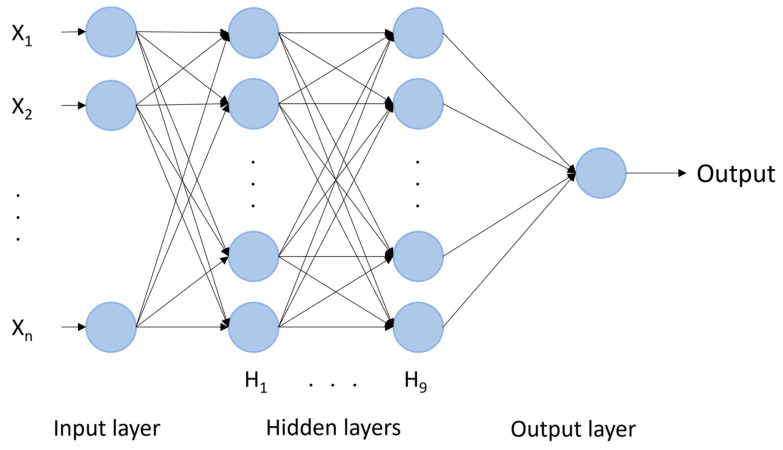
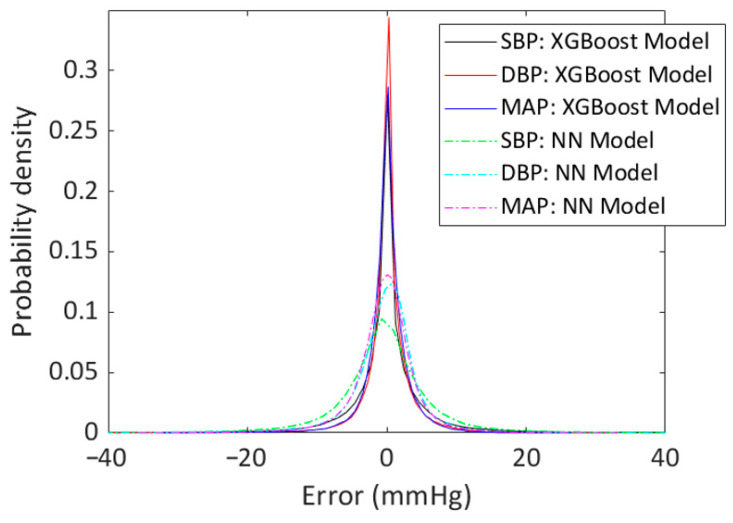
In this paper, a machine learning (ML) approach to estimate blood pressure (BP) using photoplethysmography (PPG) is presented. The final aim of this paper was to develop ML methods for estimating blood pressure (BP) in a non-invasive way that is suitable in a telemedicine health-care monitoring context. The training of regression models useful for estimating systolic blood pressure (SBP) and diastolic blood pressure (DBP) was conducted using new extracted features from PPG signals processed using the Maximal Overlap Discrete Wavelet Transform (MODWT). As a matter of fact, the interest was on the use of the most significant features obtained by the Minimum Redundancy Maximum Relevance (MRMR) selection algorithm to train eXtreme Gradient Boost (XGBoost) and Neural Network (NN) models. This aim was satisfactorily achieved by also comparing it with works in the literature; in fact, it was found that XGBoost models are more accurate than NN models in both systolic and diastolic blood pressure measurements, obtaining a Root Mean Square Error (RMSE) for SBP and DBP, respectively, of 5.67 mmHg and 3.95 mmHg. For SBP measurement, this result is an improvement compared to that reported in the literature. Furthermore, the trained XGBoost regression model fulfills the requirements of the Association for the Advancement of Medical Instrumentation (AAMI) as well as grade A of the British Hypertension Society (BHS) standard.
本文提出了一种使用光体积描记法(PPG)估计血压(BP)的机器学习(ML)方法。本文的最终目的是开发用于以非侵入方式估计血压(BP)的 ML 方法,这种方法适合远程医疗保健监测环境。使用从使用最大重叠离散小波变换(MODWT)处理的 PPG 信号中提取的新特征,对回归模型进行了训练,这些模型可用于估计收缩压(SBP)和舒张压(DBP)。实际上,研究的重点是使用最小冗余最大相关性(MRMR)选择算法获得的最重要特征来训练极端梯度提升(XGBoost)和神经网络(NN)模型。通过与文献中的工作进行比较,也达到了令人满意的效果;实际上,发现 XGBoost 模型在收缩压和舒张压测量中均比 NN 模型更准确,分别获得收缩压和舒张压的均方根误差(RMSE)为 5.67mmHg 和 3.95mmHg。对于收缩压测量,这一结果优于文献中的报道。此外,训练的 XGBoost 回归模型满足了医学仪器协会(AAMI)以及英国高血压学会(BHS)标准 A 级的要求。