School of Biomedical Sciences, Faculty of Medicine and Health, UNSW Sydney, Sydney, NSW, 2052, Australia.
Viral Immunology Systems Program, Kirby Institute, UNSW Sydney, Sydney, NSW, 2052, Australia.
Sci Rep. 2023 Oct 14;13(1):17485. doi: 10.1038/s41598-023-44559-9.
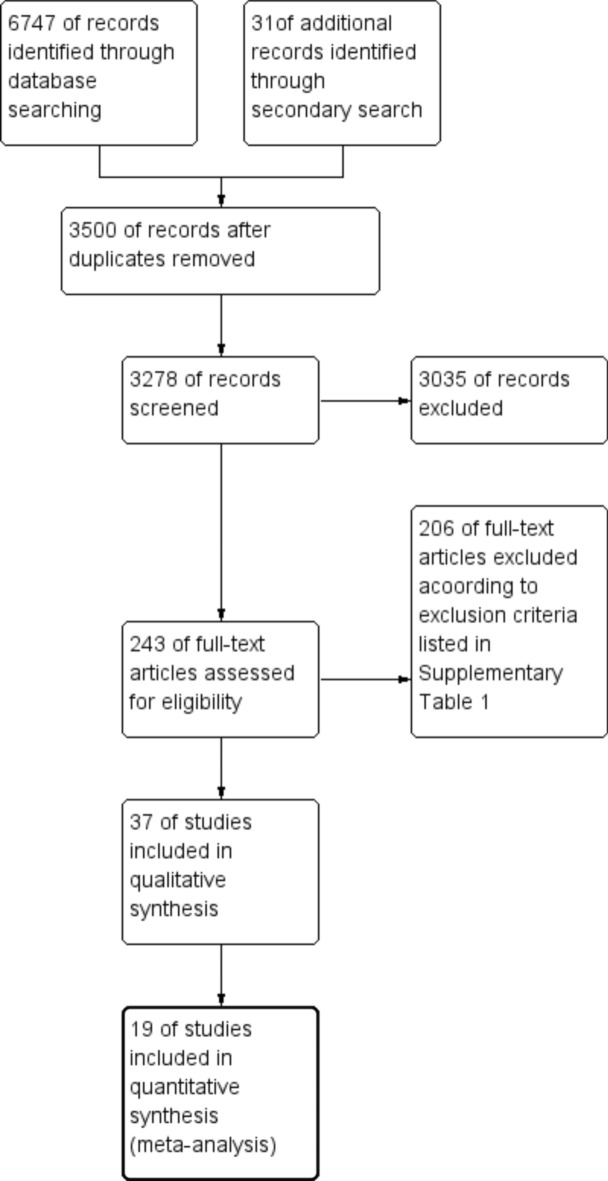
Early identification of dengue patients at risk of adverse outcomes is important to prevent hospital overcrowding in low- to middle- income countries during epidemics. We performed a systematic review to identify which biomarkers measured in first 96 h of fever could predict dengue haemorrhagic fever (DHF, World Health Organization 1997 clinical classification) or severe dengue (SD, WHO 2009, clinical classification). PubMed, Scopus, CINAHL, Web of Science, and EMBASE databases were searched for prospective cohort and nested case-control studies published from 1997 to Feb 27, 2022. The protocol for the study was registered in PROSPERO (ID: CRD42021230053). After screening 6747 publications, and analysing 37 eligible studies reporting on 5925 patients, elevated C-reactive protein, aspartate aminotransferase, interleukin-8 and decreased albumin levels were strongly associated with dengue haemorrhagic fever (by meta-analyses of multiple studies, p < 0.05), while elevated vascular cell adhesion protein 1, syndecan-1, aspartate aminotransferase and C-reactive protein levels were strongly associated with severe dengue (by meta-analyses of multiple studies, p < 0.05). Further 44 and 28 biomarkers were associated with the risk of DHF and SD respectively, but only in a single study. The meta-analyses suggest the importance of early acute inflammation with hepatic involvement in determining the subsequent course of illness in dengue.
早期识别登革热患者发生不良结局的风险对于在流行期间预防中低收入国家的医院人满为患至关重要。我们进行了一项系统评价,以确定在发热的前 96 小时内测量的哪些生物标志物可以预测登革出血热(DHF,世界卫生组织 1997 年临床分类)或严重登革热(SD,世界卫生组织 2009 年临床分类)。我们在 PubMed、Scopus、CINAHL、Web of Science 和 EMBASE 数据库中搜索了 1997 年 2 月 27 日至 2022 年 2 月 27 日发表的前瞻性队列和嵌套病例对照研究。该研究的方案已在 PROSPERO(ID:CRD42021230053)中注册。在筛选了 6747 篇出版物并分析了 37 项符合条件的研究报告的 5925 名患者后,发现升高的 C 反应蛋白、天冬氨酸转氨酶、白细胞介素 8 和降低的白蛋白水平与登革出血热密切相关(通过多项研究的荟萃分析,p<0.05),而升高的血管细胞黏附蛋白 1、硫酸乙酰肝素蛋白聚糖 1、天冬氨酸转氨酶和 C 反应蛋白水平与严重登革热密切相关(通过多项研究的荟萃分析,p<0.05)。另有 44 种和 28 种生物标志物分别与 DHF 和 SD 的风险相关,但仅在一项研究中发现。荟萃分析表明,早期急性炎症伴肝受累在确定登革热患者后续病程中的重要性。