Dong Lei, Li Xiaoyu, Leng Wenyuan, Guo Zhenke, Cai Tianyu, Ji Xing, Xu Chunru, Zhu Zhenpeng, Lin Jian
Department of Urology, Peking University First Hospital, Beijing, 100034, China.
Institute of Urology, Peking University, Beijing, 100034, China.
Regen Ther. 2023 Oct 11;24:547-560. doi: 10.1016/j.reth.2023.09.014. eCollection 2023 Dec.
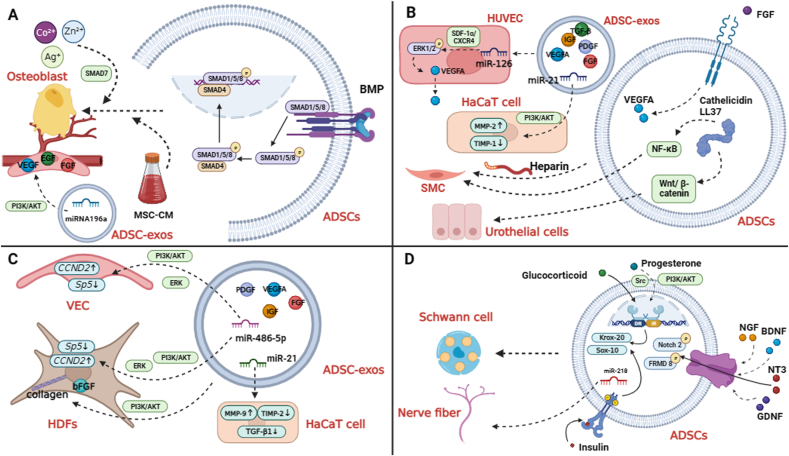
ADSCs are a large number of mesenchymal stem cells in Adipose tissue, which can be applied to tissue engineering. ADSCs have the potential of multi-directional differentiation, and can differentiate into bone tissue, cardiac tissue, urothelial cells, skin tissue, etc. Compared with other mesenchymal stem cells, ADSCs have a multitude of promising advantages, such as abundant number, accessibility in cell culture, stable function, and less immune rejection. There are two main methods to use ADSCs for tissue repair and regeneration. One is to implant the "ADSCs-scaffold composite" into the injured site to promote tissue regeneration. The other is cell-free therapy: using ADSC-exos or ADSC-CM alone to release a large number of miRNAs, cytokines and other bioactive substances to promote tissue regeneration. The tissue regeneration potential of ADSCs is regulated by a variety of cytokines, signaling molecules, and external environment. The differentiation of ADSCs into different tissues is also induced by growth factors, ions, hormones, scaffold materials, physical stimulation, and other factors. The specific mechanisms are complex, and most of the signaling pathways need to be further explored. This article reviews and summarizes the mechanism and clinical application of ADSCs in tissue injury repair so far, and puts forward further problems that need to be solved in this field, hoping to provide directions for further research in this field.
脂肪来源干细胞是脂肪组织中大量存在的间充质干细胞,可应用于组织工程。脂肪来源干细胞具有多向分化潜能,能分化为骨组织、心脏组织、尿路上皮细胞、皮肤组织等。与其他间充质干细胞相比,脂肪来源干细胞具有诸多优势,如数量丰富、易于细胞培养、功能稳定、免疫排斥少等。利用脂肪来源干细胞进行组织修复和再生主要有两种方法。一种是将“脂肪来源干细胞-支架复合物”植入损伤部位以促进组织再生。另一种是无细胞疗法:单独使用脂肪来源干细胞外泌体或脂肪来源干细胞条件培养基释放大量微小RNA、细胞因子等生物活性物质来促进组织再生。脂肪来源干细胞的组织再生潜能受多种细胞因子、信号分子及外部环境的调控。脂肪来源干细胞向不同组织的分化也受生长因子、离子、激素、支架材料、物理刺激等因素诱导。具体机制较为复杂,多数信号通路尚需进一步探索。本文综述并总结了目前脂肪来源干细胞在组织损伤修复中的作用机制及临床应用情况,并提出该领域有待进一步解决的问题,以期为该领域的深入研究提供方向。