Markhus Maria Wik, Kvestad Ingrid, Midtbø Lisa Kolden, Nerhus Ive, Ødegaard Elisabeth R, Graff Ingvild Eide, Lie Øyvind, Dahl Lisbeth, Hysing Mari, Kjellevold Marian
1Institute Institute of Marine Research, PO Box 1870, Nordnes, 5817 Bergen, NO Norway.
2Regional Centre for Child and Youth Mental Health, Uni Research Health, Uni Research, PO Box 7810, 5020 Bergen, Norway.
BMC Nutr. 2018 Feb 17;4:7. doi: 10.1186/s40795-018-0215-1. eCollection 2018.
Iodine is a key component of thyroid hormones that are critical for normal development of the brain and nervous system in utero. Recent results indicate that two thirds of pregnant women in Europe have sub-optimal iodine nutrition. In Norway, milk and seafood are the most important dietary iodine sources and contributes to about 80% of the intake.
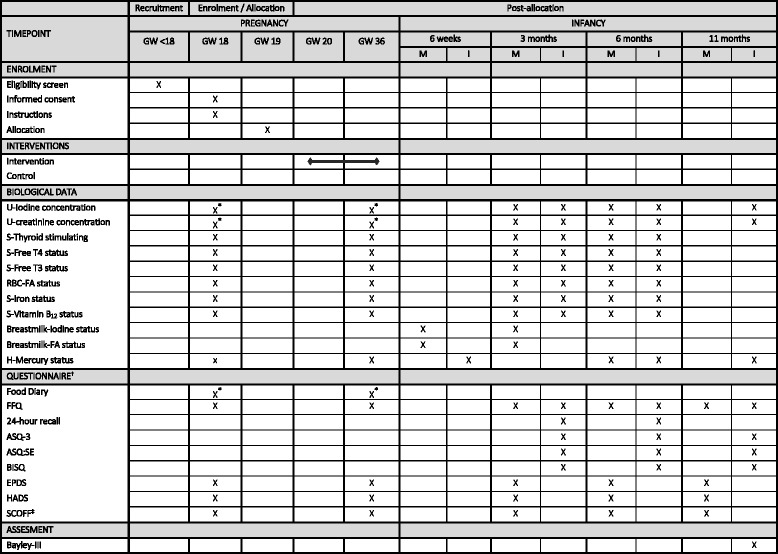
Two-armed randomized trial where 137 pregnant women were randomized to either receiving cod twice weekly, or continue with habitual diet for 16 weeks (pregnancy week 20-36). Socioeconomic- and demographic factors, dietary information and biological (urine, blood, and hair) samples are collected pre- and post-intervention, and at six weeks, three-, six-, and eleven months postpartum. Biological samples (urine, blood, and hair) of the infant are collected at six weeks, three-, six-, and eleven months postnatal. Child development is assessed by The Bayley Scale of Infant and Toddler Development, 3rd edition, at eleven months, and by parent report on the Ages and Stages Questionnaire, 3rd edition, and Ages and Stages Questionnaire: Social Emotional at three-, six-, and eleven months.
The Mommy's Food study will provide knowledge on changes in iodine nutrition when consuming iodine rich fish during pregnancy and contribute to the understanding of the impact of iodine status in pregnancy on infant neurodevelopment.
This study is registered in ClinicalTrials.gov (NCT02610959). Registered November 17, 2015.
碘是甲状腺激素的关键组成部分,对子宫内大脑和神经系统的正常发育至关重要。最近的结果表明,欧洲三分之二的孕妇碘营养状况欠佳。在挪威,牛奶和海鲜是最重要的膳食碘来源,约占碘摄入量的80%。
双臂随机试验,137名孕妇被随机分为两组,一组每周两次食用鳕鱼,另一组在16周(怀孕第20 - 36周)继续保持习惯饮食。在干预前后、产后六周、三个月、六个月和十一个月收集社会经济和人口统计学因素、饮食信息以及生物样本(尿液、血液和头发)。在婴儿出生后六周、三个月、六个月和十一个月收集其生物样本(尿液、血液和头发)。在婴儿十一个月时通过贝利婴幼儿发展量表第三版评估儿童发育情况,并在婴儿三个月、六个月和十一个月时通过家长填写的第三版年龄与阶段问卷以及年龄与阶段问卷:社会情感部分进行评估。
“妈妈的食物”研究将提供关于孕期食用富含碘的鱼类时碘营养变化的知识,并有助于理解孕期碘状态对婴儿神经发育的影响。
本研究已在ClinicalTrials.gov(NCT02610959)注册。于2015年11月17日注册。