Singh Pramesh, Kuder Hannah, Ritz Anna
Biology Department, Reed College, Portland, OR 97202, United States.
Data Intensive Studies Center, Tufts University, Medford, MA 02155, United States.
Bioinform Adv. 2023 Oct 4;3(1):vbad140. doi: 10.1093/bioadv/vbad140. eCollection 2023.
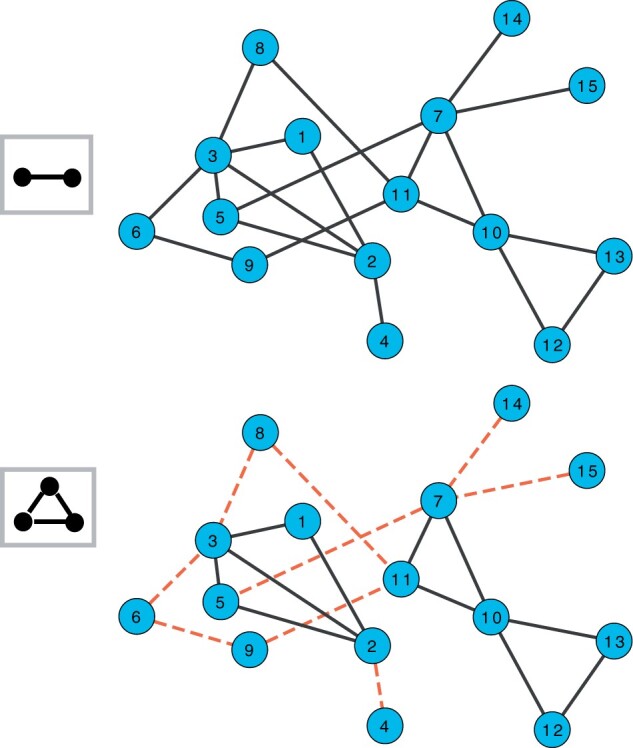
Higher-order interaction patterns among proteins have the potential to reveal mechanisms behind molecular processes and diseases. While clustering methods are used to identify functional groups within molecular interaction networks, these methods largely focus on edge density and do not explicitly take into consideration higher-order interactions. Disease genes in these networks have been shown to exhibit rich higher-order structure in their vicinity, and considering these higher-order interaction patterns in network clustering have the potential to reveal new disease-associated modules.
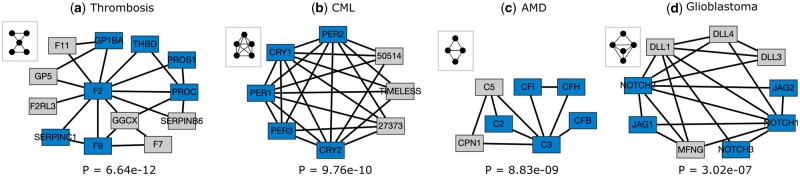
We propose a higher-order community detection method which identifies community structure in networks with respect to specific higher-order connectivity patterns beyond edges. Higher-order community detection on four different protein-protein interaction networks identifies biologically significant modules and disease modules that conventional edge-based clustering methods fail to discover. Higher-order clusters also identify disease modules from genome-wide association study data, including new modules that were not discovered by top-performing approaches in a Disease Module DREAM Challenge. Our approach provides a more comprehensive view of community structure that enables us to predict new disease-gene associations.
蛋白质之间的高阶相互作用模式有可能揭示分子过程和疾病背后的机制。虽然聚类方法用于识别分子相互作用网络中的功能组,但这些方法主要关注边密度,并未明确考虑高阶相互作用。这些网络中的疾病基因已被证明在其附近呈现出丰富的高阶结构,在网络聚类中考虑这些高阶相互作用模式有可能揭示新的疾病相关模块。
我们提出了一种高阶社区检测方法,该方法根据超出边的特定高阶连通性模式识别网络中的社区结构。在四个不同的蛋白质 - 蛋白质相互作用网络上进行的高阶社区检测识别出了传统基于边的聚类方法未能发现的具有生物学意义的模块和疾病模块。高阶聚类还从全基因组关联研究数据中识别出疾病模块,包括在疾病模块DREAM挑战中表现最佳的方法未发现的新模块。我们的方法提供了更全面的社区结构视图,使我们能够预测新的疾病 - 基因关联。