• 文献检索
  • 文档翻译
  • 深度研究
  • 学术资讯
  • Suppr Zotero 插件Zotero 插件
  • 邀请有礼
  • 套餐&价格
  • 历史记录
应用&插件
Suppr Zotero 插件Zotero 插件浏览器插件Mac 客户端Windows 客户端微信小程序
定价
高级版会员购买积分包购买API积分包
服务
文献检索文档翻译深度研究API 文档MCP 服务
关于我们
关于 Suppr公司介绍联系我们用户协议隐私条款
关注我们

Suppr 超能文献

核心技术专利:CN118964589B侵权必究
粤ICP备2023148730 号-1Suppr @ 2026

文献检索

告别复杂PubMed语法,用中文像聊天一样搜索,搜遍4000万医学文献。AI智能推荐,让科研检索更轻松。

立即免费搜索

文件翻译

保留排版,准确专业,支持PDF/Word/PPT等文件格式,支持 12+语言互译。

免费翻译文档

深度研究

AI帮你快速写综述,25分钟生成高质量综述,智能提取关键信息,辅助科研写作。

立即免费体验

由具有生物活性的罗非鱼鱼鳞胶原蛋白制成的纳米颗粒用于伤口愈合:实验方法。

Nanoparticles fabricated from the bioactive tilapia scale collagen for wound healing: Experimental approach.

作者信息

Shalaby Manal, Hamouda Dalia, Khedr Shaimaa M, Mostafa Haitham M, Saeed Hesham, Ghareeb Ahmed Z

机构信息

Medical Biotechnology Department, Institute of Genetic Engineering and Biotechnology, City of Scientific Research and Technological Applications, Alexandria, Egypt.

Centre of Excellence for Drug Preclinical Studies (CE-DPS), Pharmaceutical and Fermentation Industry Development Centre, City of Scientific Research and Technological Applications, New Borg El Arab, Alexandria, Egypt.

出版信息

PLoS One. 2023 Oct 20;18(10):e0282557. doi: 10.1371/journal.pone.0282557. eCollection 2023.

DOI:10.1371/journal.pone.0282557
PMID:37862350
原文链接:https://pmc.ncbi.nlm.nih.gov/articles/PMC10588885/
Abstract

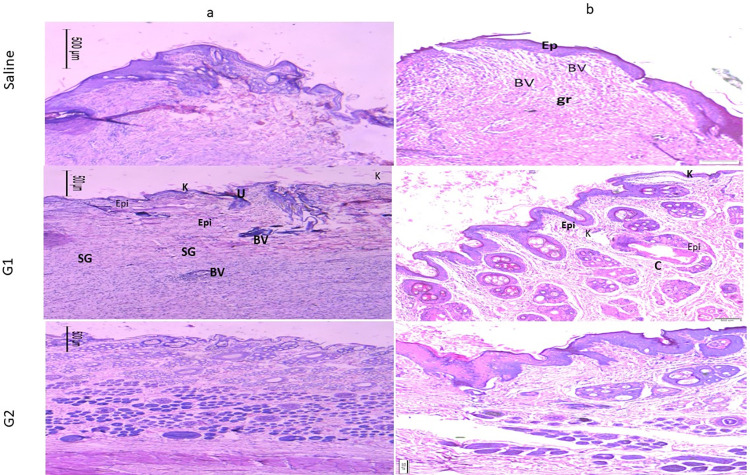
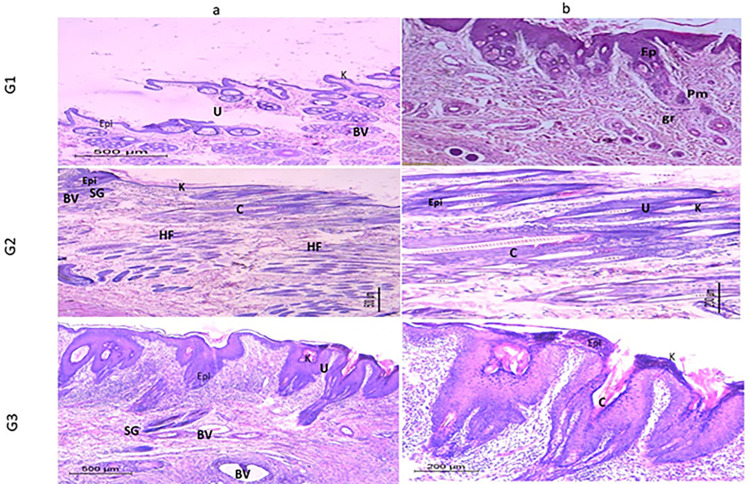
The creation of innovative wound-healing nanomaterials based on natural compounds emerges as a top research goal. This research aimed to create a gel containing collagen nanoparticles and evaluate its therapeutic potential for skin lesions. Collagen nanoparticles were produced from fish scales using desolvation techniques. Using SDS PAGE electrophoresis, Fourier transform infrared spectroscopy (FTIR) as well as the structure of the isolated collagen and its similarities to collagen type 1 were identified. The surface morphology of the isolated collagen and its reformulation into nanoparticles were examined using transmission and scanning electron microscopy. A Zeta sizer was used to examine the size, zeta potential, and distribution of the synthesized collagen nanoparticles. The cytotoxicity of the nanomaterials was investigated and an experimental model was used to evaluate the wound healing capability. The overall collagen output from Tilapia fish scales was 42%. Electrophoretic patterns revealed that the isolated collagen included a unique protein with chain bands of 126-132 kDa and an elevated beta band of 255 kDa. When compared to the isolated collagen, the collagen nanoparticles' FTIR results revealed a significant drop in the amide II (42% decrease) and amide III (32% decrease) band intensities. According to SEM analysis, the generated collagen nanoparticles ranged in size from 100 to 350 nm, with an average diameter of 182 nm determined by the zeta sizer. The produced collagen nanoparticles were polydispersed in nature and had an equivalent average zeta potential of -17.7 mV. Cytotoxicity study showed that, when treating fibroblast cells with collagen nanoparticle concentrations, very mild morphological alterations were detected after human skin fibroblasts were treated with collagen nanoparticles 32 μg/ml for 24 hours, as higher concentrations of collagen nanoparticles caused cell detachment. Macroscopical and histological investigations proved that the fabricated fish scale collagen nanoparticles promoted the healing process in comparison to the saline group.

摘要

基于天然化合物的创新型伤口愈合纳米材料的研发成为首要研究目标。本研究旨在制备一种含有胶原蛋白纳米颗粒的凝胶,并评估其对皮肤损伤的治疗潜力。采用去溶剂化技术从鱼鳞中制备胶原蛋白纳米颗粒。通过SDS-PAGE电泳、傅里叶变换红外光谱(FTIR)鉴定了分离出的胶原蛋白的结构及其与I型胶原蛋白的相似性。利用透射电子显微镜和扫描电子显微镜检查了分离出的胶原蛋白的表面形态及其重新形成纳米颗粒的情况。使用Zeta粒度分析仪检测合成的胶原蛋白纳米颗粒的尺寸、Zeta电位和分布。研究了纳米材料的细胞毒性,并使用实验模型评估伤口愈合能力。罗非鱼鱼鳞的总胶原蛋白产量为42%。电泳图谱显示,分离出的胶原蛋白包含一种独特的蛋白质,其链带为126-132 kDa,β带升高至255 kDa。与分离出的胶原蛋白相比,胶原蛋白纳米颗粒的FTIR结果显示酰胺II(降低42%)和酰胺III(降低32%)带强度显著下降。根据扫描电子显微镜分析,生成的胶原蛋白纳米颗粒尺寸在100至350 nm之间,Zeta粒度分析仪测定的平均直径为182 nm。所制备的胶原蛋白纳米颗粒在本质上是多分散的,平均Zeta电位为-17.7 mV。细胞毒性研究表明,在用胶原蛋白纳米颗粒浓度处理成纤维细胞时,当人皮肤成纤维细胞用32 μg/ml胶原蛋白纳米颗粒处理24小时后,检测到非常轻微的形态改变,因为更高浓度的胶原蛋白纳米颗粒会导致细胞 detachment。宏观和组织学研究证明,与生理盐水组相比,所制备的鱼鳞胶原蛋白纳米颗粒促进了愈合过程。

https://cdn.ncbi.nlm.nih.gov/pmc/blobs/29dd/10588885/9551ea323343/pone.0282557.g011.jpg
https://cdn.ncbi.nlm.nih.gov/pmc/blobs/29dd/10588885/983c76c4180c/pone.0282557.g001.jpg
https://cdn.ncbi.nlm.nih.gov/pmc/blobs/29dd/10588885/802e8b8a1ff6/pone.0282557.g002.jpg
https://cdn.ncbi.nlm.nih.gov/pmc/blobs/29dd/10588885/90a68fb32eef/pone.0282557.g003.jpg
https://cdn.ncbi.nlm.nih.gov/pmc/blobs/29dd/10588885/4b97bcc0a9a4/pone.0282557.g004.jpg
https://cdn.ncbi.nlm.nih.gov/pmc/blobs/29dd/10588885/1422ad79f2b0/pone.0282557.g005.jpg
https://cdn.ncbi.nlm.nih.gov/pmc/blobs/29dd/10588885/af28b99460d7/pone.0282557.g006.jpg
https://cdn.ncbi.nlm.nih.gov/pmc/blobs/29dd/10588885/56cb5b8dc122/pone.0282557.g007.jpg
https://cdn.ncbi.nlm.nih.gov/pmc/blobs/29dd/10588885/e77f4bb2d6c9/pone.0282557.g008.jpg
https://cdn.ncbi.nlm.nih.gov/pmc/blobs/29dd/10588885/e457fecf79d2/pone.0282557.g009.jpg
https://cdn.ncbi.nlm.nih.gov/pmc/blobs/29dd/10588885/a78212c0ea44/pone.0282557.g010.jpg
https://cdn.ncbi.nlm.nih.gov/pmc/blobs/29dd/10588885/9551ea323343/pone.0282557.g011.jpg
https://cdn.ncbi.nlm.nih.gov/pmc/blobs/29dd/10588885/983c76c4180c/pone.0282557.g001.jpg
https://cdn.ncbi.nlm.nih.gov/pmc/blobs/29dd/10588885/802e8b8a1ff6/pone.0282557.g002.jpg
https://cdn.ncbi.nlm.nih.gov/pmc/blobs/29dd/10588885/90a68fb32eef/pone.0282557.g003.jpg
https://cdn.ncbi.nlm.nih.gov/pmc/blobs/29dd/10588885/4b97bcc0a9a4/pone.0282557.g004.jpg
https://cdn.ncbi.nlm.nih.gov/pmc/blobs/29dd/10588885/1422ad79f2b0/pone.0282557.g005.jpg
https://cdn.ncbi.nlm.nih.gov/pmc/blobs/29dd/10588885/af28b99460d7/pone.0282557.g006.jpg
https://cdn.ncbi.nlm.nih.gov/pmc/blobs/29dd/10588885/56cb5b8dc122/pone.0282557.g007.jpg
https://cdn.ncbi.nlm.nih.gov/pmc/blobs/29dd/10588885/e77f4bb2d6c9/pone.0282557.g008.jpg
https://cdn.ncbi.nlm.nih.gov/pmc/blobs/29dd/10588885/e457fecf79d2/pone.0282557.g009.jpg
https://cdn.ncbi.nlm.nih.gov/pmc/blobs/29dd/10588885/a78212c0ea44/pone.0282557.g010.jpg
https://cdn.ncbi.nlm.nih.gov/pmc/blobs/29dd/10588885/9551ea323343/pone.0282557.g011.jpg

相似文献

1
Nanoparticles fabricated from the bioactive tilapia scale collagen for wound healing: Experimental approach.由具有生物活性的罗非鱼鱼鳞胶原蛋白制成的纳米颗粒用于伤口愈合:实验方法。
PLoS One. 2023 Oct 20;18(10):e0282557. doi: 10.1371/journal.pone.0282557. eCollection 2023.
2
Marine Collagen Peptides from the Skin of Nile Tilapia (Oreochromis niloticus): Characterization and Wound Healing Evaluation.尼罗罗非鱼(Oreochromis niloticus)皮肤中的海洋胶原蛋白肽:特性及伤口愈合评估
Mar Drugs. 2017 Mar 30;15(4):102. doi: 10.3390/md15040102.
3
The wound healing potential of collagen peptides derived from the jellyfish Rhopilema esculentum.源自海蜇(Rhopilema esculentum)的胶原蛋白肽的伤口愈合潜力。
Chin J Traumatol. 2019 Feb;22(1):12-20. doi: 10.1016/j.cjtee.2018.10.004. Epub 2019 Feb 8.
4
Comprehensive Assessment of Nile Tilapia Skin () Collagen Hydrogels for Wound Dressings.尼罗罗非鱼皮()胶原水凝胶在伤口敷料中的综合评估。
Mar Drugs. 2020 Mar 25;18(4):178. doi: 10.3390/md18040178.
5
Pepsin-Soluble Collagen from the Skin of : A Preliminary Study Evaluating Physicochemical, Antioxidant, and Wound Healing Properties.皮胶原酶可溶性:理化性质、抗氧化和伤口愈合性能的初步研究。
Mar Drugs. 2019 Dec 16;17(12):708. doi: 10.3390/md17120708.
6
β-1,3-Glucan binding protein-based silver nanoparticles enhance the wound healing potential and disease resistance in Oreochromis mossambicus against Aeromonas hydrophilla.基于β-1,3-葡聚糖结合蛋白的银纳米粒子增强了奥利亚罗非鱼对嗜水气单胞菌的伤口愈合能力和抗病能力。
Microb Pathog. 2022 Jan;162:105360. doi: 10.1016/j.micpath.2021.105360. Epub 2021 Dec 15.
7
Wound healing properties of green (using Lawsonia inermis leaf extract) and chemically synthesized ZnO nanoparticles in albino rats.绿色(使用无刺散沫花叶提取物)和化学合成的氧化锌纳米颗粒对白化大鼠的伤口愈合特性。
Environ Sci Pollut Res Int. 2022 Apr;29(16):23975-23987. doi: 10.1007/s11356-021-17670-5. Epub 2021 Nov 24.
8
Polymeric scaffold of Gallic acid loaded chitosan nanoparticles infused with collagen-fibrin for wound dressing application.载没食子酸壳聚糖纳米粒子的胶原纤维聚合物支架在伤口敷料中的应用。
Int J Biol Macromol. 2020 Dec 15;165(Pt A):930-947. doi: 10.1016/j.ijbiomac.2020.09.212. Epub 2020 Oct 2.
9
Physicochemical and Biocompatibility Properties of Type I Collagen from the Skin of Nile Tilapia () for Biomedical Applications.用于生物医学应用的尼罗罗非鱼()皮 I 型胶原蛋白的物理化学和生物相容性特性。
Mar Drugs. 2019 Feb 26;17(3):137. doi: 10.3390/md17030137.
10
In vitro and in vivo studies of novel fabricated bioactive dressings based on collagen and zinc oxide 3D scaffolds.新型基于胶原和氧化锌 3D 支架的生物活性敷料的体外和体内研究。
Int J Pharm. 2019 Feb 25;557:199-207. doi: 10.1016/j.ijpharm.2018.12.063. Epub 2018 Dec 29.

引用本文的文献

1
Collagen-Based Nanoparticles as Drug Delivery System in Wound Healing Applications.基于胶原蛋白的纳米粒子作为药物传递系统在创伤愈合中的应用。
Int J Nanomedicine. 2024 Nov 6;19:11321-11341. doi: 10.2147/IJN.S485588. eCollection 2024.
2
Collagen and Its Derivatives Serving Biomedical Purposes: A Review.用于生物医学目的的胶原蛋白及其衍生物:综述
Polymers (Basel). 2024 Sep 22;16(18):2668. doi: 10.3390/polym16182668.
3
Natural Compounds and Biomimetic Engineering to Influence Fibroblast Behavior in Wound Healing.天然化合物和仿生工程对创伤愈合中成纤维细胞行为的影响。

本文引用的文献

1
Enhanced Antifungal and Wound Healing Efficacy of Statistically Optimized, Physicochemically Evaluated Econazole-Triamcinolone Loaded Silica Nanoparticles.经统计学优化及物理化学评估的负载益康唑-曲安奈德的二氧化硅纳米颗粒的增强抗真菌及伤口愈合功效
Front Chem. 2022 May 3;10:836678. doi: 10.3389/fchem.2022.836678. eCollection 2022.
2
Collagen-functionalized electrospun smooth and porous polymeric scaffolds for the development of human skin-equivalent.用于开发人体皮肤等效物的胶原蛋白功能化电纺光滑多孔聚合物支架。
RSC Adv. 2020 Jul 15;10(45):26594-26603. doi: 10.1039/d0ra04648e.
3
Laser-Triggered Injectable Gelatin Hydrogels System for Combinatorial Upconversion Fluorescence Imaging and Antitumor Chemophotothermal Therapy.
Int J Mol Sci. 2024 Mar 14;25(6):3274. doi: 10.3390/ijms25063274.
用于组合上转换荧光成像和抗肿瘤化学光热疗法的激光触发可注射明胶水凝胶系统
ACS Appl Bio Mater. 2019 Sep 16;2(9):3722-3729. doi: 10.1021/acsabm.9b00220. Epub 2019 Aug 12.
4
Collagen-Based Nanofibers for Skin Regeneration and Wound Dressing Applications.用于皮肤再生和伤口敷料应用的基于胶原蛋白的纳米纤维
Polymers (Basel). 2021 Dec 13;13(24):4368. doi: 10.3390/polym13244368.
5
Natural-Based Biomaterial for Skin Wound Healing (Gelatin vs. Collagen): Expert Review.用于皮肤伤口愈合的天然生物材料(明胶与胶原蛋白):专家综述。
Polymers (Basel). 2021 Jul 14;13(14):2319. doi: 10.3390/polym13142319.
6
Pharmaco-Technical Evaluation of Statistically Formulated and Optimized Dual Drug-Loaded Silica Nanoparticles for Improved Antifungal Efficacy and Wound Healing.用于提高抗真菌功效和伤口愈合的统计学配方和优化的双载药二氧化硅纳米颗粒的药学技术评估
ACS Omega. 2021 Mar 18;6(12):8210-8225. doi: 10.1021/acsomega.0c06242. eCollection 2021 Mar 30.
7
Fish Collagen: Extraction, Characterization, and Applications for Biomaterials Engineering.鱼胶原蛋白:提取、表征及其在生物材料工程中的应用
Polymers (Basel). 2020 Sep 28;12(10):2230. doi: 10.3390/polym12102230.
8
Recent Advances in Nanomaterial-Based Wound-Healing Therapeutics.基于纳米材料的伤口愈合疗法的最新进展
Pharmaceutics. 2020 May 30;12(6):499. doi: 10.3390/pharmaceutics12060499.
9
Nanoparticle-protein corona complexes govern the biological fates and functions of nanoparticles.纳米颗粒-蛋白质冠复合物决定了纳米颗粒的生物学命运和功能。
J Mater Chem B. 2014 Apr 21;2(15):2060-2083. doi: 10.1039/c3tb21526a. Epub 2014 Mar 5.
10
Collagen Hydrolysates for Skin Protection: Oral Administration and Topical Formulation.用于皮肤保护的胶原蛋白水解物:口服给药与局部制剂
Antioxidants (Basel). 2020 Feb 22;9(2):181. doi: 10.3390/antiox9020181.