Department of Bioengineering, University of California, Los Angeles, Los Angeles, CA, 90095, USA.
Medical Scientist Training Program, University of California, Los Angeles, Los Angeles, CA, 90095, USA.
Nat Commun. 2023 Oct 20;14(1):6643. doi: 10.1038/s41467-023-42231-4.
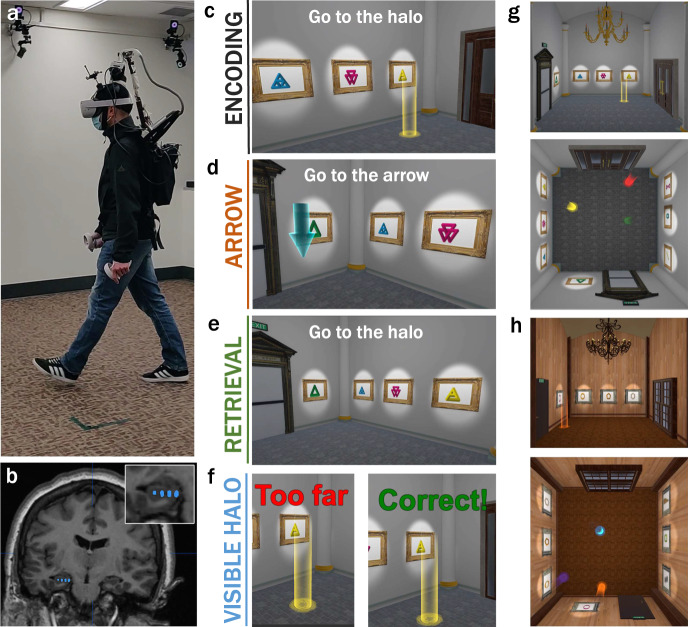
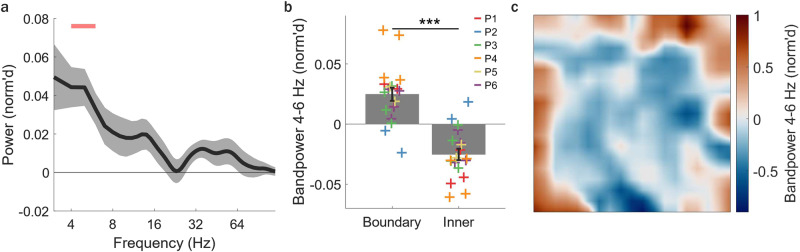
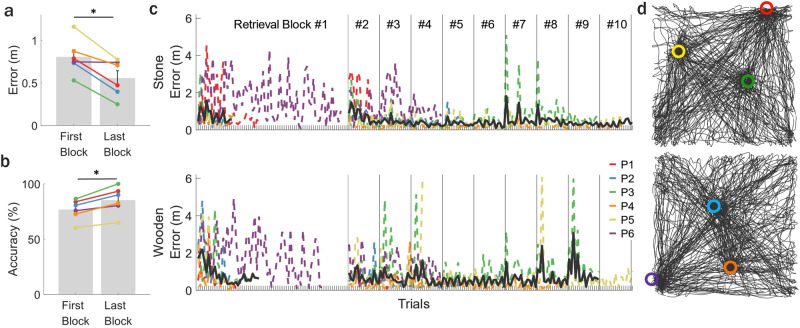
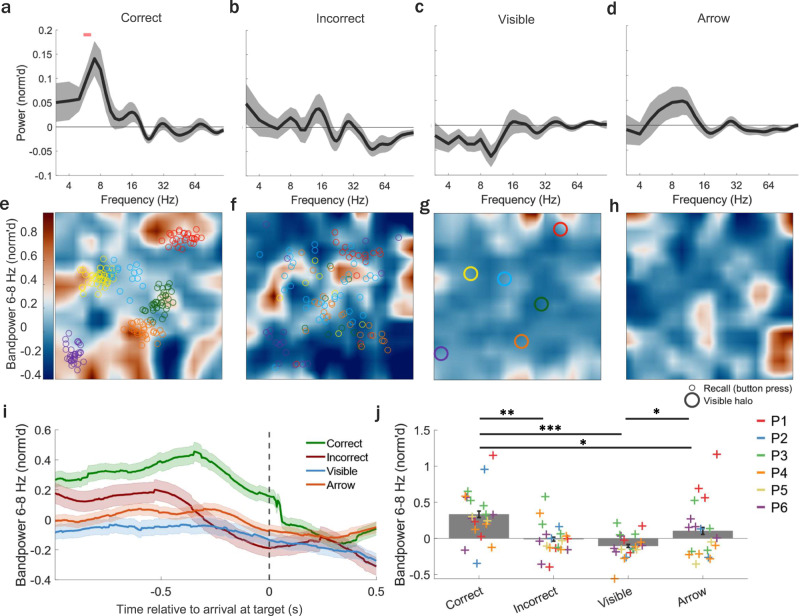
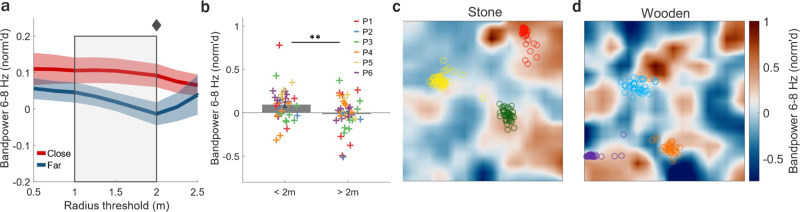
Our ability to recall memories of personal experiences is an essential part of daily life. These episodic memories often involve movement through space and thus require continuous encoding of one's position relative to the surrounding environment. The medial temporal lobe (MTL) is thought to be critically involved, based on studies in freely moving rodents and stationary humans. However, it remains unclear if and how the MTL represents both space and memory especially during physical navigation, given challenges associated with deep brain recordings in humans during movement. We recorded intracranial electroencephalographic (iEEG) activity while participants completed an ambulatory spatial memory task within an immersive virtual reality environment. MTL theta activity was modulated by successful memory retrieval or spatial positions within the environment, depending on dynamically changing behavioral goals. Altogether, these results demonstrate how human MTL oscillations can represent both memory and space in a temporally flexible manner during freely moving navigation.
我们回忆个人经历的能力是日常生活的重要组成部分。这些情景记忆通常涉及到在空间中的移动,因此需要不断地对自身相对于周围环境的位置进行编码。基于在自由移动的啮齿动物和静止的人类中的研究,认为内侧颞叶(MTL)是至关重要的。然而,由于在运动过程中对人类进行深部脑记录的挑战,目前尚不清楚 MTL 是否以及如何同时表示空间和记忆,特别是在身体导航期间。我们在参与者在沉浸式虚拟现实环境中完成巡回空间记忆任务时记录了颅内脑电图(iEEG)活动。MTL 的θ活动根据动态变化的行为目标,受到成功记忆检索或环境中空间位置的调制。总的来说,这些结果表明人类 MTL 振荡在自由移动导航期间如何以灵活的时间方式同时表示记忆和空间。