Nanomedicine Research Center, The Third Affiliated Hospital of Sun Yat-sen University, Guangzhou, 510630, China.
Department of Medical Ultrasonic, The Third Affiliated Hospital of Sun Yat-sen University, Guangzhou, 510630, China.
Adv Sci (Weinh). 2023 Nov;10(33):e2302134. doi: 10.1002/advs.202302134. Epub 2023 Oct 23.
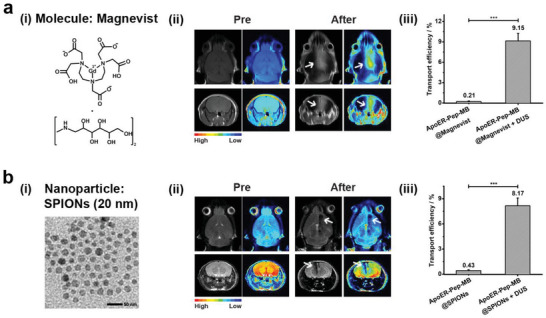
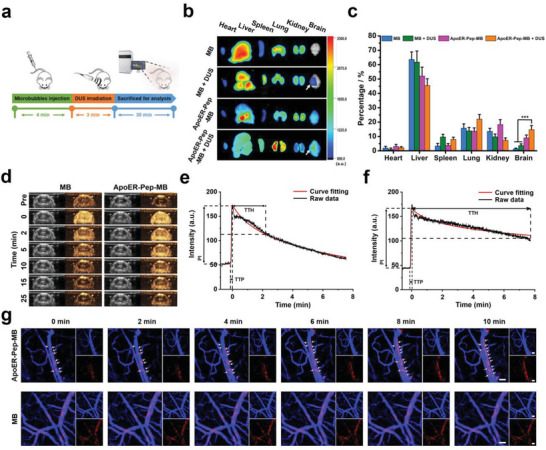
The protective blood-brain barrier (BBB) prevents most therapeutic agents from entering the brain. Currently, focused ultrasound (FUS) is mostly employed to create microbubbles that induce a cavitation effect to open the BBB. However, microbubbles pass quickly through brain microvessels, substantially limiting the cavitation effect. Here, we constructed a novel perfluoropropane-loaded microbubble, termed ApoER-Pep-MB, which possessed a siloxane bonds-crosslinked surface to increase the microbubble stability against turbulence in blood circulation and was decorated with binding peptide for apolipoprotein E receptor (ApoER-Pep). The microbubble with tailor-made micron size (2 µm) and negative surface charge (-30 mV) performed ApoER-mediated binding rather than internalization into brain capillary endothelial cells. Consequently, the microbubble accumulated on the brain microvessels, based on which even a low-energy ultrasound with less safety risk than FUS, herein diagnostic ultrasound (DUS), could create a strong cavitation effect to open the BBB. Evans Blue and immunofluorescence staining studies demonstrated that the DUS-triggered cavitation effect not only temporarily opened the BBB for 2 h but also caused negligible damage to the brain tissue. Therefore, various agents, ranging from small molecules to nanoscale objects, can be efficiently delivered to target regions of the brain, offering tremendous opportunities for the treatment of brain diseases.
血脑屏障(BBB)具有保护作用,可阻止大多数治疗药物进入大脑。目前,聚焦超声(FUS)主要用于产生微泡,以产生空化效应来打开 BBB。然而,微泡很快通过脑微血管,大大限制了空化效应。在这里,我们构建了一种新型的全氟丙烷负载微泡,称为 ApoER-Pep-MB,它具有硅氧烷键交联表面,可增加微泡在血液循环中抗湍流的稳定性,并被结合肽(ApoER-Pep)修饰。这种具有定制微米尺寸(2 µm)和负表面电荷(-30 mV)的微泡通过载脂蛋白 E 受体(ApoER-Pep)进行 ApoER 介导的结合,而不是内化到脑毛细血管内皮细胞中。因此,微泡在脑微血管上聚集,在此基础上,即使是比 FUS 安全性风险更低的低能量超声(DUS)也能产生强大的空化效应来打开 BBB。伊文思蓝和免疫荧光染色研究表明,DUS 触发的空化效应不仅能使 BBB 暂时开放 2 小时,而且对脑组织几乎没有损伤。因此,各种药物,从小分子到纳米级物体,都可以有效地递送到大脑的目标区域,为治疗脑部疾病提供了巨大的机会。