• 文献检索
  • 文档翻译
  • 深度研究
  • 学术资讯
  • Suppr Zotero 插件Zotero 插件
  • 邀请有礼
  • 套餐&价格
  • 历史记录
应用&插件
Suppr Zotero 插件Zotero 插件浏览器插件Mac 客户端Windows 客户端微信小程序
定价
高级版会员购买积分包购买API积分包
服务
文献检索文档翻译深度研究API 文档MCP 服务
关于我们
关于 Suppr公司介绍联系我们用户协议隐私条款
关注我们

Suppr 超能文献

核心技术专利:CN118964589B侵权必究
粤ICP备2023148730 号-1Suppr @ 2026

文献检索

告别复杂PubMed语法,用中文像聊天一样搜索,搜遍4000万医学文献。AI智能推荐,让科研检索更轻松。

立即免费搜索

文件翻译

保留排版,准确专业,支持PDF/Word/PPT等文件格式,支持 12+语言互译。

免费翻译文档

深度研究

AI帮你快速写综述,25分钟生成高质量综述,智能提取关键信息,辅助科研写作。

立即免费体验

利用消费者可穿戴数字生物标志物,通过研究项目数据集对产后抑郁症进行个性化识别。

Harnessing consumer wearable digital biomarkers for individualized recognition of postpartum depression using the Research Program dataset.

作者信息

Hurwitz Eric, Butzin-Dozier Zachary, Master Hiral, O'Neil Shawn T, Walden Anita, Holko Michelle, Patel Rena C, Haendel Melissa A

机构信息

Department of Biomedical Informatics, University of Colorado Anschutz Medical Campus, Aurora, CO, USA.

Wright Center for Clinical and Translational Research, Massey Cancer Center, Virginia Commonwealth University, Richmond, VA, USA.

出版信息

medRxiv. 2023 Oct 14:2023.10.13.23296965. doi: 10.1101/2023.10.13.23296965.

DOI:10.1101/2023.10.13.23296965
PMID:37873471
原文链接:https://pmc.ncbi.nlm.nih.gov/articles/PMC10593061/
Abstract

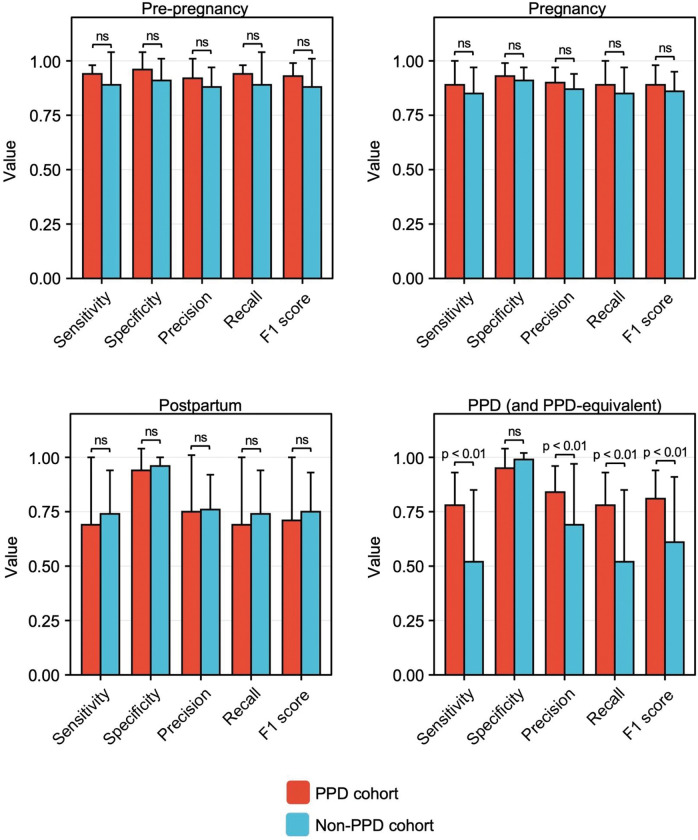
Postpartum depression (PPD), afflicting one in seven women, poses a major challenge in maternal health. Existing approaches to detect PPD heavily depend on in-person postpartum visits, leading to cases of the condition being overlooked and untreated. We explored the potential of consumer wearable-derived digital biomarkers for PPD recognition to address this gap. Our study demonstrated that intra-individual machine learning (ML) models developed using these digital biomarkers can discern between pre-pregnancy, pregnancy, postpartum without depression, and postpartum with depression time periods (i.e., PPD diagnosis). When evaluating variable importance, calories burned from the basal metabolic rate (calories BMR) emerged as the digital biomarker most predictive of PPD. To confirm the specificity of our method, we demonstrated that models developed in women without PPD could not accurately classify the PPD-equivalent phase. Prior depression history did not alter model efficacy for PPD recognition. Furthermore, the individualized models demonstrated superior performance compared to a conventional cohort-based model for the detection of PPD, underscoring the effectiveness of our individualized ML approach. This work establishes consumer wearables as a promising avenue for PPD identification. More importantly, it also emphasizes the utility of individualized ML model methodology, potentially transforming early disease detection strategies.

摘要

产后抑郁症(PPD)困扰着七分之一的女性,是孕产妇健康领域的一项重大挑战。现有的产后抑郁症检测方法严重依赖产后的当面问诊,导致该病症的一些病例被忽视且未得到治疗。我们探索了利用消费者可穿戴设备获取的数字生物标志物来识别产后抑郁症的潜力,以填补这一空白。我们的研究表明,使用这些数字生物标志物开发的个体内机器学习(ML)模型能够区分孕前、孕期、无抑郁症的产后以及患有抑郁症的产后时期(即产后抑郁症诊断)。在评估变量重要性时,基础代谢率消耗的卡路里(基础代谢率卡路里)成为最能预测产后抑郁症的数字生物标志物。为了确认我们方法的特异性,我们证明了在没有产后抑郁症的女性中开发的模型无法准确分类与产后抑郁症等效的阶段。既往抑郁症病史并未改变模型对产后抑郁症识别的效果。此外,与传统的基于队列的模型相比,个体模型在检测产后抑郁症方面表现更优,突出了我们个体机器学习方法的有效性。这项工作确立了消费者可穿戴设备作为产后抑郁症识别的一个有前景的途径。更重要的是,它还强调了个体机器学习模型方法的实用性,可能会改变早期疾病检测策略。

https://cdn.ncbi.nlm.nih.gov/pmc/blobs/d0e4/10593061/13c4a6ba9ee7/nihpp-2023.10.13.23296965v1-f0008.jpg
https://cdn.ncbi.nlm.nih.gov/pmc/blobs/d0e4/10593061/2f8be253ffaf/nihpp-2023.10.13.23296965v1-f0001.jpg
https://cdn.ncbi.nlm.nih.gov/pmc/blobs/d0e4/10593061/685a33383ff5/nihpp-2023.10.13.23296965v1-f0002.jpg
https://cdn.ncbi.nlm.nih.gov/pmc/blobs/d0e4/10593061/9b36021a56d3/nihpp-2023.10.13.23296965v1-f0003.jpg
https://cdn.ncbi.nlm.nih.gov/pmc/blobs/d0e4/10593061/809b9259561a/nihpp-2023.10.13.23296965v1-f0004.jpg
https://cdn.ncbi.nlm.nih.gov/pmc/blobs/d0e4/10593061/fcb7a308c665/nihpp-2023.10.13.23296965v1-f0005.jpg
https://cdn.ncbi.nlm.nih.gov/pmc/blobs/d0e4/10593061/307d67248aa3/nihpp-2023.10.13.23296965v1-f0006.jpg
https://cdn.ncbi.nlm.nih.gov/pmc/blobs/d0e4/10593061/ba327257d6eb/nihpp-2023.10.13.23296965v1-f0007.jpg
https://cdn.ncbi.nlm.nih.gov/pmc/blobs/d0e4/10593061/13c4a6ba9ee7/nihpp-2023.10.13.23296965v1-f0008.jpg
https://cdn.ncbi.nlm.nih.gov/pmc/blobs/d0e4/10593061/2f8be253ffaf/nihpp-2023.10.13.23296965v1-f0001.jpg
https://cdn.ncbi.nlm.nih.gov/pmc/blobs/d0e4/10593061/685a33383ff5/nihpp-2023.10.13.23296965v1-f0002.jpg
https://cdn.ncbi.nlm.nih.gov/pmc/blobs/d0e4/10593061/9b36021a56d3/nihpp-2023.10.13.23296965v1-f0003.jpg
https://cdn.ncbi.nlm.nih.gov/pmc/blobs/d0e4/10593061/809b9259561a/nihpp-2023.10.13.23296965v1-f0004.jpg
https://cdn.ncbi.nlm.nih.gov/pmc/blobs/d0e4/10593061/fcb7a308c665/nihpp-2023.10.13.23296965v1-f0005.jpg
https://cdn.ncbi.nlm.nih.gov/pmc/blobs/d0e4/10593061/307d67248aa3/nihpp-2023.10.13.23296965v1-f0006.jpg
https://cdn.ncbi.nlm.nih.gov/pmc/blobs/d0e4/10593061/ba327257d6eb/nihpp-2023.10.13.23296965v1-f0007.jpg
https://cdn.ncbi.nlm.nih.gov/pmc/blobs/d0e4/10593061/13c4a6ba9ee7/nihpp-2023.10.13.23296965v1-f0008.jpg

相似文献

1
Harnessing consumer wearable digital biomarkers for individualized recognition of postpartum depression using the Research Program dataset.利用消费者可穿戴数字生物标志物,通过研究项目数据集对产后抑郁症进行个性化识别。
medRxiv. 2023 Oct 14:2023.10.13.23296965. doi: 10.1101/2023.10.13.23296965.
2
Harnessing Consumer Wearable Digital Biomarkers for Individualized Recognition of Postpartum Depression Using the All of Us Research Program Data Set: Cross-Sectional Study.利用 All of Us 研究计划数据集的消费者可穿戴数字生物标志物进行个体化产后抑郁症识别:横断面研究。
JMIR Mhealth Uhealth. 2024 May 2;12:e54622. doi: 10.2196/54622.
3
Unlocking the potential of wearable device wear time to enhance postpartum depression screening and detection.挖掘可穿戴设备佩戴时长的潜力,以加强产后抑郁症的筛查与检测。
medRxiv. 2024 Oct 7:2024.10.07.24315026. doi: 10.1101/2024.10.07.24315026.
4
Machine learning prediction models for postpartum depression: A multicenter study in Japan.机器学习预测产后抑郁症模型:日本多中心研究。
J Obstet Gynaecol Res. 2022 Jul;48(7):1775-1785. doi: 10.1111/jog.15266. Epub 2022 Apr 19.
5
A promising new model of care for postpartum depression: A randomised controlled trial of a brief home visitation program conducted in Houston, Texas, USA.一种有前景的产后抑郁症护理新模式:在美国得克萨斯州休斯顿进行的一项简短家访计划的随机对照试验。
Health Soc Care Community. 2022 Sep;30(5):e2203-e2213. doi: 10.1111/hsc.13658. Epub 2021 Dec 5.
6
Effectiveness of interpersonal psychotherapy in comparison to other psychological and pharmacological interventions for reducing depressive symptoms in women diagnosed with postpartum depression in low- and middle-income countries: A systematic review.在低收入和中等收入国家,人际心理治疗与其他心理和药物干预措施相比,对减轻被诊断为产后抑郁症的女性抑郁症状的有效性:一项系统评价。
Campbell Syst Rev. 2024 Apr 21;20(2):e1399. doi: 10.1002/cl2.1399. eCollection 2024 Jun.
7
[GABAergic approach of postpartum depression: A translational review of literature].[产后抑郁症的γ-氨基丁酸能治疗方法:文献的转化性综述]
Encephale. 2020 Apr;46(2):123-134. doi: 10.1016/j.encep.2019.09.007. Epub 2019 Nov 22.
8
Development and validation of a machine learning-based postpartum depression prediction model: A nationwide cohort study.基于机器学习的产后抑郁症预测模型的开发和验证:一项全国性队列研究。
Depress Anxiety. 2021 Apr;38(4):400-411. doi: 10.1002/da.23123. Epub 2020 Dec 7.
9
[Association between postpartum depression and concentrations of transforming growth factor-β in human colostrum: a nested cohort study].产后抑郁症与人类初乳中转化生长因子-β浓度之间的关联:一项巢式队列研究
Nan Fang Yi Ke Da Xue Xue Bao. 2022 Sep 20;42(9):1426-1430. doi: 10.12122/j.issn.1673-4254.2022.09.21.
10
Potential CSF biomarkers of postpartum depression following delivery via caesarian section.剖宫产术后产后抑郁症的潜在脑脊液生物标志物。
J Affect Disord. 2023 Dec 1;342:177-181. doi: 10.1016/j.jad.2023.09.021. Epub 2023 Sep 18.

本文引用的文献

1
Who is pregnant? Defining real-world data-based pregnancy episodes in the National COVID Cohort Collaborative (N3C).谁怀孕了?在国家新冠队列协作组(N3C)中定义基于真实世界数据的妊娠事件。
JAMIA Open. 2023 Aug 16;6(3):ooad067. doi: 10.1093/jamiaopen/ooad067. eCollection 2023 Oct.
2
Wearable Artificial Intelligence for Anxiety and Depression: Scoping Review.可穿戴人工智能在焦虑和抑郁中的应用:综述研究。
J Med Internet Res. 2023 Jan 19;25:e42672. doi: 10.2196/42672.
3
Association of step counts over time with the risk of chronic disease in the All of Us Research Program.
随着时间的推移,步数与 All of Us 研究计划中慢性病风险的关系。
Nat Med. 2022 Nov;28(11):2301-2308. doi: 10.1038/s41591-022-02012-w. Epub 2022 Oct 10.
4
Exploration for biomarkers of postpartum depression based on metabolomics: A systematic review.基于代谢组学的产后抑郁症生物标志物研究:系统综述。
J Affect Disord. 2022 Nov 15;317:298-306. doi: 10.1016/j.jad.2022.08.043. Epub 2022 Aug 27.
5
Postpartum Visit Attendance in the United States: A Systematic Review.美国的产后访视参与情况:一项系统评价。
Womens Health Issues. 2022 Jul-Aug;32(4):369-375. doi: 10.1016/j.whi.2022.02.002. Epub 2022 Mar 15.
6
Digital Biomarkers for Depression Screening With Wearable Devices: Cross-sectional Study With Machine Learning Modeling.基于可穿戴设备的抑郁筛查数字生物标志物:机器学习建模的横断面研究。
JMIR Mhealth Uhealth. 2021 Oct 25;9(10):e24872. doi: 10.2196/24872.
7
Estimation of postpartum depression risk from electronic health records using machine learning.基于机器学习的电子健康记录产后抑郁风险评估。
BMC Pregnancy Childbirth. 2021 Sep 17;21(1):630. doi: 10.1186/s12884-021-04087-8.
8
All Models are Wrong, but are Useful: Learning a Variable's Importance by Studying an Entire Class of Prediction Models Simultaneously.所有模型都是有缺陷的,但都是有用的:通过同时研究一整个类别的预测模型来了解变量的重要性。
J Mach Learn Res. 2019;20.
9
Postpartum Metabolism: How Does It Change from Pregnancy and What are the Potential Implications?产后代谢:它如何从孕期发生变化以及有哪些潜在影响?
Int J Womens Health. 2021 Jun 17;13:591-599. doi: 10.2147/IJWH.S314469. eCollection 2021.
10
Personalized machine learning of depressed mood using wearables.使用可穿戴设备进行抑郁情绪的个性化机器学习。
Transl Psychiatry. 2021 Jun 9;11(1):338. doi: 10.1038/s41398-021-01445-0.