• 文献检索
  • 文档翻译
  • 深度研究
  • 学术资讯
  • Suppr Zotero 插件Zotero 插件
  • 邀请有礼
  • 套餐&价格
  • 历史记录
应用&插件
Suppr Zotero 插件Zotero 插件浏览器插件Mac 客户端Windows 客户端微信小程序
定价
高级版会员购买积分包购买API积分包
服务
文献检索文档翻译深度研究API 文档MCP 服务
关于我们
关于 Suppr公司介绍联系我们用户协议隐私条款
关注我们

Suppr 超能文献

核心技术专利:CN118964589B侵权必究
粤ICP备2023148730 号-1Suppr @ 2026

文献检索

告别复杂PubMed语法,用中文像聊天一样搜索,搜遍4000万医学文献。AI智能推荐,让科研检索更轻松。

立即免费搜索

文件翻译

保留排版,准确专业,支持PDF/Word/PPT等文件格式,支持 12+语言互译。

免费翻译文档

深度研究

AI帮你快速写综述,25分钟生成高质量综述,智能提取关键信息,辅助科研写作。

立即免费体验

基于机器学习的电子健康记录产后抑郁风险评估。

Estimation of postpartum depression risk from electronic health records using machine learning.

机构信息

KI Research Institute, Kfar Malal, Israel.

Division of Health Informatics, Department of Population Health Sciences, Weill Cornell Medicine, New York, NY, USA.

出版信息

BMC Pregnancy Childbirth. 2021 Sep 17;21(1):630. doi: 10.1186/s12884-021-04087-8.

DOI:10.1186/s12884-021-04087-8
PMID:34535116
原文链接:https://pmc.ncbi.nlm.nih.gov/articles/PMC8447665/
Abstract

BACKGROUND

Postpartum depression is a widespread disorder, adversely affecting the well-being of mothers and their newborns. We aim to utilize machine learning for predicting risk of postpartum depression (PPD) using primary care electronic health records (EHR) data, and to evaluate the potential value of EHR-based prediction in improving the accuracy of PPD screening and in early identification of women at risk.

METHODS

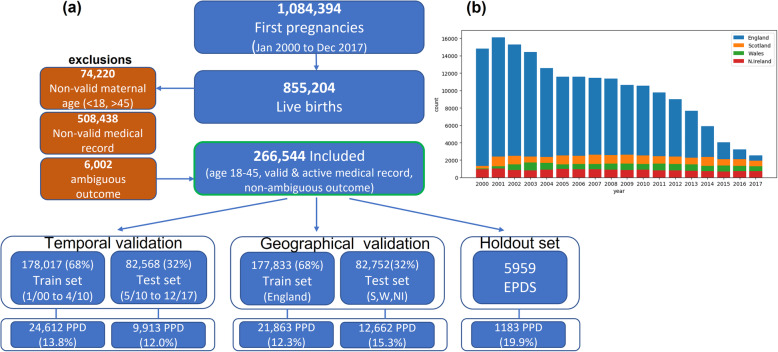
We analyzed EHR data of 266,544 women from the UK who gave first live birth between 2000 and 2017. We extracted a multitude of socio-demographic and medical variables and constructed a machine learning model that predicts the risk of PPD during the year following childbirth. We evaluated the model's performance using multiple validation methodologies and measured its accuracy as a stand-alone tool and as an adjunct to the standard questionnaire-based screening by Edinburgh postnatal depression scale (EPDS).

RESULTS

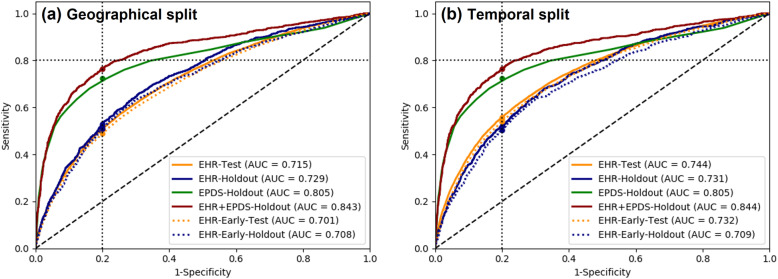
The prevalence of PPD in the analyzed cohort was 13.4%. Combing EHR-based prediction with EPDS score increased the area under the receiver operator characteristics curve (AUC) from 0.805 to 0.844 and the sensitivity from 0.72 to 0.76, at specificity of 0.80. The AUC of the EHR-based prediction model alone varied from 0.72 to 0.74 and decreased by only 0.01-0.02 when applied as early as before the beginning of pregnancy.

CONCLUSIONS

PPD risk prediction using EHR data may provide a complementary quantitative and objective tool for PPD screening, allowing earlier (pre-pregnancy) and more accurate identification of women at risk, timely interventions and potentially improved outcomes for the mother and child.

摘要

背景

产后抑郁症是一种广泛存在的疾病,会对母亲及其新生儿的健康产生不利影响。我们旨在利用机器学习,通过初级保健电子健康记录(EHR)数据预测产后抑郁症(PPD)的风险,并评估基于 EHR 的预测在提高 PPD 筛查准确性和早期识别风险妇女方面的潜在价值。

方法

我们分析了来自英国的 266544 名首次分娩的女性的 EHR 数据,这些女性在 2000 年至 2017 年期间分娩。我们提取了大量社会人口统计学和医学变量,并构建了一个机器学习模型,预测产后一年内发生 PPD 的风险。我们使用多种验证方法评估了模型的性能,并测量了其作为独立工具和作为爱丁堡产后抑郁量表(EPDS)基于问卷的标准筛查的辅助工具的准确性。

结果

在分析的队列中,PPD 的患病率为 13.4%。将基于 EHR 的预测与 EPDS 评分相结合,将接收者操作特征曲线下的面积(AUC)从 0.805 提高到 0.844,敏感性从 0.72 提高到 0.76,特异性为 0.80。仅基于 EHR 的预测模型的 AUC 从 0.72 到 0.74 不等,当应用于怀孕前早期时,仅降低了 0.01-0.02。

结论

使用 EHR 数据进行 PPD 风险预测可能为 PPD 筛查提供一种补充的定量和客观工具,从而更早(怀孕前)更准确地识别风险妇女,及时进行干预,并可能改善母婴结局。
https://cdn.ncbi.nlm.nih.gov/pmc/blobs/ea1a/8447665/5e5fe3bfd08c/12884_2021_4087_Fig4_HTML.jpg
https://cdn.ncbi.nlm.nih.gov/pmc/blobs/ea1a/8447665/25ef15bfc7c2/12884_2021_4087_Fig1_HTML.jpg
https://cdn.ncbi.nlm.nih.gov/pmc/blobs/ea1a/8447665/a0289df4f366/12884_2021_4087_Fig2_HTML.jpg
https://cdn.ncbi.nlm.nih.gov/pmc/blobs/ea1a/8447665/e41ef5ae60ff/12884_2021_4087_Fig3_HTML.jpg
https://cdn.ncbi.nlm.nih.gov/pmc/blobs/ea1a/8447665/5e5fe3bfd08c/12884_2021_4087_Fig4_HTML.jpg
https://cdn.ncbi.nlm.nih.gov/pmc/blobs/ea1a/8447665/25ef15bfc7c2/12884_2021_4087_Fig1_HTML.jpg
https://cdn.ncbi.nlm.nih.gov/pmc/blobs/ea1a/8447665/a0289df4f366/12884_2021_4087_Fig2_HTML.jpg
https://cdn.ncbi.nlm.nih.gov/pmc/blobs/ea1a/8447665/e41ef5ae60ff/12884_2021_4087_Fig3_HTML.jpg
https://cdn.ncbi.nlm.nih.gov/pmc/blobs/ea1a/8447665/5e5fe3bfd08c/12884_2021_4087_Fig4_HTML.jpg

相似文献

1
Estimation of postpartum depression risk from electronic health records using machine learning.基于机器学习的电子健康记录产后抑郁风险评估。
BMC Pregnancy Childbirth. 2021 Sep 17;21(1):630. doi: 10.1186/s12884-021-04087-8.
2
Development and validation of a machine learning-based postpartum depression prediction model: A nationwide cohort study.基于机器学习的产后抑郁症预测模型的开发和验证:一项全国性队列研究。
Depress Anxiety. 2021 Apr;38(4):400-411. doi: 10.1002/da.23123. Epub 2020 Dec 7.
3
Development and validation of a machine learning algorithm for predicting the risk of postpartum depression among pregnant women.开发和验证一种机器学习算法,以预测孕妇产后抑郁症的风险。
J Affect Disord. 2021 Jan 15;279:1-8. doi: 10.1016/j.jad.2020.09.113. Epub 2020 Sep 30.
4
Using Electronic Health Records and Machine Learning to Predict Postpartum Depression.利用电子健康记录和机器学习预测产后抑郁症。
Stud Health Technol Inform. 2019 Aug 21;264:888-892. doi: 10.3233/SHTI190351.
5
Harnessing Consumer Wearable Digital Biomarkers for Individualized Recognition of Postpartum Depression Using the All of Us Research Program Data Set: Cross-Sectional Study.利用 All of Us 研究计划数据集的消费者可穿戴数字生物标志物进行个体化产后抑郁症识别:横断面研究。
JMIR Mhealth Uhealth. 2024 May 2;12:e54622. doi: 10.2196/54622.
6
Using clinical decision support as a means of implementing a universal postpartum depression screening program.将临床决策支持作为实施通用产后抑郁症筛查项目的一种手段。
Arch Womens Ment Health. 2016 Jun;19(3):501-5. doi: 10.1007/s00737-015-0596-y. Epub 2015 Dec 16.
7
Trajectory on postpartum depression of Chinese women and the risk prediction models: A machine-learning based three-wave follow-up research.基于机器学习的三波随访研究:中国女性产后抑郁症轨迹及其风险预测模型。
J Affect Disord. 2024 Nov 15;365:185-192. doi: 10.1016/j.jad.2024.08.074. Epub 2024 Aug 16.
8
Machine learning prediction models for postpartum depression: A multicenter study in Japan.机器学习预测产后抑郁症模型:日本多中心研究。
J Obstet Gynaecol Res. 2022 Jul;48(7):1775-1785. doi: 10.1111/jog.15266. Epub 2022 Apr 19.
9
A community-based screening initiative to identify mothers at risk for postpartum depression.一项基于社区的筛查倡议,旨在识别有产后抑郁症风险的母亲。
J Obstet Gynecol Neonatal Nurs. 2011 Jan-Feb;40(1):52-61. doi: 10.1111/j.1552-6909.2010.01199.x. Epub 2010 Dec 1.
10
Postpartum depression among women who have experienced intimate partner violence: A prospective cohort study at Moshi, Tanzania.遭受亲密伴侣暴力的女性产后抑郁症:坦桑尼亚莫希的一项前瞻性队列研究。
J Affect Disord. 2017 Aug 15;218:238-245. doi: 10.1016/j.jad.2017.04.063. Epub 2017 Apr 29.

引用本文的文献

1
Machine learning-based nomogram for predicting depressive symptoms in women: A cross-sectional study in Guangdong Province, China.基于机器学习的预测女性抑郁症状的列线图:中国广东省的一项横断面研究。
World J Psychiatry. 2025 Aug 19;15(8):106622. doi: 10.5498/wjp.v15.i8.106622.
2
Machine Learning Models to Predict Risk of Maternal Morbidity and Mortality From Electronic Medical Record Data: Scoping Review.利用电子病历数据预测孕产妇发病和死亡风险的机器学习模型:范围综述
J Med Internet Res. 2025 Aug 14;27:e68225. doi: 10.2196/68225.
3
Navigating promise and perils: applying artificial intelligence to the perinatal mental health care cascade.

本文引用的文献

1
Development and validation of a machine learning-based postpartum depression prediction model: A nationwide cohort study.基于机器学习的产后抑郁症预测模型的开发和验证:一项全国性队列研究。
Depress Anxiety. 2021 Apr;38(4):400-411. doi: 10.1002/da.23123. Epub 2020 Dec 7.
2
Machine Learning Models for the Prediction of Postpartum Depression: Application and Comparison Based on a Cohort Study.用于预测产后抑郁症的机器学习模型:基于队列研究的应用与比较
JMIR Med Inform. 2020 Apr 30;8(4):e15516. doi: 10.2196/15516.
3
Financial Toll of Untreated Perinatal Mood and Anxiety Disorders Among 2017 Births in the United States.
应对希望与风险:将人工智能应用于围产期心理健康照护流程
Npj Health Syst. 2025;2(1):26. doi: 10.1038/s44401-025-00030-7. Epub 2025 Jul 23.
4
Unlocking the Potential of Wear Time of a Wearable Device to Enhance Postpartum Depression Screening and Detection: Cross-Sectional Study.挖掘可穿戴设备佩戴时长在加强产后抑郁筛查与检测方面的潜力:横断面研究
JMIR Form Res. 2025 May 23;9:e67585. doi: 10.2196/67585.
5
Predictive Analysis of Postpartum Depression Using Machine Learning.基于机器学习的产后抑郁症预测分析
Healthcare (Basel). 2025 Apr 14;13(8):897. doi: 10.3390/healthcare13080897.
6
Leveraging artificial intelligence in the prediction, diagnosis and treatment of depression and anxiety among perinatal women in low- and middle-income countries: a systematic review.利用人工智能预测、诊断和治疗低收入和中等收入国家围产期妇女的抑郁和焦虑:一项系统综述。
BMJ Ment Health. 2025 Apr 15;28(1):e301445. doi: 10.1136/bmjment-2024-301445.
7
Prediction of postpartum depression in women: development and validation of multiple machine learning models.女性产后抑郁症的预测:多种机器学习模型的开发与验证
J Transl Med. 2025 Mar 7;23(1):291. doi: 10.1186/s12967-025-06289-6.
8
Prediction of adverse pregnancy outcomes using machine learning techniques: evidence from analysis of electronic medical records data in Rwanda.使用机器学习技术预测不良妊娠结局:来自卢旺达电子病历数据分析的证据。
BMC Med Inform Decis Mak. 2025 Feb 12;25(1):76. doi: 10.1186/s12911-025-02921-z.
9
Interpretable Machine Learning Model for Predicting Postpartum Depression: Retrospective Study.用于预测产后抑郁症的可解释机器学习模型:回顾性研究
JMIR Med Inform. 2025 Jan 20;13:e58649. doi: 10.2196/58649.
10
A Plasma Proteomics-Based Model for Identifying the Risk of Postpartum Depression Using Machine Learning.一种基于血浆蛋白质组学的机器学习模型用于识别产后抑郁风险
J Proteome Res. 2025 Feb 7;24(2):824-833. doi: 10.1021/acs.jproteome.4c00826. Epub 2025 Jan 7.
美国 2017 年分娩人群中未经治疗的围产期情绪和焦虑障碍的经济代价。
Am J Public Health. 2020 Jun;110(6):888-896. doi: 10.2105/AJPH.2020.305619. Epub 2020 Apr 16.
4
A Comprehensive Analysis of Post-partum Depression Risk Factors: The Role of Socio-Demographic, Individual, Relational, and Delivery Characteristics.产后抑郁风险因素的综合分析:社会人口学、个体、人际关系及分娩特征的作用
Front Public Health. 2019 Oct 24;7:295. doi: 10.3389/fpubh.2019.00295. eCollection 2019.
5
Using Electronic Health Records and Machine Learning to Predict Postpartum Depression.利用电子健康记录和机器学习预测产后抑郁症。
Stud Health Technol Inform. 2019 Aug 21;264:888-892. doi: 10.3233/SHTI190351.
6
Honesty and comfort levels in mothers when screened for perinatal depression and anxiety.母亲在接受围产期抑郁和焦虑筛查时的诚实度和舒适度。
Women Birth. 2020 Mar;33(2):e142-e150. doi: 10.1016/j.wombi.2019.04.001. Epub 2019 May 25.
7
Consequences of maternal postpartum depression: A systematic review of maternal and infant outcomes.产后抑郁症的后果:对母婴结局的系统评价
Womens Health (Lond). 2019 Jan-Dec;15:1745506519844044. doi: 10.1177/1745506519844044.
8
The international postpartum depression: action towards causes and treatment (PACT) consortium.国际产后抑郁:病因与治疗行动(PACT)联合会。
Int Rev Psychiatry. 2019 May;31(3):229-236. doi: 10.1080/09540261.2018.1551191. Epub 2019 Feb 27.
9
Interventions to Prevent Perinatal Depression: Evidence Report and Systematic Review for the US Preventive Services Task Force.预防围产期抑郁的干预措施:美国预防服务工作组的证据报告和系统评价。
JAMA. 2019 Feb 12;321(6):588-601. doi: 10.1001/jama.2018.20865.
10
Depression, depressive symptoms and treatments in women who have recently given birth: UK cohort study.近期分娩女性的抑郁症、抑郁症状及治疗:英国队列研究。
BMJ Open. 2018 Oct 24;8(10):e022152. doi: 10.1136/bmjopen-2018-022152.