Neuroglee Therapeutics, Singapore, Singapore.
Department of Psychiatry, The University of Hong Kong, Hong Kong SAR, China (Hong Kong).
JMIR Mhealth Uhealth. 2021 Oct 25;9(10):e24872. doi: 10.2196/24872.
Depression is a prevalent mental disorder that is undiagnosed and untreated in half of all cases. Wearable activity trackers collect fine-grained sensor data characterizing the behavior and physiology of users (ie, digital biomarkers), which could be used for timely, unobtrusive, and scalable depression screening.
The aim of this study was to examine the predictive ability of digital biomarkers, based on sensor data from consumer-grade wearables, to detect risk of depression in a working population.
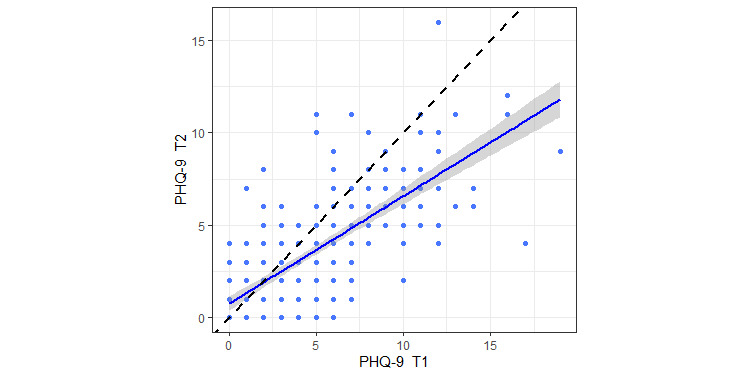
This was a cross-sectional study of 290 healthy working adults. Participants wore Fitbit Charge 2 devices for 14 consecutive days and completed a health survey, including screening for depressive symptoms using the 9-item Patient Health Questionnaire (PHQ-9), at baseline and 2 weeks later. We extracted a range of known and novel digital biomarkers characterizing physical activity, sleep patterns, and circadian rhythms from wearables using steps, heart rate, energy expenditure, and sleep data. Associations between severity of depressive symptoms and digital biomarkers were examined with Spearman correlation and multiple regression analyses adjusted for potential confounders, including sociodemographic characteristics, alcohol consumption, smoking, self-rated health, subjective sleep characteristics, and loneliness. Supervised machine learning with statistically selected digital biomarkers was used to predict risk of depression (ie, symptom severity and screening status). We used varying cutoff scores from an acceptable PHQ-9 score range to define the depression group and different subsamples for classification, while the set of statistically selected digital biomarkers remained the same. For the performance evaluation, we used k-fold cross-validation and obtained accuracy measures from the holdout folds.
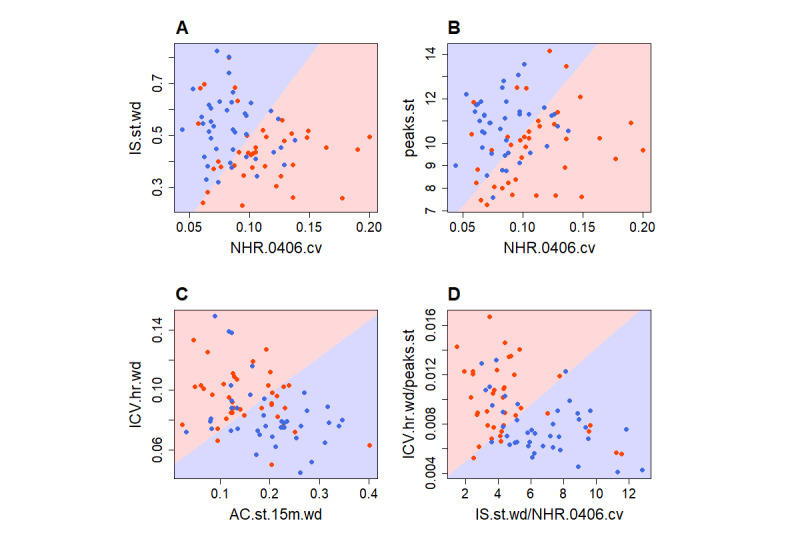
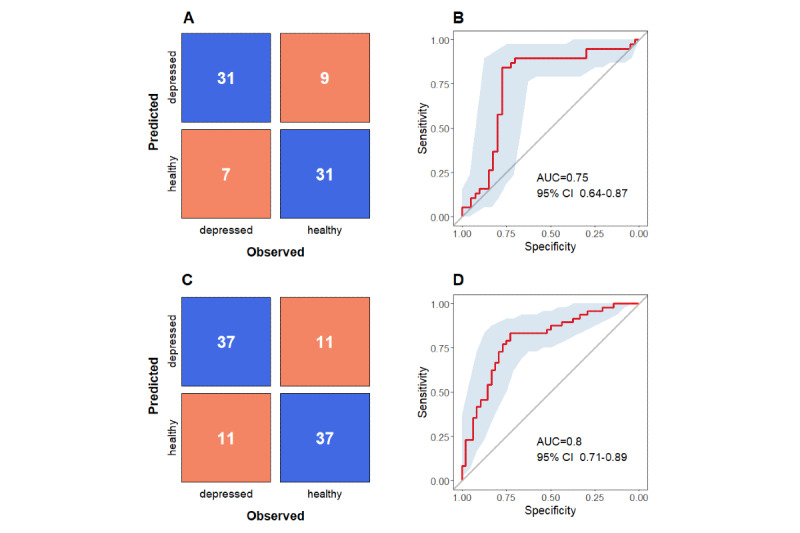
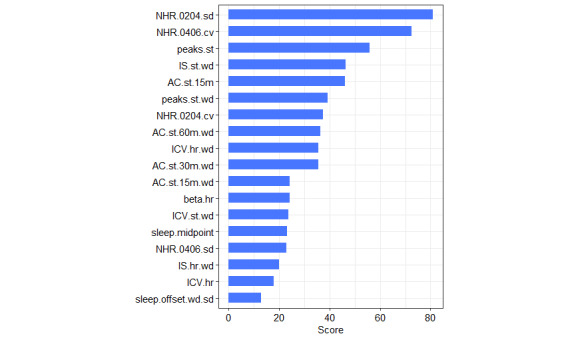
A total of 267 participants were included in the analysis. The mean age of the participants was 33 (SD 8.6, range 21-64) years. Out of 267 participants, there was a mild female bias displayed (n=170, 63.7%). The majority of the participants were Chinese (n=211, 79.0%), single (n=163, 61.0%), and had a university degree (n=238, 89.1%). We found that a greater severity of depressive symptoms was robustly associated with greater variation of nighttime heart rate between 2 AM and 4 AM and between 4 AM and 6 AM; it was also associated with lower regularity of weekday circadian rhythms based on steps and estimated with nonparametric measures of interdaily stability and autocorrelation as well as fewer steps-based daily peaks. Despite several reliable associations, our evidence showed limited ability of digital biomarkers to detect depression in the whole sample of working adults. However, in balanced and contrasted subsamples comprised of depressed and healthy participants with no risk of depression (ie, no or minimal depressive symptoms), the model achieved an accuracy of 80%, a sensitivity of 82%, and a specificity of 78% in detecting subjects at high risk of depression.
Digital biomarkers that have been discovered and are based on behavioral and physiological data from consumer wearables could detect increased risk of depression and have the potential to assist in depression screening, yet current evidence shows limited predictive ability. Machine learning models combining these digital biomarkers could discriminate between individuals with a high risk of depression and individuals with no risk.
抑郁症是一种普遍存在的精神障碍,有一半的病例未被诊断和治疗。可穿戴活动追踪器可收集精细的传感器数据,这些数据可用于描述用户的行为和生理特征(即数字生物标志物),从而实现及时、非侵入性且可扩展的抑郁筛查。
本研究旨在检验基于消费级可穿戴设备传感器数据的数字生物标志物,在工作人群中检测抑郁风险的预测能力。
这是一项横断面研究,共纳入 290 名健康的在职成年人。参与者连续 14 天佩戴 Fitbit Charge 2 设备,并在基线和 2 周后完成健康调查,包括使用 9 项患者健康问卷(PHQ-9)进行抑郁症状筛查。我们从可穿戴设备的步数、心率、能量消耗和睡眠数据中提取了一系列已知和新颖的数字生物标志物,用于描述身体活动、睡眠模式和昼夜节律。使用 Spearman 相关和多元回归分析,对数字生物标志物与抑郁症状严重程度之间的相关性进行了调整,调整了潜在混杂因素,包括社会人口统计学特征、饮酒、吸烟、自我报告的健康状况、主观睡眠特征和孤独感。使用统计学选择的数字生物标志物进行监督机器学习,以预测抑郁风险(即症状严重程度和筛查状况)。我们使用可接受的 PHQ-9 评分范围内的不同截断分数来定义抑郁组和不同的子样本进行分类,而统计学选择的数字生物标志物保持不变。对于性能评估,我们使用 k 折交叉验证,并从保留的折叠中获得准确性度量。
共纳入 267 名参与者进行分析。参与者的平均年龄为 33 岁(SD 8.6,范围 21-64)。在 267 名参与者中,存在轻度的女性偏倚(n=170,63.7%)。大多数参与者为中国人(n=211,79.0%)、单身(n=163,61.0%)和拥有大学学历(n=238,89.1%)。我们发现,抑郁症状严重程度与夜间心率在 2 AM 和 4 AM 之间以及在 4 AM 和 6 AM 之间的较大变化显著相关;它还与工作日昼夜节律的规律性较低有关,这是基于步骤和使用非参数测量日内稳定性和自相关以及基于步骤的每日峰值较少来估计的。尽管存在一些可靠的关联,但我们的证据表明,数字生物标志物在整个成年工作人群中检测抑郁的能力有限。然而,在由抑郁和健康参与者组成的平衡且对比的子样本中,这些参与者没有抑郁风险(即没有或仅有轻微的抑郁症状),模型在检测有高抑郁风险的参与者时达到了 80%的准确率、82%的灵敏度和 78%的特异性。
基于消费者可穿戴设备的行为和生理数据发现的数字生物标志物,可以检测到抑郁风险的增加,并有可能辅助抑郁筛查,但目前的证据表明其预测能力有限。结合这些数字生物标志物的机器学习模型可以区分有高抑郁风险的个体和无风险的个体。