Faculty of Medicine, Damascus University, Damascus, Syria.
German-Syrian Research Society e.V., Frankfurt, Germany.
Sci Rep. 2023 Oct 24;13(1):18150. doi: 10.1038/s41598-023-45388-6.
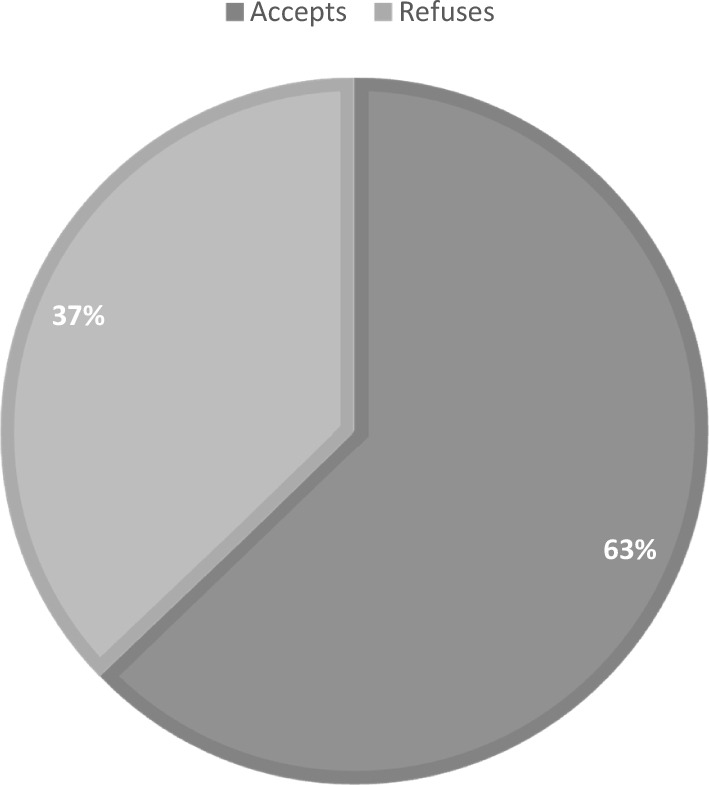
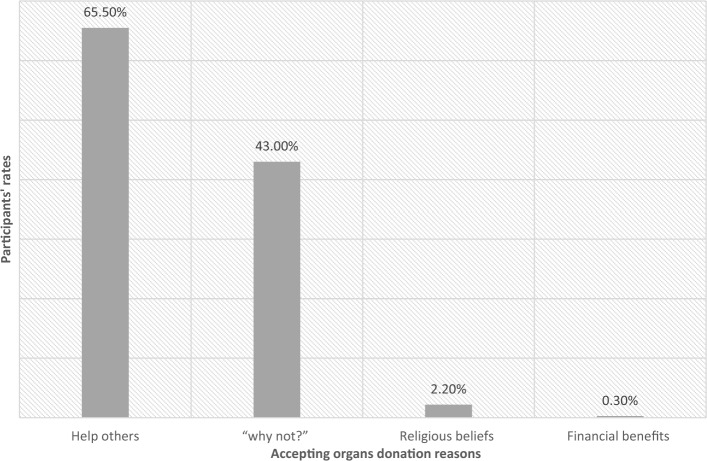
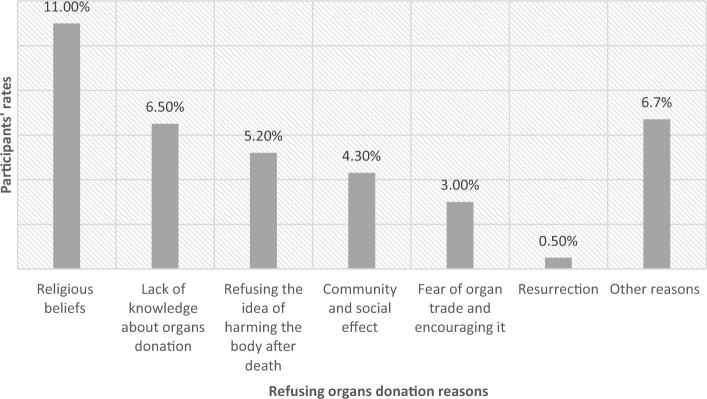
Organ donation is vital to saving lives, but its success depends on people's willingness to donate organs. This descriptive cross-sectional survey aimed to investigate attitudes towards organ donation in Damascus, Syria. Understanding attitudes is crucial for the success of organ donation programs, especially in countries with similar settings. This study was a descriptive cross-sectional survey aimed at understanding patients' attitudes towards organ donation in Damascus, Syria. Data was collected through a carefully constructed validated survey through face-to-face interviews. 600 participants were randomly interviewed, 62.8% agreed to donate their organs after death, with helping others being the primary reason. Religious beliefs were the primary reason for organ refusal in males, while for females, it was lack of knowledge and religious beliefs. However, there were no significant differences between genders or educational level and age groups in the acceptance of organ donation. The percentage of those who agree to donate their organs after death encourages taking an effective step to build an integrated donation system, not just a center. Bearing in mind that there is no correlation with age, gender or even educational level, which means that the system may include different groups of society.
器官捐献对拯救生命至关重要,但它的成功取决于人们捐献器官的意愿。本描述性横断面调查旨在研究叙利亚大马士革的人们对器官捐献的态度。了解态度对于器官捐献计划的成功至关重要,特别是在类似环境的国家。本研究是一项描述性的横断面调查,旨在了解叙利亚大马士革的患者对器官捐献的态度。通过面对面访谈,使用精心设计的经过验证的调查问卷收集数据。随机采访了 600 名参与者,62.8%的人表示死后愿意捐献器官,主要原因是帮助他人。宗教信仰是男性拒绝器官捐献的主要原因,而女性则是缺乏知识和宗教信仰。然而,在接受器官捐献方面,性别、教育程度和年龄组之间没有显著差异。同意死后捐献器官的比例鼓励采取有效措施建立一个综合的捐献系统,而不仅仅是一个中心。需要注意的是,这与年龄、性别甚至教育程度都没有相关性,这意味着该系统可能包括社会的不同群体。