Bertocchi Ilaria, Rocha-Almeida Florbela, Romero-Barragán María Teresa, Cambiaghi Marco, Carretero-Guillén Alejandro, Botta Paolo, Dogbevia Godwin K, Treviño Mario, Mele Paolo, Oberto Alessandra, Larkum Matthew E, Gruart Agnes, Sprengel Rolf, Delgado-García José Maria, Hasan Mazahir T
Department of Molecular Neurobiology, Max Planck Institute for Medical Research, Jahnstrasse 29, 69120 Heidelberg, Germany.
Department of Neuroscience "Rita Levi Montalcini", Neuroscience Institute Cavalieri Ottolenghi (NICO), University of Turin, 10043 Turin, Italy.
iScience. 2023 Sep 25;26(11):108050. doi: 10.1016/j.isci.2023.108050. eCollection 2023 Nov 17.
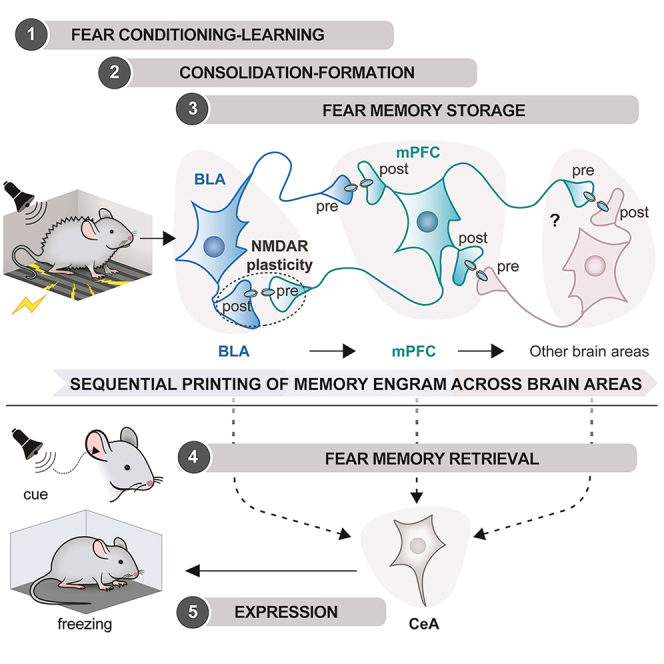
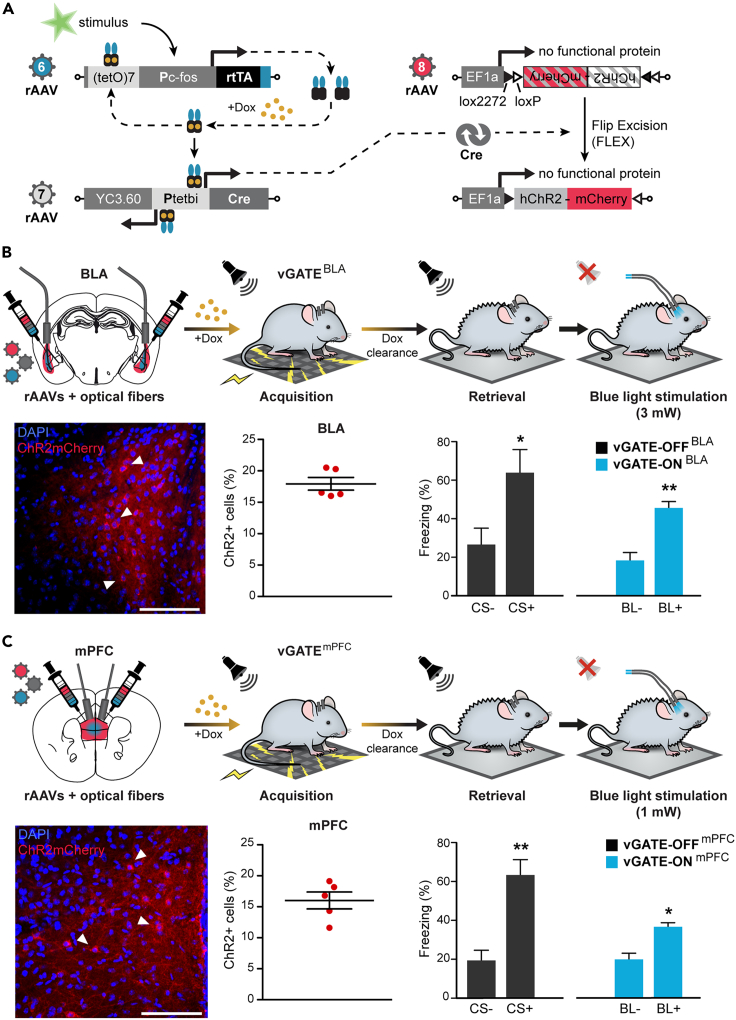
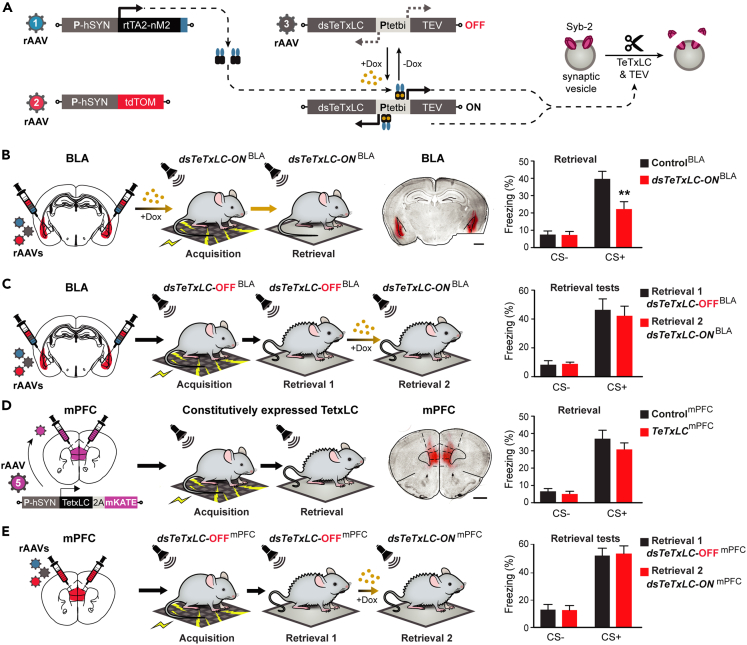
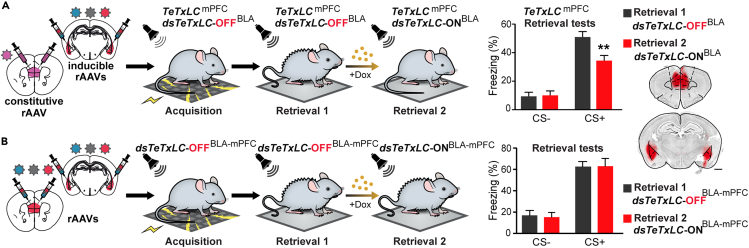
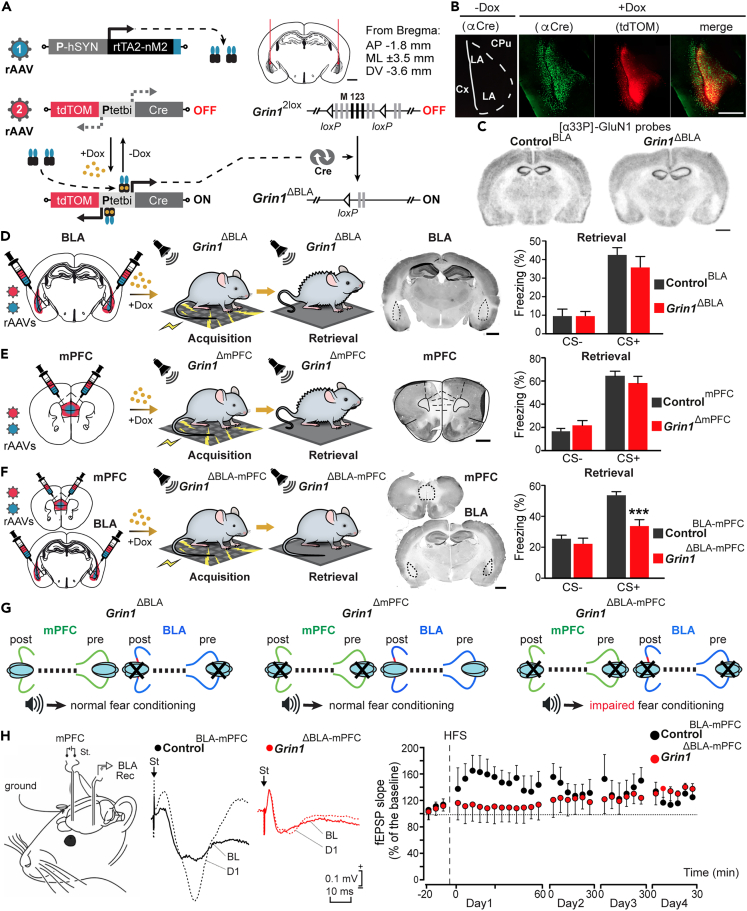
The organization of fear memory involves the participation of multiple brain regions. However, it is largely unknown how fear memory is formed, which circuit pathways are used for "printing" memory engrams across brain regions, and the role of identified brain circuits in memory retrieval. With advanced genetic methods, we combinatorially blocked presynaptic output and manipulated N-methyl-D-aspartate receptor (NMDAR) in the basolateral amygdala (BLA) and medial prefrontal cortex (mPFC) before and after cued fear conditioning. Further, we tagged fear-activated neurons during associative learning for optogenetic memory recall. We found that presynaptic mPFC and postsynaptic BLA NMDARs are required for fear memory formation, but not expression. Our results provide strong evidence that NMDAR-dependent synaptic plasticity drives multi-trace systems consolidation for the sequential printing of fear memory engrams from BLA to mPFC and, subsequently, to the other regions, for flexible memory retrieval.
恐惧记忆的组织涉及多个脑区的参与。然而,恐惧记忆是如何形成的、哪些神经回路用于在脑区之间“印记”记忆痕迹,以及已确定的脑回路在记忆检索中的作用,在很大程度上尚不清楚。利用先进的遗传学方法,我们在条件性恐惧训练前后,组合性地阻断了基底外侧杏仁核(BLA)和内侧前额叶皮质(mPFC)的突触前输出,并操纵了N-甲基-D-天冬氨酸受体(NMDAR)。此外,我们在联想学习期间标记了恐惧激活的神经元,用于光遗传学记忆回忆。我们发现,突触前mPFC和突触后BLA的NMDAR对恐惧记忆的形成是必需的,但对其表达则不是。我们的结果提供了强有力的证据,表明依赖NMDAR的突触可塑性驱动多痕迹系统巩固,用于将恐惧记忆痕迹从BLA依次印记到mPFC,随后再印记到其他区域,以实现灵活的记忆检索。