Department of Public Health Sciences, University of Rochester Medical Center, 265 Crittenden Boulevard Box 420644, Rochester, NY, 14642, USA.
Department of Epidemiology, Johns Hopkins Bloomberg School of Public Health, 615 N Wolfe St, Baltimore, MD, 21205, USA.
BMC Public Health. 2023 Oct 25;23(1):2103. doi: 10.1186/s12889-023-16916-w.
More than one-third of individuals experience post-acute sequelae of SARS-CoV-2 infection (PASC, which includes long-COVID). The objective is to identify risk factors associated with PASC/long-COVID diagnosis.
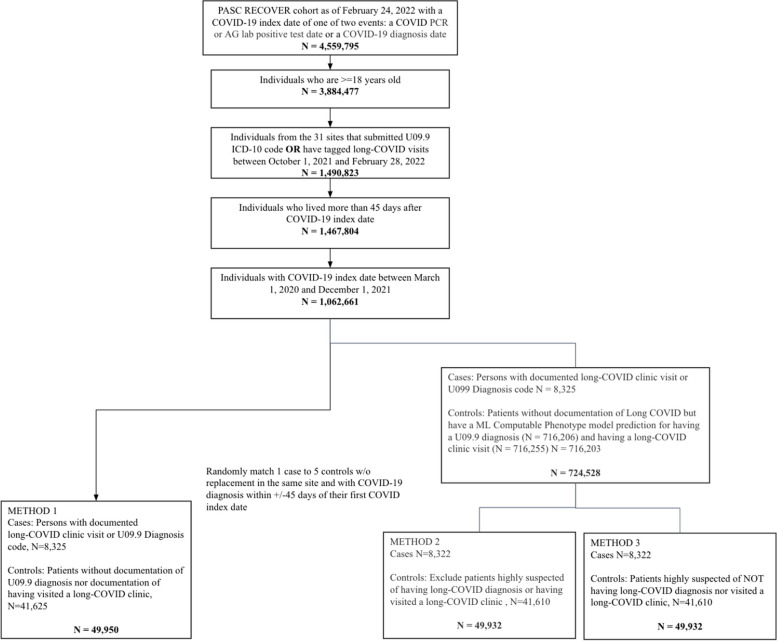
This was a retrospective case-control study including 31 health systems in the United States from the National COVID Cohort Collaborative (N3C). 8,325 individuals with PASC (defined by the presence of the International Classification of Diseases, version 10 code U09.9 or a long-COVID clinic visit) matched to 41,625 controls within the same health system and COVID index date within ± 45 days of the corresponding case's earliest COVID index date. Measurements of risk factors included demographics, comorbidities, treatment and acute characteristics related to COVID-19. Multivariable logistic regression, random forest, and XGBoost were used to determine the associations between risk factors and PASC.
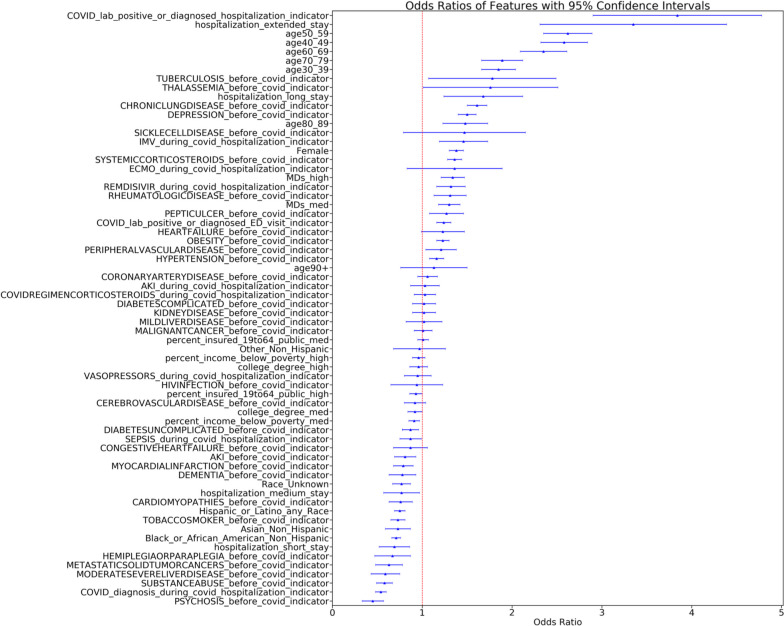
Among 8,325 individuals with PASC, the majority were > 50 years of age (56.6%), female (62.8%), and non-Hispanic White (68.6%). In logistic regression, middle-age categories (40 to 69 years; OR ranging from 2.32 to 2.58), female sex (OR 1.4, 95% CI 1.33-1.48), hospitalization associated with COVID-19 (OR 3.8, 95% CI 3.05-4.73), long (8-30 days, OR 1.69, 95% CI 1.31-2.17) or extended hospital stay (30 + days, OR 3.38, 95% CI 2.45-4.67), receipt of mechanical ventilation (OR 1.44, 95% CI 1.18-1.74), and several comorbidities including depression (OR 1.50, 95% CI 1.40-1.60), chronic lung disease (OR 1.63, 95% CI 1.53-1.74), and obesity (OR 1.23, 95% CI 1.16-1.3) were associated with increased likelihood of PASC diagnosis or care at a long-COVID clinic. Characteristics associated with a lower likelihood of PASC diagnosis or care at a long-COVID clinic included younger age (18 to 29 years), male sex, non-Hispanic Black race, and comorbidities such as substance abuse, cardiomyopathy, psychosis, and dementia. More doctors per capita in the county of residence was associated with an increased likelihood of PASC diagnosis or care at a long-COVID clinic. Our findings were consistent in sensitivity analyses using a variety of analytic techniques and approaches to select controls.
This national study identified important risk factors for PASC diagnosis such as middle age, severe COVID-19 disease, and specific comorbidities. Further clinical and epidemiological research is needed to better understand underlying mechanisms and the potential role of vaccines and therapeutics in altering PASC course.
超过三分之一的个体经历了 SARS-CoV-2 感染的急性后遗症(PASC,包括长新冠)。本研究旨在确定与 PASC/长新冠诊断相关的风险因素。
这是一项在美国全国 COVID 队列协作(N3C)的 31 个医疗系统中进行的回顾性病例对照研究。31 个医疗系统共纳入 8325 名 PASC 患者(通过存在国际疾病分类第 10 版 U09.9 编码或长新冠诊所就诊来定义),并与同一医疗系统和 COVID 索引日期内 COVID 索引日期±45 天内的 41625 名对照相匹配。风险因素的测量包括与 COVID-19 相关的人口统计学、合并症、治疗和急性特征。多变量逻辑回归、随机森林和 XGBoost 用于确定风险因素与 PASC 之间的关联。
在 8325 名 PASC 患者中,大多数患者年龄大于 50 岁(56.6%)、女性(62.8%)和非西班牙裔白人(68.6%)。在逻辑回归中,中年组(40-69 岁;比值比范围为 2.32-2.58)、女性(比值比 1.4,95%置信区间 1.33-1.48)、与 COVID-19 相关的住院治疗(比值比 3.8,95%置信区间 3.05-4.73)、较长(8-30 天,比值比 1.69,95%置信区间 1.31-2.17)或延长住院时间(30 天+,比值比 3.38,95%置信区间 2.45-4.67)、接受机械通气(比值比 1.44,95%置信区间 1.18-1.74)和几种合并症,包括抑郁症(比值比 1.50,95%置信区间 1.40-1.60)、慢性肺病(比值比 1.63,95%置信区间 1.53-1.74)和肥胖(比值比 1.23,95%置信区间 1.16-1.3)与 PASC 诊断或长新冠诊所就诊的可能性增加相关。与 PASC 诊断或长新冠诊所就诊可能性降低相关的特征包括年龄较小(18-29 岁)、男性、非西班牙裔黑人种族以及合并症,如药物滥用、心肌病、精神病和痴呆。居住县每千人的医生人数增加与 PASC 诊断或长新冠诊所就诊的可能性增加相关。我们的研究结果在使用各种分析技术和方法选择对照的敏感性分析中是一致的。
这项全国性研究确定了 PASC 诊断的重要风险因素,如中年、严重的 COVID-19 疾病和特定的合并症。需要进一步的临床和流行病学研究,以更好地了解潜在机制以及疫苗和治疗方法在改变 PASC 病程中的作用。