Feinstein Institutes for Medical Research, Northwell Health, Manhasset, NY, United States.
See Acknowledgments, .
J Med Internet Res. 2021 Feb 10;23(2):e24246. doi: 10.2196/24246.
Predicting early respiratory failure due to COVID-19 can help triage patients to higher levels of care, allocate scarce resources, and reduce morbidity and mortality by appropriately monitoring and treating the patients at greatest risk for deterioration. Given the complexity of COVID-19, machine learning approaches may support clinical decision making for patients with this disease.
Our objective is to derive a machine learning model that predicts respiratory failure within 48 hours of admission based on data from the emergency department.
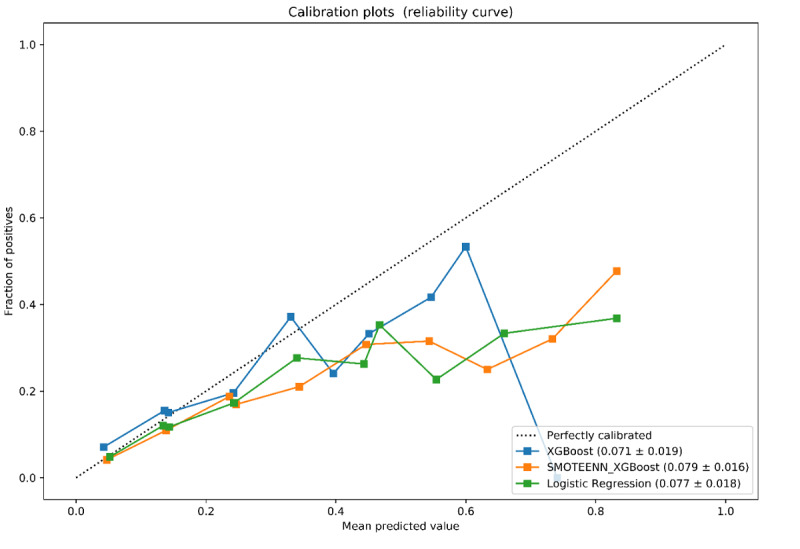
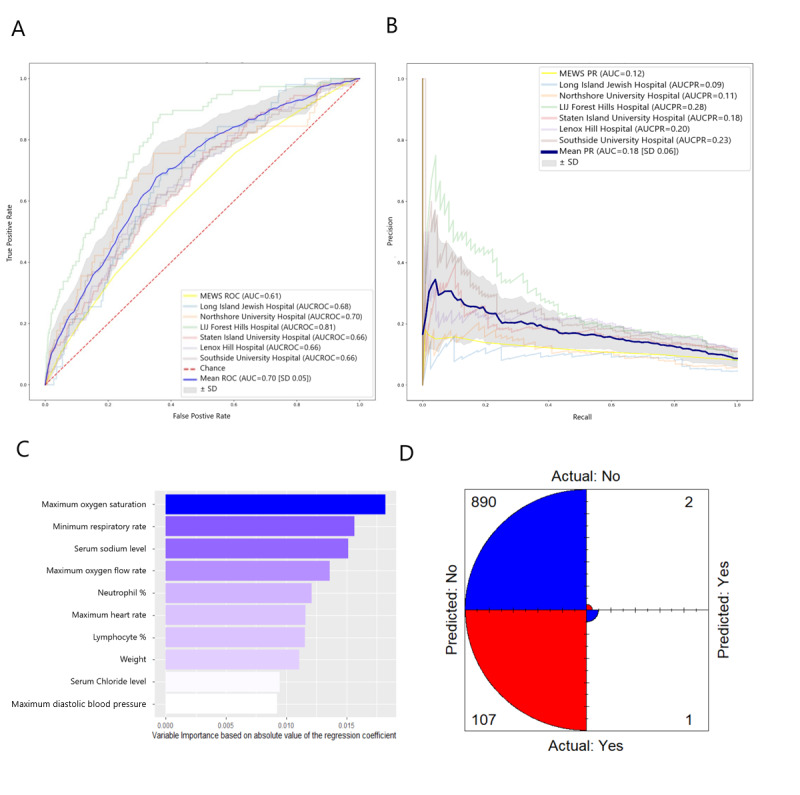
Data were collected from patients with COVID-19 who were admitted to Northwell Health acute care hospitals and were discharged, died, or spent a minimum of 48 hours in the hospital between March 1 and May 11, 2020. Of 11,525 patients, 933 (8.1%) were placed on invasive mechanical ventilation within 48 hours of admission. Variables used by the models included clinical and laboratory data commonly collected in the emergency department. We trained and validated three predictive models (two based on XGBoost and one that used logistic regression) using cross-hospital validation. We compared model performance among all three models as well as an established early warning score (Modified Early Warning Score) using receiver operating characteristic curves, precision-recall curves, and other metrics.
The XGBoost model had the highest mean accuracy (0.919; area under the curve=0.77), outperforming the other two models as well as the Modified Early Warning Score. Important predictor variables included the type of oxygen delivery used in the emergency department, patient age, Emergency Severity Index level, respiratory rate, serum lactate, and demographic characteristics.
The XGBoost model had high predictive accuracy, outperforming other early warning scores. The clinical plausibility and predictive ability of XGBoost suggest that the model could be used to predict 48-hour respiratory failure in admitted patients with COVID-19.
预测 COVID-19 导致的早期呼吸衰竭有助于对患者进行分诊,将有限的资源分配给病情较重的患者,并通过对最有可能恶化的患者进行适当监测和治疗,降低发病率和死亡率。鉴于 COVID-19 的复杂性,机器学习方法可能会为患有该病的患者提供临床决策支持。
我们旨在根据急诊科的数据建立一种预测患者入院后 48 小时内呼吸衰竭的机器学习模型。
数据采集自 2020 年 3 月 1 日至 5 月 11 日期间,在诺斯韦尔健康(Northwell Health)急性护理医院住院且出院、死亡或至少住院 48 小时的 COVID-19 患者。在 11525 例患者中,有 933 例(8.1%)在入院后 48 小时内接受了有创机械通气。模型中使用的变量包括急诊科通常收集的临床和实验室数据。我们使用跨医院验证方法训练和验证了三种预测模型(两种基于 XGBoost,一种使用逻辑回归)。我们通过接受者操作特征曲线、精度-召回曲线和其他指标比较了所有三种模型以及一种既定的早期预警评分(改良早期预警评分)的模型性能。
XGBoost 模型的平均准确率最高(0.919;曲线下面积=0.77),优于其他两种模型和改良早期预警评分。重要的预测变量包括急诊科使用的氧气输送类型、患者年龄、紧急严重程度指数水平、呼吸频率、血清乳酸和人口统计学特征。
XGBoost 模型具有较高的预测准确率,优于其他早期预警评分。XGBoost 的临床合理性和预测能力表明,该模型可用于预测入院的 COVID-19 患者在 48 小时内的呼吸衰竭。