Digital Health, Faculty of Engineering, School of Computer Science, Electrical and Electronic Engineering, University of Bristol, Amberly Brigden, 1 Cathedral Square, Bristol, BS1 5DD, UK.
Faculty of Health Sciences, Centre for Child and Adolescent Health, University of Bristol, Bristol, BS8 2PS, UK.
Qual Life Res. 2024 Feb;33(2):443-452. doi: 10.1007/s11136-023-03535-6. Epub 2023 Oct 27.
To explore the views of clinicians and researchers about the challenges of measuring health-related quality of life (HRQoL) in children (5-11 years) and to explore whether digital ecological momentary assessment (EMA) could enhance HRQoL measurement.
Semi-structured qualitative interviews with 18 professionals (10 academics/researchers, four clinicians, four with both professional backgrounds) experienced in child HRQoL measurement. We analysed data thematically.
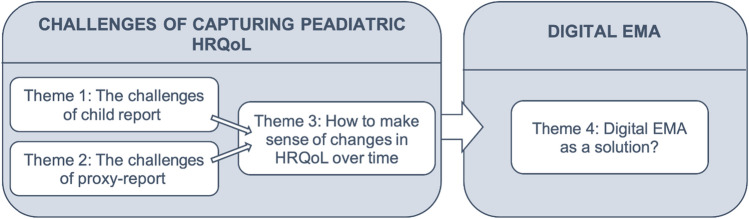
Theme One describes the uncertainty around conceptualising HRQoL for children and which domains to include; the greater immediacy and sensitivity of children's reflections on their HRQoL, leading to high variability of the construct; and the wide individual differences across childhood, incongruent with fixed HRQoL measures. Theme Two describes the challenges of proxy reporting, questioning whether proxies can meaningfully report a child's HRQoL and reflecting on discrepancies between child and proxy reporting. Theme Three covers the challenge of interpreting change in HRQoL over time; does a change in HRQoL reflect a change in health, or does this reflect developmental changes in how children report HRQoL. Theme Four discusses digital EMA for HRQoL data capture. In-the-moment, repeated measurement could provide rich data and address challenges of recall, ecological validity and variability; passive data could provide objective markers to supplement subjective responses; and technology could enable personalisation and child-centred design. However, participants also raised methodological, practical and ethical challenges of digital approaches.
Digital EMA may address some of the challenges of HRQoL data collection with children. We conclude by discussing potential future research to explore and develop this approach.
探讨临床医生和研究人员对儿童(5-11 岁)健康相关生活质量(HRQoL)测量挑战的看法,并探讨数字生态瞬时评估(EMA)是否可以增强 HRQoL 测量。
对 18 名专业人员(10 名学者/研究人员、4 名临床医生、4 名具有专业背景的人员)进行半结构化定性访谈,这些专业人员在儿童 HRQoL 测量方面经验丰富。我们对数据进行了主题分析。
主题一描述了对儿童 HRQoL 概念化以及包含哪些领域的不确定性;儿童对其 HRQoL 的即时反应和敏感性更高,导致该结构的变异性更大;儿童在整个童年时期的个体差异很大,与固定的 HRQoL 测量不一致。主题二描述了代理报告的挑战,质疑代理是否可以有意义地报告儿童的 HRQoL,并反思儿童和代理报告之间的差异。主题三涵盖了随时间变化解释 HRQoL 变化的挑战;HRQoL 的变化是否反映了健康的变化,或者这是否反映了儿童报告 HRQoL 的方式的发展变化。主题四讨论了用于 HRQoL 数据采集的数字 EMA。实时、重复测量可以提供丰富的数据,并解决回忆、生态有效性和变异性的挑战;被动数据可以提供客观标记来补充主观反应;并且技术可以实现个性化和以儿童为中心的设计。然而,参与者还提出了数字方法的方法学、实际和伦理挑战。
数字 EMA 可能会解决儿童 HRQoL 数据收集的一些挑战。我们最后讨论了探索和开发这种方法的潜在未来研究。