School of Medicine, Hirosaki University, Hirosaki 036-8562, Japan.
Department of Social Medicine, Graduate School of Medicine, Hirosaki University, Hirosaki 036-8562, Japan.
Nutrients. 2023 Oct 16;15(20):4373. doi: 10.3390/nu15204373.
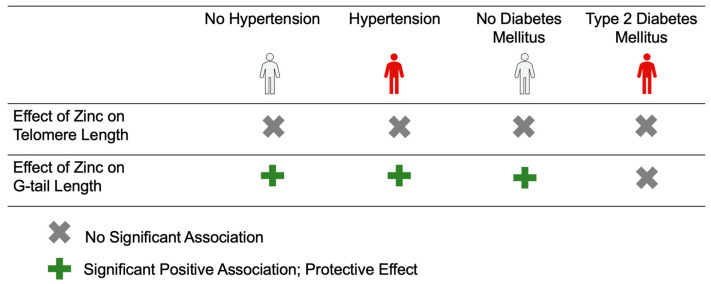
Telomeres, repeated TTAGGG sequences at chromosomal ends, shorten with age and indicate cellular lifespan. Zinc can protect against telomere damage through its anti-oxidative effect. Meanwhile, telomere shortening was correlated with metabolic diseases of hypertension and type 2 diabetes. The objective of this study was to investigate whether the association between zinc and telomere length differs by the presence or absence of hypertension/type 2 diabetes. This is a cross-sectional study with 1064 participants of the Iwaki area, Japan. Multiple linear regression models were performed to test the hypothesis. A higher serum zinc concentration was significantly associated with a longer G-tail length (β = 48.11, 95% confidence intervals [CI]: 25.69, 70.54, < 0.001). By multivariate linear regression analysis, there was a significant positive association between zinc and G-tail length in both hypertensive (β = 46.84, 95%CI: 9.69, 84.0, = 0.014) and non-hypertensive groups (β = 49.47, 95%CI: 20.75, 78.18, = 0.001), while the association was significant only in the non-diabetes group (β = 50.82, 95%CI: 27.54, 74.11, < 0.001). In conclusion, higher zinc concentration was significantly associated with longer G-tail length. The protective effect of zinc on G-tail did not differ by hypertension status; however, it disappeared in individuals with type 2 diabetes.
端粒是染色体末端重复的 TTAGGG 序列,随着年龄的增长而缩短,表明细胞寿命。锌可以通过其抗氧化作用来保护端粒免受损伤。同时,端粒缩短与高血压和 2 型糖尿病等代谢性疾病有关。本研究旨在探讨锌与端粒长度之间的关联是否因高血压/2 型糖尿病的存在与否而不同。这是一项在日本岩木地区的 1064 名参与者中进行的横断面研究。采用多元线性回归模型检验假设。血清锌浓度较高与 G 尾长度较长显著相关(β=48.11,95%置信区间[CI]:25.69,70.54,<0.001)。通过多元线性回归分析,在高血压组(β=46.84,95%CI:9.69,84.0,=0.014)和非高血压组(β=49.47,95%CI:20.75,78.18,=0.001)中,锌与 G 尾长度之间均存在显著正相关,而在非糖尿病组中,这种相关性更为显著(β=50.82,95%CI:27.54,74.11,<0.001)。综上所述,较高的锌浓度与较长的 G 尾长度显著相关。锌对 G 尾的保护作用与高血压状态无关,但在 2 型糖尿病患者中则消失。