College of Natural and Computational Sciences, Center for Food Science and Nutrition, Addis Ababa University, Addis Ababa, Ethiopia.
Department of Food Science and Applied Nutrition, Addis Ababa Science and Technology University, P O, Box 16417, Addis Ababa, Ethiopia.
Br J Nutr. 2023 Nov 14;130(9):1573-1579. doi: 10.1017/S0007114523000508. Epub 2023 Mar 6.
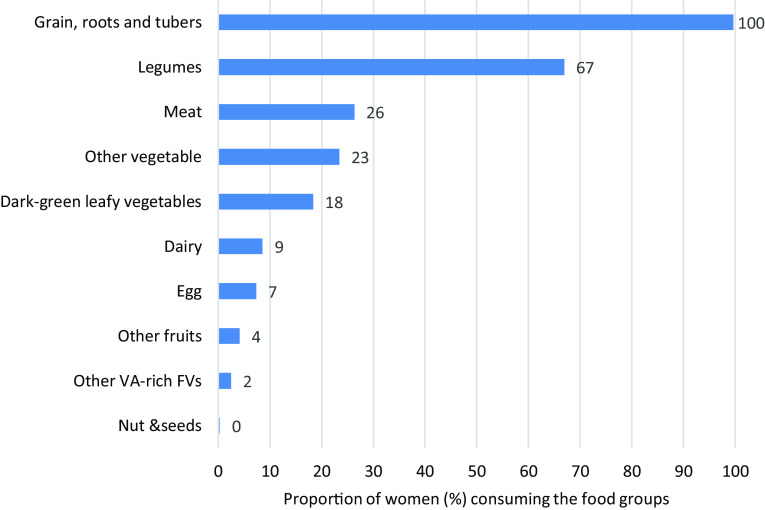
Improving diet quality is recognised as a double-duty action that can simultaneously address multiple forms of malnutrition. This study aimed to assess diet quality among non-pregnant non-lactating women of reproductive age (WRA) in Addis Ababa, Ethiopia. A 1-d quantitative 24 h recall was conducted among 653 non-pregnant/non-lactating women. Diet quality, assessed using the women dietary diversity score (WDDS), the Global Diet Quality Score (GDQS) and the Nova 4 classification reflecting consumption of ultra-processed foods (UPF), was compared. The proportion that meets the minimum dietary diversity for women (MDD-W) was estimated. The average MDD-W score was 2·6 (sd 0·9), with only 3 % of women meeting the MDD-W (≥ 5 food groups). Consumption of wholegrain and legumes was high, but UPF were also consumed by 9 % of the women. GDQS was positively associated with WDDS, age and skipping breakfast and was negatively associated with eating out of home and UPF consumption ( < 0·05). The multivariate regression model showed that GDQS (total) was not associated with wealth but was significantly associated with both UPF and WDDS ( < 0·001). Unlike UPF and WDDS alone, GDQS was able to predict both nutrient adequacy and unhealthy dietary practices. The diet quality of WRA in Addis Ababa is low in diversity, possibly exposing them to higher risk of nutrient inadequacy and non-communicable diseases as reflected by the low GDQS. Understanding what drives food and dietary choices in urban settings is urgently needed.
改善饮食质量被认为是一种双重行动,既能同时解决多种形式的营养不良问题。本研究旨在评估埃塞俄比亚亚的斯亚贝巴的育龄期(WRA)非妊娠非哺乳期妇女的饮食质量。对 653 名非妊娠/非哺乳期妇女进行了 1 天的定量 24 小时回顾性研究。使用女性饮食多样性评分(WDDS)、全球饮食质量评分(GDQS)和反映超加工食品(UPF)消费的 Nova 4 分类来评估饮食质量。估计了符合女性最低饮食多样性要求(MDD-W)的比例。平均 MDD-W 评分为 2.6(标准差 0.9),只有 3%的女性符合 MDD-W(≥5 种食物组)。全谷物和豆类的消费较高,但也有 9%的妇女消费 UPF。GDQS 与 WDDS、年龄和不吃早餐呈正相关,与外出就餐和 UPF 消费呈负相关(<0.05)。多变量回归模型显示,GDQS(总和)与财富无关,但与 UPF 和 WDDS 显著相关(<0.001)。与 UPF 和 WDDS 不同,GDQS 能够预测营养充足和不健康的饮食行为。亚的斯亚贝巴的 WRA 饮食质量多样性低,这可能使她们面临更高的营养不足和非传染性疾病风险,这反映在低 GDQS 上。迫切需要了解是什么驱动了城市环境中的食物和饮食选择。