Department of Physics, Umeå University, 901 87, Umeå, Sweden.
Integrated Science Lab, Department of Physics, Umeå University, Umeå, Sweden.
Sci Rep. 2023 Oct 31;13(1):18758. doi: 10.1038/s41598-023-44212-5.
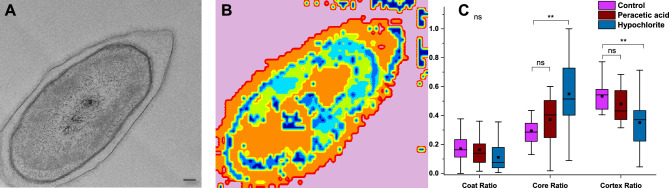
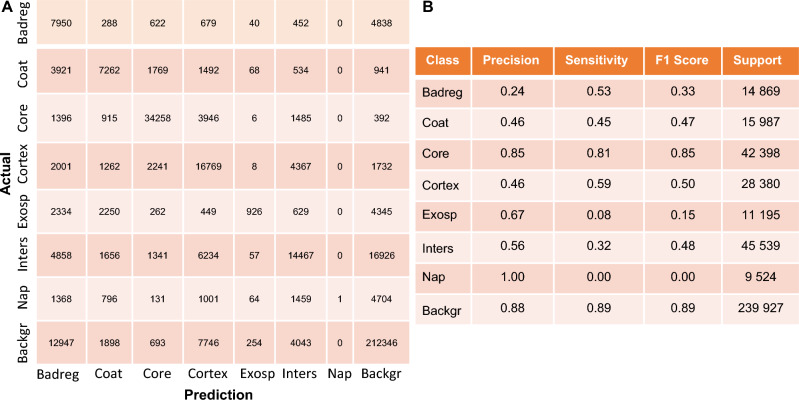
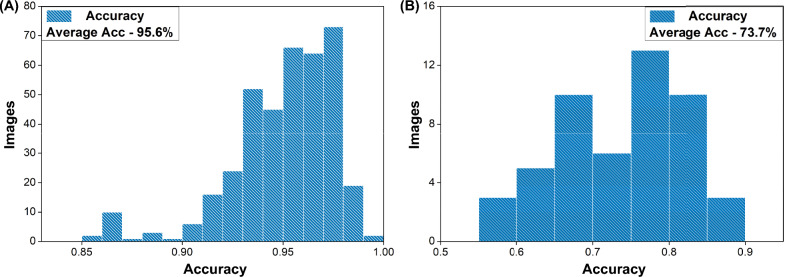
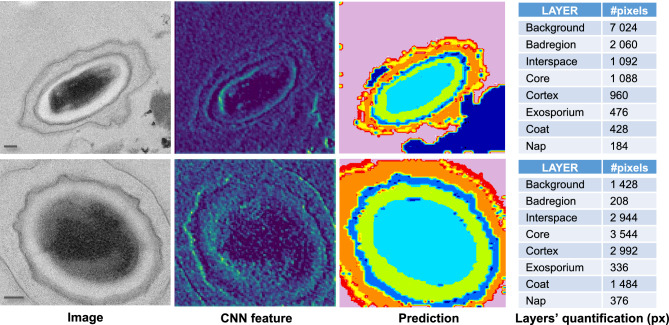
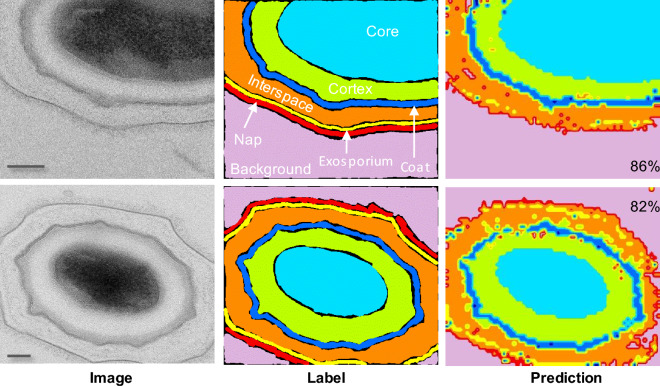
We present a new approach to segment and classify bacterial spore layers from Transmission Electron Microscopy (TEM) images using a hybrid Convolutional Neural Network (CNN) and Random Forest (RF) classifier algorithm. This approach utilizes deep learning, with the CNN extracting features from images, and the RF classifier using those features for classification. The proposed model achieved 73% accuracy, 64% precision, 46% sensitivity, and 47% F1-score with test data. Compared to other classifiers such as AdaBoost, XGBoost, and SVM, our proposed model demonstrates greater robustness and higher generalization ability for non-linear segmentation. Our model is also able to identify spores with a damaged core as verified using TEMs of chemically exposed spores. Therefore, the proposed method will be valuable for identifying and characterizing spore features in TEM images, reducing labor-intensive work as well as human bias.
我们提出了一种新的方法,使用混合卷积神经网络 (CNN) 和随机森林 (RF) 分类器算法,从透射电子显微镜 (TEM) 图像中分割和分类细菌孢子层。该方法利用深度学习,CNN 从图像中提取特征,RF 分类器使用这些特征进行分类。所提出的模型在测试数据上达到了 73%的准确率、64%的精度、46%的灵敏度和 47%的 F1 分数。与其他分类器(如 AdaBoost、XGBoost 和 SVM)相比,我们提出的模型对于非线性分割表现出更强的稳健性和更高的泛化能力。我们的模型还能够识别核心受损的孢子,这已通过对化学暴露孢子的 TEM 验证。因此,该方法对于在 TEM 图像中识别和描述孢子特征非常有价值,可以减少劳动密集型工作和人为偏见。