Department of Chemistry and Biochemistry, Florida State University, Tallahassee, FL, 32306, USA.
National High Magnetic Field Laboratory, Tallahassee, FL, 32310, USA.
Commun Biol. 2023 Nov 1;6(1):1109. doi: 10.1038/s42003-023-05490-x.
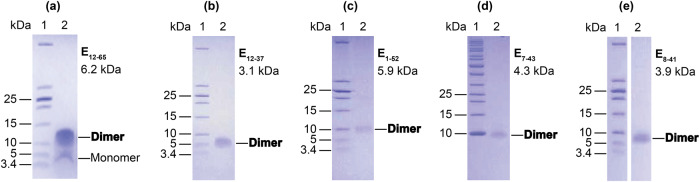
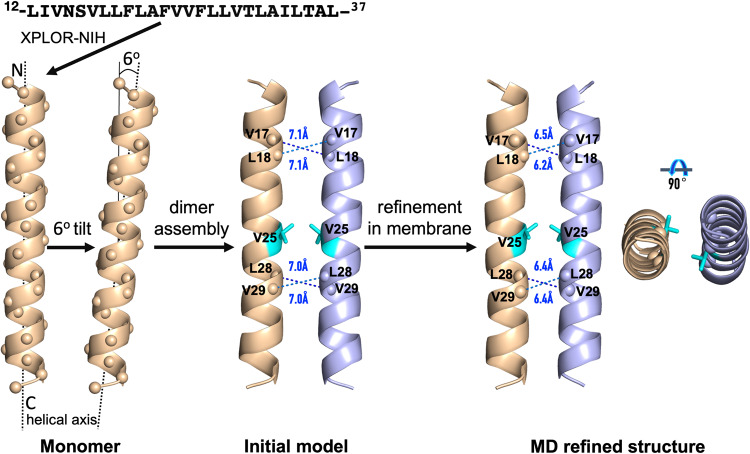
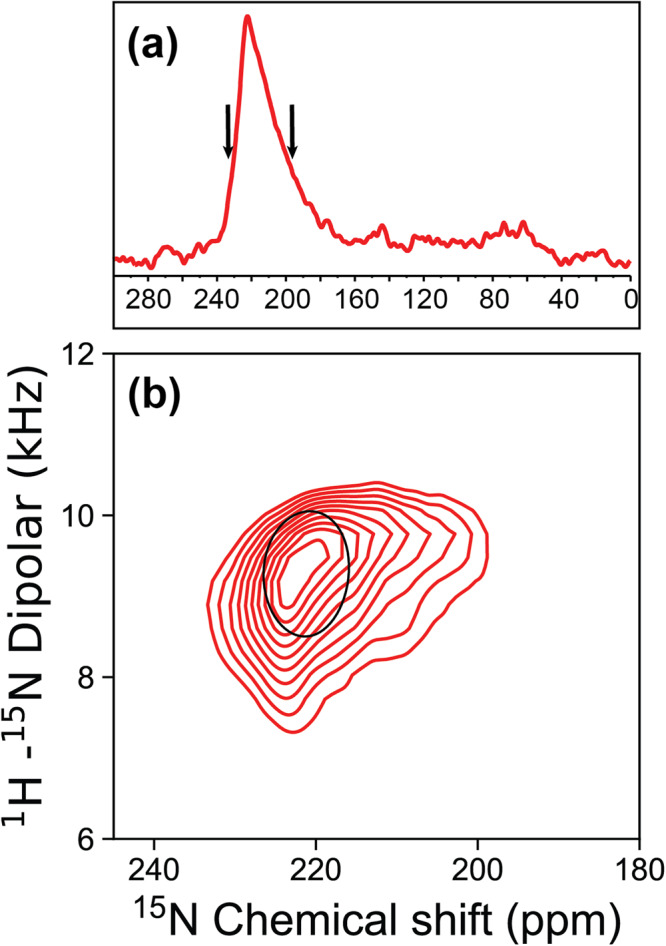
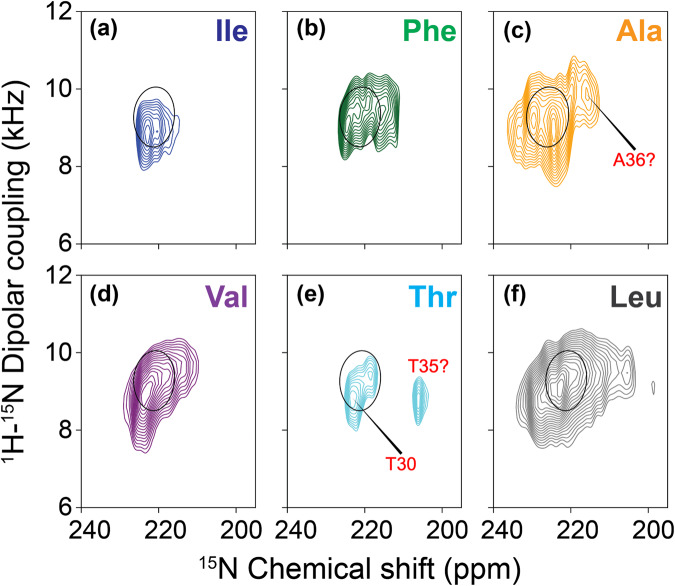
The SARS-CoV-2 E protein is a transmembrane (TM) protein with its N-terminus exposed on the external surface of the virus. At debate is its oligomeric state, let alone its function. Here, the TM structure of the E protein is characterized by oriented sample and magic angle spinning solid-state NMR in lipid bilayers and refined by molecular dynamics simulations. This protein was previously found to be a pentamer, with a hydrophobic pore that appears to function as an ion channel. We identify only a front-to-front, symmetric helix-helix interface, leading to a dimeric structure that does not support channel activity. The two helices have a tilt angle of only 6°, resulting in an extended interface dominated by Leu and Val sidechains. While residues Val14-Thr35 are almost all buried in the hydrophobic region of the membrane, Asn15 lines a water-filled pocket that potentially serves as a drug-binding site. The E and other viral proteins may adopt different oligomeric states to help perform multiple functions.
SARS-CoV-2 的 E 蛋白是一种跨膜(TM)蛋白,其 N 端暴露在病毒的外表面。目前仍存在争议的是其寡聚状态,更不用说其功能了。在这里,E 蛋白的 TM 结构通过定向样品和魔角旋转固态 NMR 在脂质双层中进行了表征,并通过分子动力学模拟进行了细化。该蛋白之前被发现是一个五聚体,具有一个似乎作为离子通道的疏水性孔。我们只鉴定出一种前对前、对称的螺旋-螺旋界面,导致二聚体结构不支持通道活性。两个螺旋的倾斜角度只有 6°,导致由亮氨酸和缬氨酸侧链主导的扩展界面。虽然残基 Val14-Thr35 几乎全部埋藏在膜的疏水区,但 Asn15 排列在一个充满水的口袋中,该口袋可能作为药物结合位点。E 蛋白和其他病毒蛋白可能采用不同的寡聚状态来帮助执行多种功能。