Chi Young-In, Jorge Salomão D, Jensen Davin R, Smith Brian C, Volkman Brian F, Mathison Angela J, Lomberk Gwen, Zimmermann Michael T, Urrutia Raul
Linda T. and John A. Mellowes Center for Genomic Sciences and Precision Medicine, Medical College of Wisconsin, Milwaukee, WI, USA.
Division of Research, Department of Surgery, Medical College of Wisconsin, Milwaukee, WI, USA.
Comput Struct Biotechnol J. 2023 Oct 13;21:5249-5258. doi: 10.1016/j.csbj.2023.10.022. eCollection 2023.
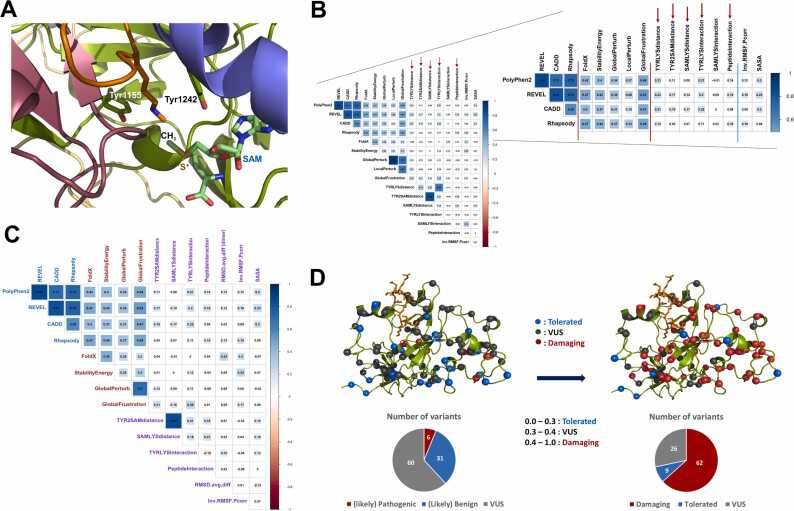
This study investigates the functional significance of assorted variants of uncertain significance (VUS) in euchromatic histone lysine methyltransferase 1 (EHMT1), which is critical for early development and normal physiology. EHMT1 mutations cause Kleefstra syndrome and are linked to various human cancers. However, accurate functional interpretations of these variants are yet to be made, limiting diagnoses and future research. To overcome this, we integrate conventional tools for variant calling with computational biophysics and biochemistry to conduct multi-layered mechanistic analyses of the SET catalytic domain of EHMT1, which is critical for this protein function. We use molecular mechanics and molecular dynamics (MD)-based metrics to analyze the SET domain structure and functional motions resulting from 97 Kleefstra syndrome missense variants within the domain. Our approach allows us to classify the variants in a mechanistic manner into SV (Structural Variant), DV (Dynamic Variant), SDV (Structural and Dynamic Variant), and VUS (Variant of Uncertain Significance). Our findings reveal that the damaging variants are mostly mapped around the active site, substrate binding site, and pre-SET regions. Overall, we report an improvement for this method over conventional tools for variant interpretation and simultaneously provide a molecular mechanism for variant dysfunction.
本研究调查了常染色质组蛋白赖氨酸甲基转移酶1(EHMT1)中各种意义未明变异体(VUS)的功能意义,EHMT1对早期发育和正常生理功能至关重要。EHMT1突变会导致克莱夫斯特拉综合征,并与多种人类癌症相关。然而,这些变异体的准确功能解释尚未得出,这限制了诊断和未来的研究。为了克服这一问题,我们将传统的变异体检测工具与计算生物物理学和生物化学相结合,对EHMT1的SET催化结构域进行多层次的机制分析,该结构域对该蛋白功能至关重要。我们使用基于分子力学和分子动力学(MD)的指标来分析该结构域内97个克莱夫斯特拉综合征错义变异体导致的SET结构域结构和功能运动。我们的方法使我们能够以机制方式将这些变异体分类为结构变异体(SV)、动态变异体(DV)、结构和动态变异体(SDV)以及意义未明变异体(VUS)。我们的研究结果表明,有害变异体大多位于活性位点、底物结合位点和SET前区域周围。总体而言,我们报告了该方法相对于传统变异体解释工具的改进,同时提供了变异体功能障碍的分子机制。