Choi Young-Jin, Lee Kyung-Suk, Jeong Jin Hyeok, Kim Kyunghoon, Yang Seung, Na Jae Yoon, Hwang Jae Kyoon, Choe Yunsoo, Kim Kyu Rang, Han Mae-Ja, Lee Yung-Seop, Oh Jae-Won
Department of Pediatrics, College of Medicine, Hanyang University, Seoul, Korea.
Department of Pediatrics, Hanyang University Guri Hospital, Guri, Korea.
Allergy Asthma Immunol Res. 2023 Nov;15(6):825-836. doi: 10.4168/aair.2023.15.6.825.
Atmospheric fungi are associated with respiratory allergies in humans, and some fungal spores can cause allergic diseases. Environmental and biological factors influence the concentrations of atmospheric spores. In this study, we evaluated the climate change-induced annual variations in fungal spore concentrations and allergic sensitization rates in the Seoul Metropolitan Area over a period of 25 years.
Fungal spores and pollen were obtained from Hanyang University Seoul and Guri Hospitals; they were identified and counted for 25 years (1998-2022). The study participants included patients who underwent tests for allergic diseases in both hospitals. Their allergenic sensitization rates were determined via allergic skin prick and serum tests, after which their sensitization rates to allergenic fungi and pollens were calculated. The daily climatic variables were obtained from the Korea Meteorological Administration.
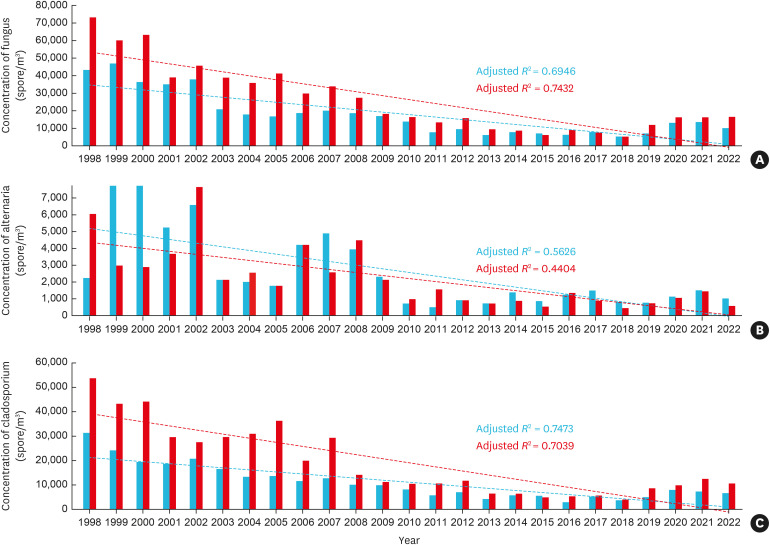
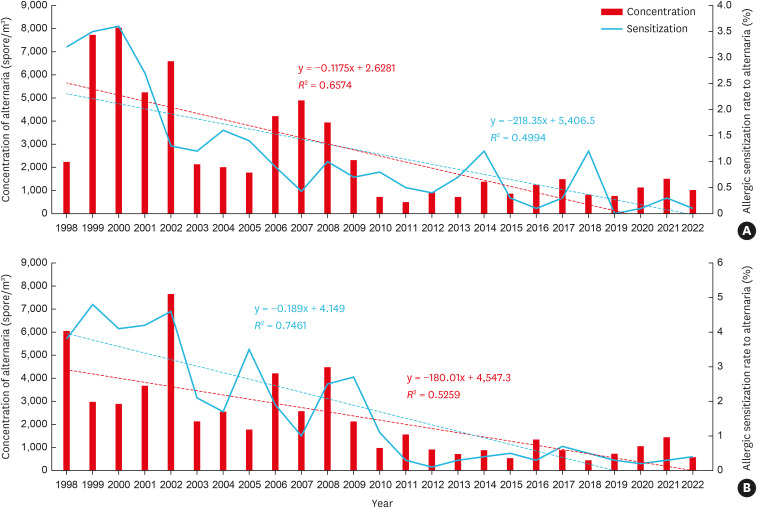
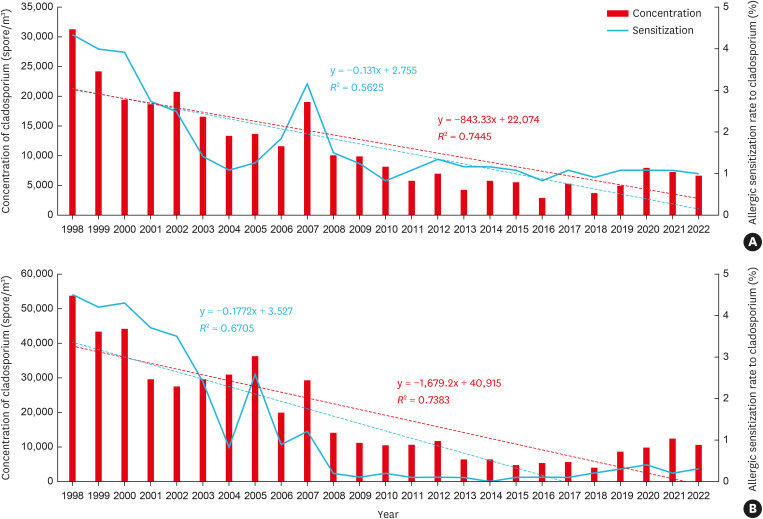
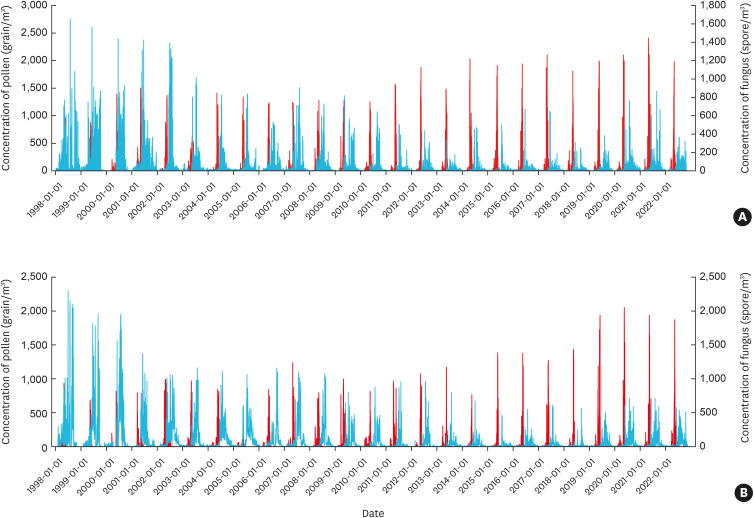
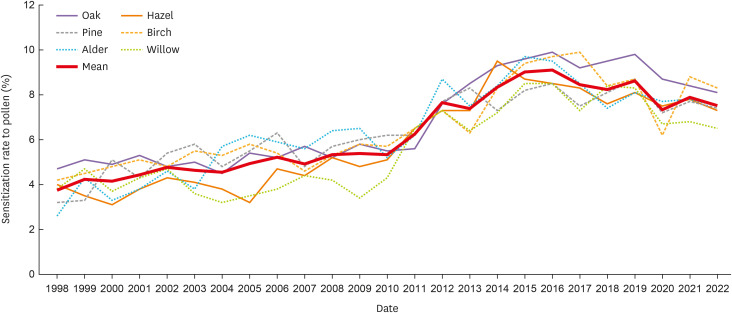
The total annual atmospheric fungal concentrations decreased in both areas during the period. Simultaneously, we recruited 21,394 patients with allergies (asthma, 1,550; allergic rhinitis, 5,983; and atopic dermatitis, 5,422) from Seoul and Guri Hospitals for allergenic fungal sensitization evaluations over the period. The allergenic fungal sensitization rates decreased annually in both areas over that time `+( [3.5%] and [4.4%] in 1998; [0.2%] and [0.2%] in 2022). In contrast, the annual pollen concentrations increased with the sensitization rates to pollen in children.
The atmospheric fungal concentrations decreased annually, with allergic sensitization rate decreasing over the period of 25 years. Allergenic fungal sporulation could decrease with climate changes, such as desertification and drought. Extended monitoring periods and further large-scale studies are required to confirm the causality and to evaluate the impact of climate change.
大气真菌与人类呼吸道过敏有关,一些真菌孢子可引发过敏性疾病。环境和生物因素会影响大气孢子的浓度。在本研究中,我们评估了25年间气候变化导致的首尔大都市区真菌孢子浓度和过敏致敏率的年度变化。
从汉阳大学首尔医院和九里医院获取真菌孢子和花粉;对其进行了25年(1998 - 2022年)的鉴定和计数。研究参与者包括在两家医院接受过敏性疾病检测的患者。通过过敏性皮肤点刺试验和血清检测确定他们的致敏率,之后计算他们对致敏真菌和花粉的致敏率。每日气候变量数据来自韩国气象厅。
在此期间,两个地区的年度大气真菌总浓度均下降。同时,我们在这段时间从首尔和九里医院招募了21394名过敏患者(哮喘患者1550名、过敏性鼻炎患者5983名、特应性皮炎患者5422名)进行致敏真菌致敏评估。在此期间,两个地区的致敏真菌致敏率均逐年下降(1998年分别为[3.5%]和[4.4%];2022年分别为[0.2%]和[0.2%])。相比之下,年度花粉浓度随儿童对花粉的致敏率上升而增加。
大气真菌浓度逐年下降,过敏致敏率在25年期间也有所下降。随着沙漠化和干旱等气候变化,致敏真菌的孢子形成可能会减少。需要延长监测期并开展进一步的大规模研究来证实因果关系并评估气候变化的影响。