Ettman Catherine K, Galea Sandro
Department of Health Policy and Management, Johns Hopkins Bloomberg School of Public Health, Baltimore, MD, United States.
Office of the Dean, Boston University School of Public Health, Boston, MA, United States.
JMIR Ment Health. 2023 Nov 16;10:e49936. doi: 10.2196/49936.
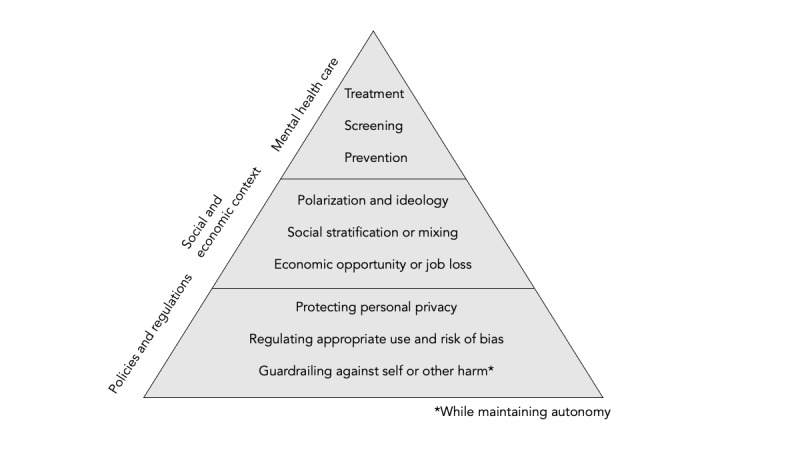
The integration of artificial intelligence (AI) into everyday life has galvanized a global conversation on the possibilities and perils of AI on human health. In particular, there is a growing need to anticipate and address the potential impact of widely accessible, enhanced, and conversational AI on mental health. We propose 3 considerations to frame how AI may influence population mental health: through the advancement of mental health care; by altering social and economic contexts; and through the policies that shape the adoption, use, and potential abuse of AI-enhanced tools.
人工智能(AI)融入日常生活引发了一场全球范围内关于AI对人类健康的可能性与风险的讨论。特别是,越来越有必要预测并应对广泛可用、功能增强且具备对话能力的AI对心理健康的潜在影响。我们提出三点思考,以构建AI可能影响人群心理健康的框架:通过推进精神卫生保健;通过改变社会和经济环境;以及通过塑造AI增强工具的采用、使用和潜在滥用情况的政策。