Lancet Glob Health. 2023 Dec;11(12):e1931-e1942. doi: 10.1016/S2214-109X(23)00432-1.
Bangladesh has made substantial progress in improving socioeconomic and health indicators over the past 50 years, but data on national disease burden are scarce. We used data from the Global Burden of Diseases, Injuries, and Risk Factors Study (GBD) 2019 to estimate the burden of diseases and risk factors in Bangladesh from 1990 to 2019.
For this systematic analysis, we analysed data from vital registration systems, surveys, and censuses using multistage modelling processes to estimate life expectancy at birth, mortality rate, years of life lost (YLLs), years lived with disability (YLDs), and disability-adjusted life-years (DALYs). Additionally, we compared the health status of Bangladesh with that of the other countries in the GBD south Asia region-Bhutan, India, Nepal, and Pakistan.
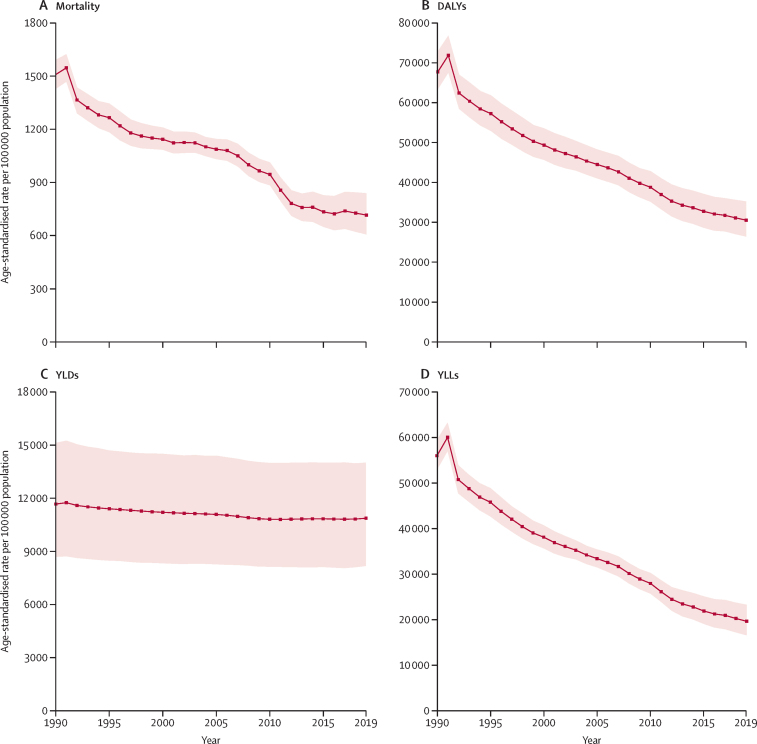
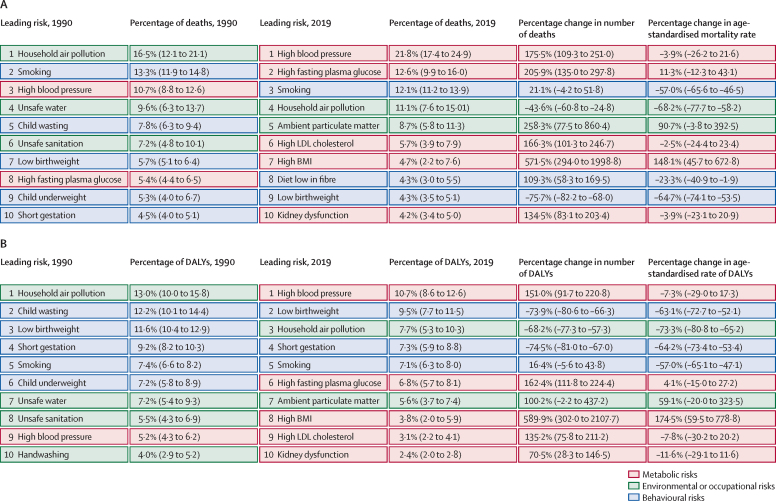
Life expectancy at birth in Bangladesh increased from 58·2 years (95% uncertainty interval 57·1-59·2) in 1990 to 74·6 years (72·4-76·7) in 2019. Between 1990 and 2019, the age-standardised mortality rate decreased from 1509·3 (1428·6-1592·1) to 714·4 (604·9-838·2) deaths per 100 000 population. In 2019, non-communicable diseases represented 14 of the top 20 causes of death; the leading three causes were stroke, ischaemic heart disease, and chronic obstructive pulmonary disease. High blood pressure, high fasting plasma glucose, and smoking were the top three risk factors. From 1990 to 2019, the rate of all-cause DALYs decreased by 54·9% (48·8-60·4). In 2019, the leading causes of DALYs and YLLs were neonatal disorders, stroke, and ischaemic heart disease, whereas musculoskeletal disorders, depressive disorders, and low back pain were the leading causes of YLDs. Bangladesh has the lowest age-standardised rates of mortality, YLDs, and YLLs and the highest life expectancy at birth in south Asia.
Over the past 30 years, mortality rates have reduced by more than half in Bangladesh. Bangladesh must now address the double burden of communicable and non-communicable diseases. Cost-effective, multisectoral efforts are needed to prevent and control non-communicable diseases, promote healthy lifestyles, and prevent premature mortality and disabilities.
Bill & Melinda Gates Foundation.
For the Bangla translation of the abstract see Supplementary Materials section.
在过去的 50 年里,孟加拉国在改善社会经济和健康指标方面取得了重大进展,但国家疾病负担数据仍然匮乏。我们使用 2019 年全球疾病、伤害和危险因素研究(GBD)的数据,来估计 1990 年至 2019 年期间孟加拉国的疾病和危险因素负担。
在这项系统分析中,我们通过多阶段建模过程分析了来自人口登记系统、调查和人口普查的数据,以估计出生时预期寿命、死亡率、丧失的生命年数(YLLs)、伤残生命年数(YLDs)和伤残调整生命年数(DALYs)。此外,我们将孟加拉国的健康状况与 GBD 南亚地区的其他国家(不丹、印度、尼泊尔和巴基斯坦)进行了比较。
孟加拉国的出生时预期寿命从 1990 年的 58.2 岁(95%不确定区间 57.1-59.2)增加到 2019 年的 74.6 岁(72.4-76.7)。1990 年至 2019 年期间,年龄标准化死亡率从 1509.3(1428.6-1592.1)降至 714.4(604.9-838.2)每 100000 人死亡。2019 年,非传染性疾病占前 20 大死因中的 14 项;前三位死因是中风、缺血性心脏病和慢性阻塞性肺疾病。高血压、空腹血糖升高和吸烟是前三大风险因素。1990 年至 2019 年期间,所有原因导致的 DALYs 下降了 54.9%(48.8-60.4)。2019 年,导致 DALYs 和 YLLs 的主要原因是新生儿疾病、中风和缺血性心脏病,而肌肉骨骼疾病、抑郁障碍和腰痛是 YLDs 的主要原因。孟加拉国在南亚地区的死亡率、YLDs 和 YLLs 的年龄标准化率最低,出生时预期寿命最高。
在过去的 30 年里,孟加拉国的死亡率下降了一半以上。孟加拉国现在必须应对传染性和非传染性疾病的双重负担。需要采取具有成本效益的多部门努力,以预防和控制非传染性疾病,促进健康的生活方式,并防止过早死亡和残疾。
比尔及梅琳达·盖茨基金会。