Center for Health Sciences, SRI International, Menlo Park, California.
Department of Psychiatry and Behavioral Sciences, Stanford University School of Medicine, Stanford, California.
JAMA Netw Open. 2023 Nov 1;6(11):e2343618. doi: 10.1001/jamanetworkopen.2023.43618.
Anomalous brain development and mental health problems are prevalent in fetal alcohol spectrum disorders (FASD), but there is a paucity of longitudinal brain imaging research into adulthood. This study presents long-term follow-up of brain volumetrics in a cohort of participants with FASD.
To test whether brain tissue declines faster with aging in individuals with FASD compared with control participants.
DESIGN, SETTING, AND PARTICIPANTS: This cohort study used magnetic resonance imaging (MRI) data collected from individuals with FASD and control individuals (age 13-37 years at first magnetic resonance imaging [MRI1] acquired 1997-2000) compared with data collected 20 years later (MRI2; 2018-2021). Participants were recruited for MRI1 through the University of Washington Fetal Alcohol Syndrome (FAS) Follow-Up Study. For MRI2, former participants were recruited by the University of Washington Fetal Alcohol and Drug Unit. Data were analyzed from October 2022 to August 2023.
Intracranial volume (ICV) and regional cortical and cerebellar gray matter, white matter, and cerebrospinal fluid volumes were quantified automatically and analyzed, with group and sex as between-participant factors and age as a within-participant variable.
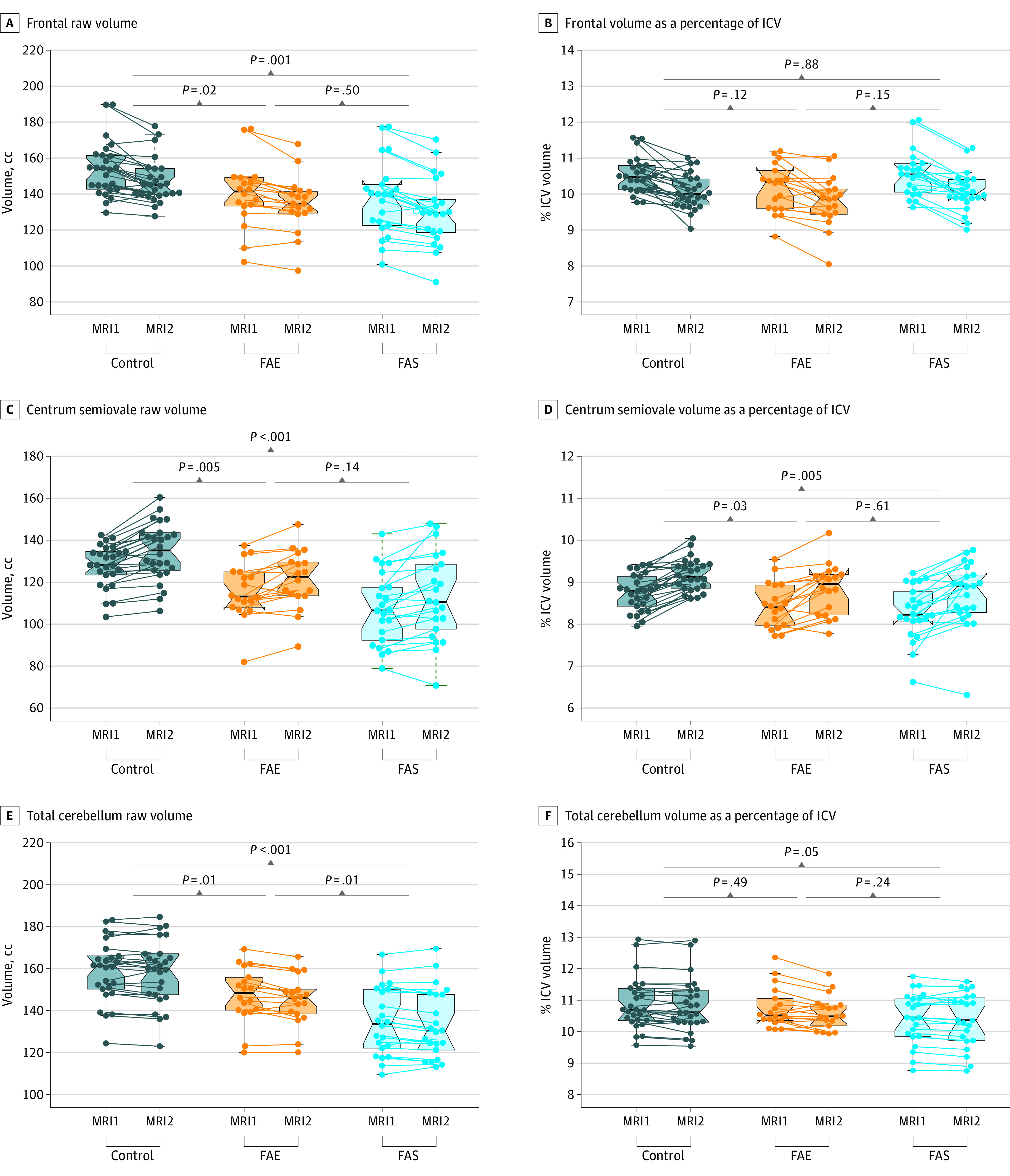
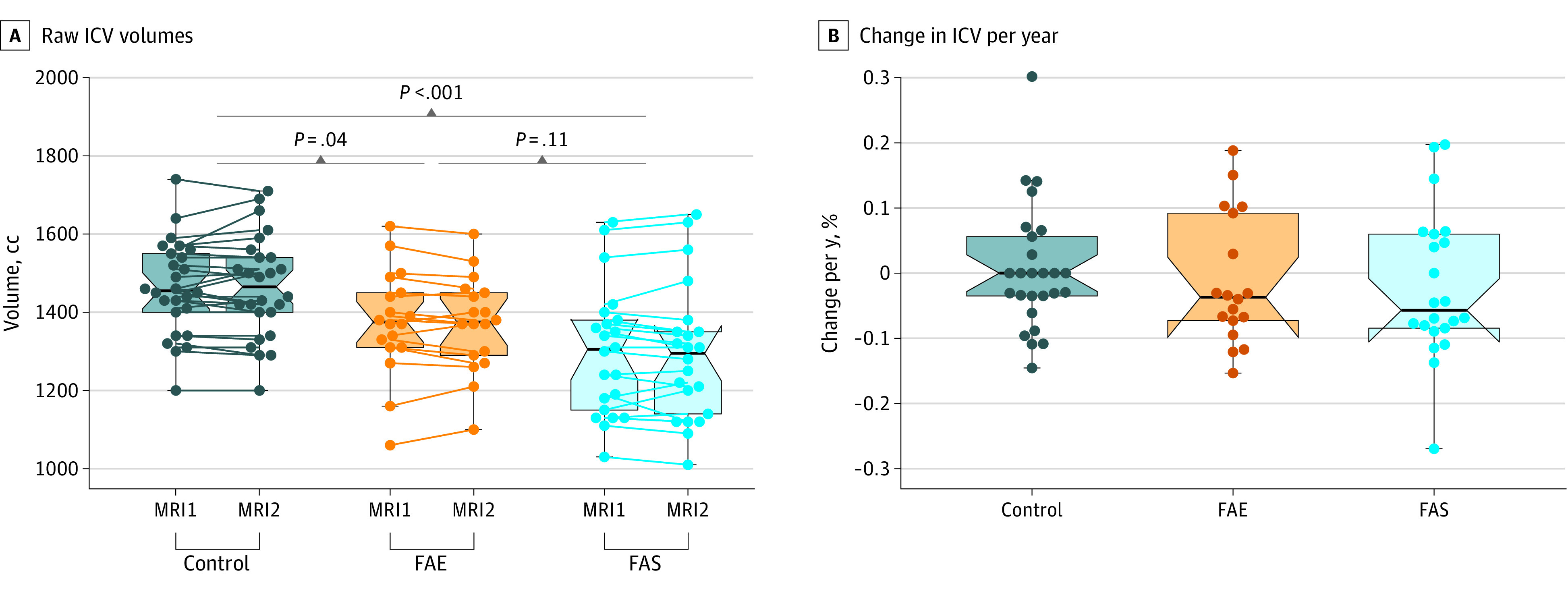
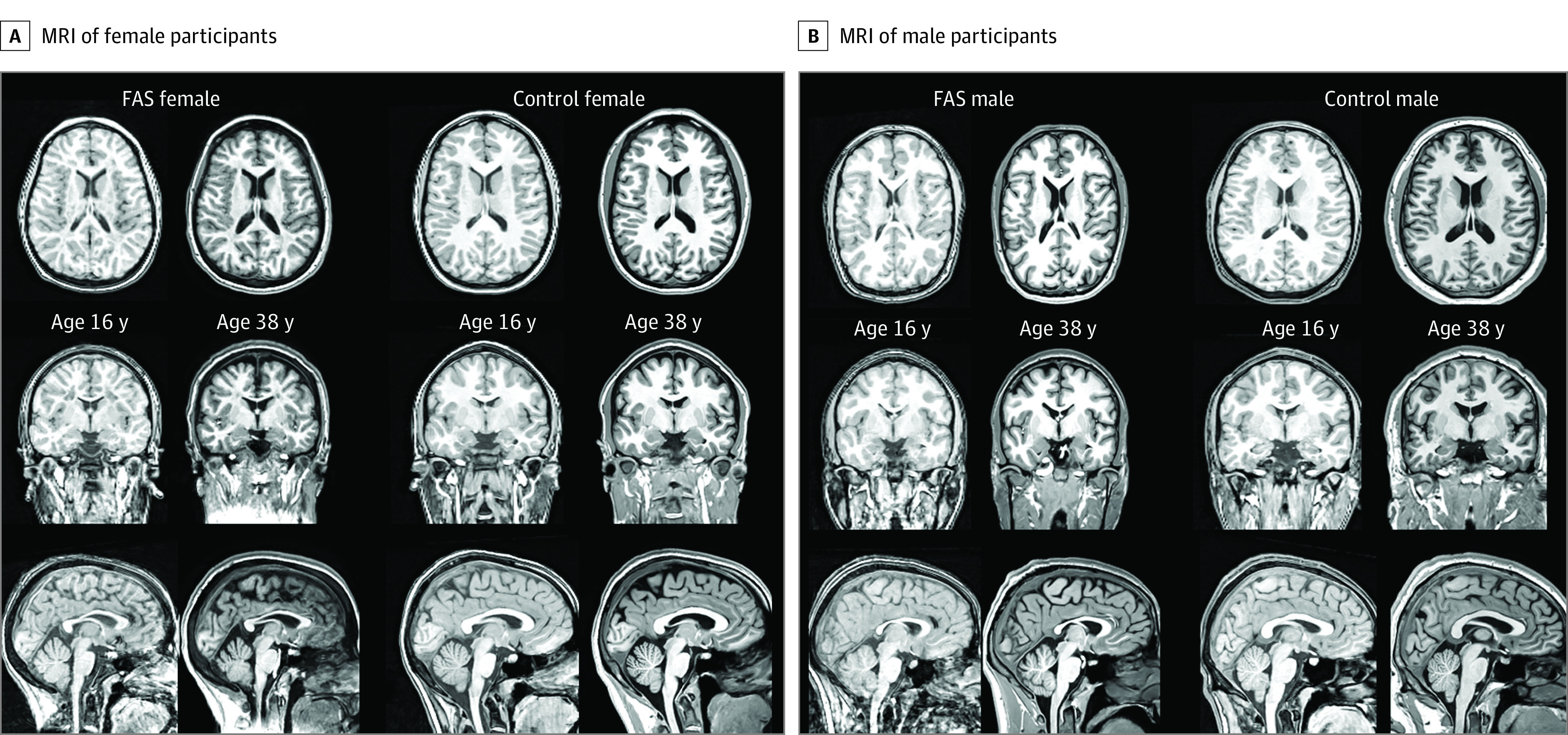
Of 174 individuals with MRI1 data, 48 refused participation, 36 were unavailable, and 24 could not be located. The remaining 66 individuals (37.9%) were rescanned for MRI2, including 26 controls, 18 individuals with nondysmorphic heavily exposed fetal alcohol effects (FAE; diagnosed prior to MRI1), and 22 individuals with FAS. Mean (SD) age was 22.9 (5.6) years at MRI1 and 44.7 (6.5) years at MRI2, and 35 participants (53%) were male. The FAE and FAS groups exhibited enduring stepped volume deficits at MRI1 and MRI2; volumes among control participants were greater than among participants with FAE, which were greater than volumes among participants with FAS (eg, mean [SD] ICV: control, 1462.3 [119.3] cc at MRI1 and 1465.4 [129.4] cc at MRI2; FAE, 1375.6 [134.1] cc at MRI1 and 1371.7 [120.3] cc at MRI2; FAS, 1297.3 [163.0] cc at MRI1 and 1292.7 [172.1] cc at MRI2), without diagnosis-by-age interactions. Despite these persistent volume deficits, the FAE participants and FAS participants showed patterns of neurodevelopment within reference ranges: increase in white matter and decrease in gray matter of the cortex and decrease in white matter and increase in gray matter of the cerebellum.
The findings of this cohort study support a nonaccelerating enduring, brain structural dysmorphic spectrum following prenatal alcohol exposure and a diagnostic distinction based on the degree of dysmorphia. FASD was not a progressive brain structural disorder by middle age, but whether accelerated decline occurs in later years remains to be determined.
在胎儿酒精谱系障碍(FASD)中,异常的大脑发育和心理健康问题很常见,但缺乏对成年期的纵向脑成像研究。本研究对 FASD 队列参与者的脑体积进行了长期随访。
测试 FASD 个体的脑组织是否比对照组个体随年龄增长更快地减少。
设计、地点和参与者:本队列研究使用了从 FASD 个体和对照组个体(首次磁共振成像 [MRI1] 采集时年龄为 13-37 岁,采集于 1997-2000 年)收集的磁共振成像(MRI)数据,与 20 年后(MRI2;2018-2021 年)采集的数据进行了比较。参与者是通过华盛顿大学胎儿酒精综合征(FAS)随访研究招募来进行 MRI1 的。对于 MRI2,以前的参与者是由华盛顿大学胎儿酒精和药物单位招募的。数据于 2022 年 10 月至 2023 年 8 月进行分析。
颅内体积(ICV)和皮质及小脑的灰质、白质和脑脊液体积通过自动定量分析进行,以群体和性别作为参与者间因素,年龄作为参与者内变量。
在有 MRI1 数据的 174 名参与者中,48 人拒绝参与,36 人无法获得,24 人无法找到。其余 66 人(37.9%)接受了 MRI2 的扫描,包括 26 名对照者、18 名非畸形重度暴露胎儿酒精效应(FAE;在 MRI1 之前诊断)和 22 名 FAS 患者。MRI1 时的平均(SD)年龄为 22.9(5.6)岁,MRI2 时为 44.7(6.5)岁,35 名参与者(53%)为男性。FAE 和 FAS 组在 MRI1 和 MRI2 时均表现出持续的阶梯式体积缺陷;对照组参与者的体积大于 FAE 参与者,而 FAE 参与者的体积又大于 FAS 参与者(例如,平均[SD]ICV:对照组,MRI1 为 1462.3[119.3]cc,MRI2 为 1465.4[129.4]cc;FAE,MRI1 为 1375.6[134.1]cc,MRI2 为 1371.7[120.3]cc;FAS,MRI1 为 1297.3[163.0]cc,MRI2 为 1292.7[172.1]cc),但无诊断-年龄交互作用。尽管存在这些持续的体积缺陷,但 FAE 参与者和 FAS 参与者表现出了在参考范围内的神经发育模式:白质增加,皮质灰质减少,白质减少,小脑灰质增加。
本队列研究的结果支持了在产前酒精暴露后存在非加速性持续的、大脑结构畸形的谱系,并基于畸形程度进行了诊断区分。到中年时,FASD 并不是一种进行性的大脑结构障碍,但在以后的几年里是否会加速下降仍有待确定。