University of Nottingham, UK.
Autism. 2024 Jul;28(7):1828-1837. doi: 10.1177/13623613231211457. Epub 2023 Nov 18.
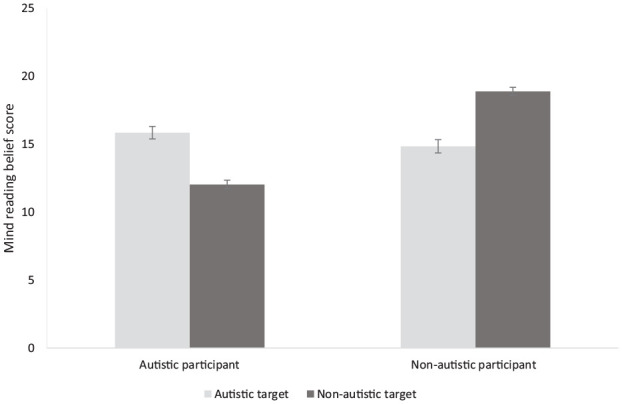
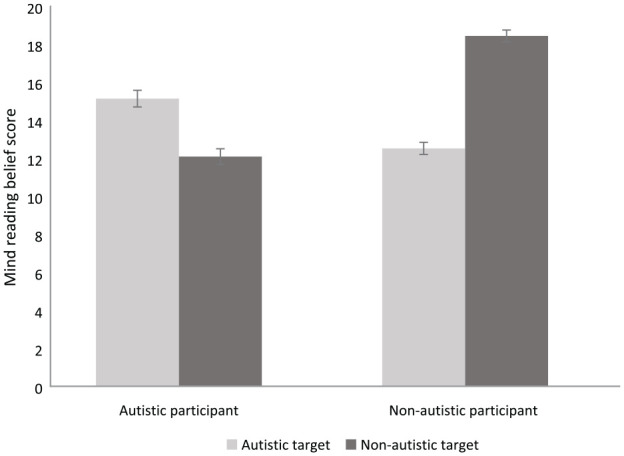
Autistic people are often characterised as having problems with mindreading, which refers to understanding other people's thoughts, beliefs and feelings. However, it has recently been suggested that mindreading difficulties may be a two-way issue between autistic and non-autistic people. This would imply that autistic people may not have difficulty reading the minds of other autistic people, whereas non-autistic people may struggle to read autistic people effectively. In this study, we created a survey in which we asked a relatively large sample of autistic and non-autistic people to rate their own and others' mindreading abilities in relation to autistic and non-autistic others, respectively. Both groups believed that they were better at reading others in their own group than the other group. The autistic respondents reported levels of mindreading skill at least commensurate with the non-autistic respondents when the mind to be read was specified as autistic. Thus, both groups of participants' responses were consistent with the notion that mindreading abilities are relational. Although self-reports are subjective, such beliefs could have important consequences for well-being and intergroup relations.
自闭症患者通常被认为在心理解读方面存在问题,心理解读是指理解他人的想法、信仰和感受。然而,最近有人提出,心理解读困难可能是自闭症患者和非自闭症患者之间的双向问题。这意味着自闭症患者可能不会难以解读其他自闭症患者的心理,而非自闭症患者可能难以有效地解读自闭症患者的心理。在这项研究中,我们创建了一个调查,要求相对大量的自闭症患者和非自闭症患者分别对自己和他人的心理解读能力进行评估,以自己和他人的自闭症程度为参照。两组参与者都认为,与另一组相比,他们更善于解读自己组内的人。当需要解读的心理为自闭症时,自闭症受访者报告的心理解读技能水平至少与非自闭症受访者相当。因此,两组参与者的反应都符合心理解读能力具有关系性的观点。尽管自我报告是主观的,但这些信念可能对幸福感和群体间关系产生重要影响。