Li Xuewei, Zuo Lili, Zhao Heng, Hu Jie, Tang Tao, Wang Kai, Li Yan, Zhao Mingwei
Institute of Medical Technology, Peking University Health Science Center, Beijing, China.
Department of Ophthalmology and Clinical Centre of Optometry, Peking University People's Hospital, Beijing, 100044, China.
Eye Vis (Lond). 2023 Nov 20;10(1):47. doi: 10.1186/s40662-023-00364-z.
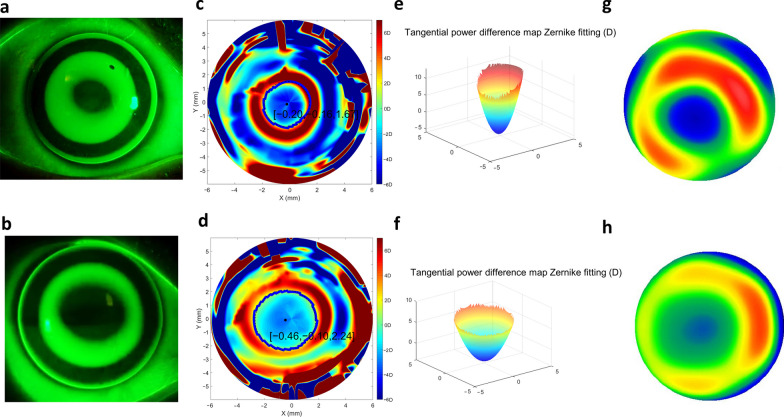
To investigate the control effect on the axial length elongation using corneal refractive therapy (CRT) with different optical zone diameters (BOZDs). We also sought to compare the difference in higher-order aberrations (HOAs), treatment zone (TZ) size and Zernike defocus coefficient with different BOZDs and seek the optimal parameter for predicting axial elongation.
This prospective cohort study included 7- to 14-year-olds fitted with orthokeratology (ortho-K) lenses of 5-mm (5-mm group) or 6-mm BOZD (6-mm group). Axial length (AL), corneal topography, HOAs and Zernike defocus coefficient were obtained at baseline, and 1, 3, 6, 9 and 12 months follow-up visits. Multivariate regression analyses were used to explore the association between AL change and ocular biometric parameters. Receiver operating characteristic (ROC) curve analysis was used to determine the best diagnostic value for AL change in ocular biometric parameters.
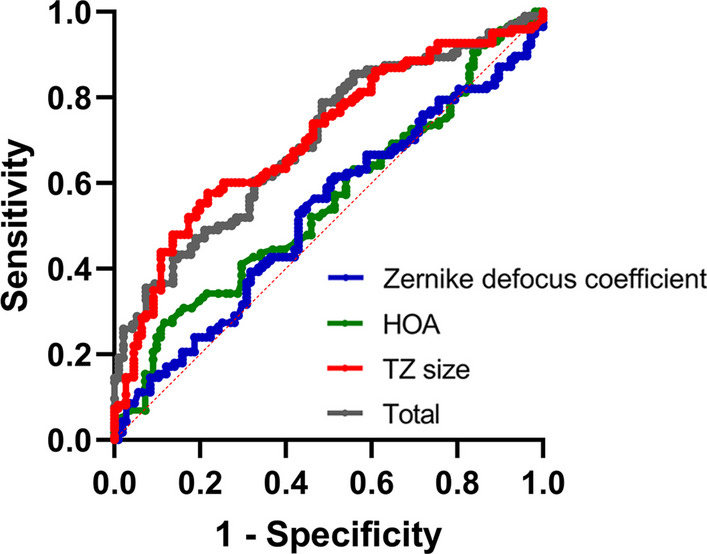
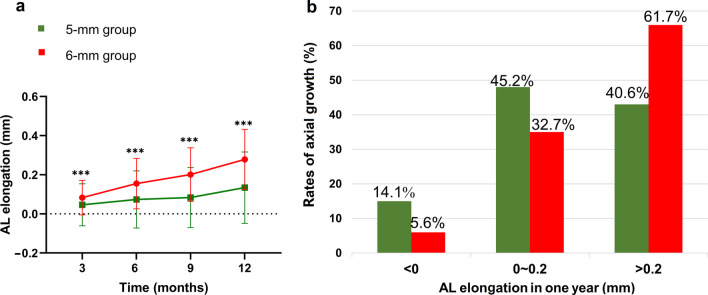
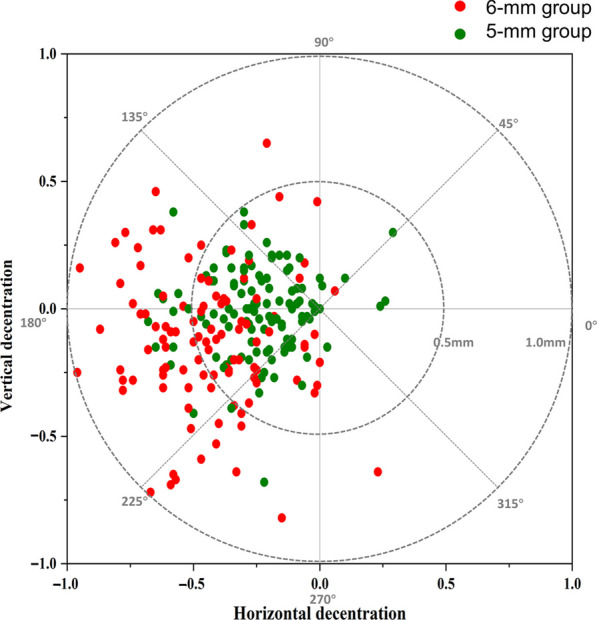
In total, 301 participants completed the one-year follow-up. The mean AL change in the 5-mm group (0.13 ± 0.18 mm) was less than that in the 6-mm group (0.27 ± 0.15 mm) at the 12 months visit. The TZ size and decentration were smaller, while the Zernike defocus coefficient and HOAs were higher in the 5-mm group (all P < 0.05). Older age and smaller TZ size were protective factors against AL elongation in multiple regression. In predicting AL elongation, TZ diameter yielded an area under the ROC curve of 0.684 with a cut-off value of 3.82 mm.
The 5-mm group showed 0.14 mm (51.8%) less axial elongation than the 6-mm group. The 5-mm BOZD produced a smaller TZ size, higher Zernike defocus coefficient and higher HOA after reshaping of the cornea. TZ size was the best predictor of AL elongation. TZ diameter less than 3.82 mm may lead to AL elongation less than 0.2 mm in one year.
探讨不同光学区直径(BOZD)的角膜塑形术(CRT)对眼轴长度增长的控制效果。我们还试图比较不同BOZD下高阶像差(HOA)、治疗区(TZ)大小和泽尼克离焦系数的差异,并寻找预测眼轴伸长的最佳参数。
这项前瞻性队列研究纳入了7至14岁佩戴5毫米(5毫米组)或6毫米BOZD角膜塑形镜(ortho-K)的儿童。在基线以及随访1、3、6、9和12个月时测量眼轴长度(AL)、角膜地形图、HOA和泽尼克离焦系数。采用多变量回归分析来探讨AL变化与眼部生物测量参数之间的关联。使用受试者工作特征(ROC)曲线分析来确定眼部生物测量参数中AL变化的最佳诊断值。
共有301名参与者完成了一年的随访。在12个月随访时,5毫米组的平均AL变化(0.13±0.18毫米)小于6毫米组(0.27±0.15毫米)。5毫米组的TZ大小和偏心度较小,而泽尼克离焦系数和HOA较高(所有P<0.05)。在多元回归中,年龄较大和TZ大小较小是防止AL伸长的保护因素。在预测AL伸长方面,TZ直径的ROC曲线下面积为0.684,截断值为3.82毫米。
5毫米组的眼轴伸长比6毫米组少0.14毫米(51.8%)。5毫米的BOZD在角膜重塑后产生的TZ大小较小、泽尼克离焦系数较高和HOA较高。TZ大小是AL伸长的最佳预测指标。TZ直径小于3.82毫米可能导致一年内AL伸长小于0.2毫米。