Buckinx Fanny, Adam Stéphane, Aubertin-Leheudre Mylène, De Saint Hubert Marie, Mouton Alexandre, Potier Florence, Reginster Jean-Yves, Bruyere Olivier
WHO Collaborating Center for Public Health Aspects of Musculo-Skeletal Health and Ageing, Division of Public Health, Epidemiology and Health Economics, University of Liège, 4000 Liège, Belgium.
Psychology of Aging Unit, University of Liège, 4000 Liège, Belgium.
Epidemiologia (Basel). 2023 Nov 6;4(4):464-482. doi: 10.3390/epidemiologia4040039.
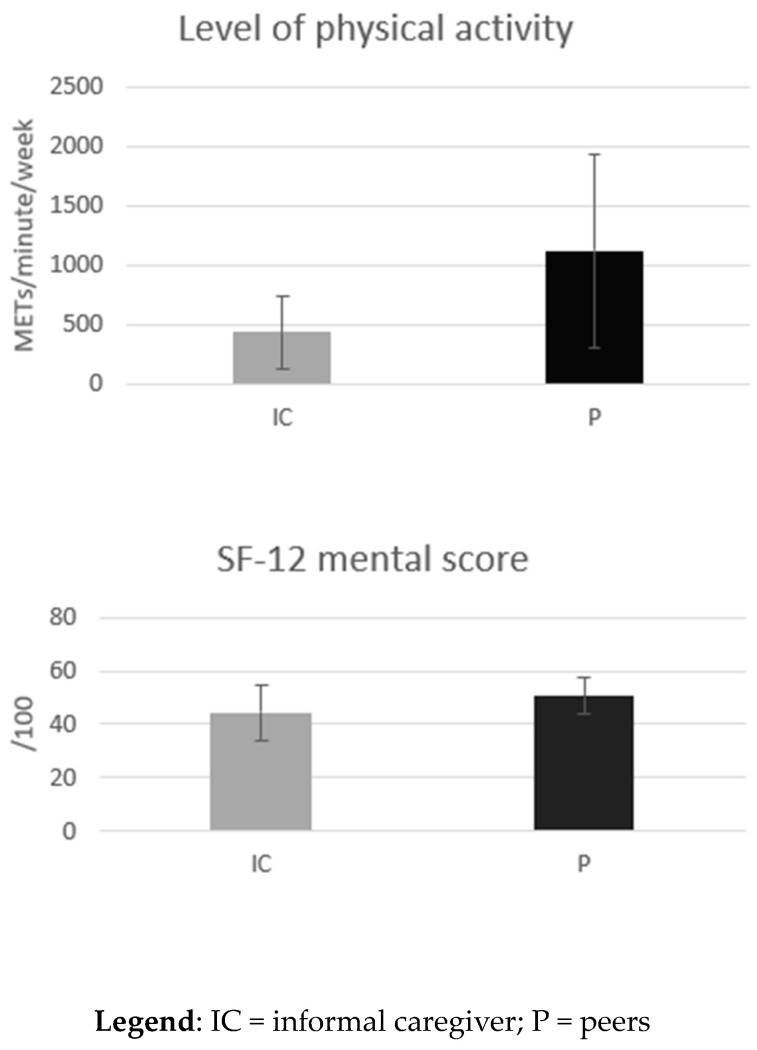
Informal caregivers' own quality of life, health status, and determinants are poorly understood despite their concern for the health of the individuals they assist. To compare the quality of life and the health determinants of older informal caregivers with those of older adults without caregiving responsibilities. An online survey was designed to investigate the quality of life and the health determinants of people aged 65 years and over, with a focus on informal caregivers. In addition to socio-demographic data, the number of informal caregivers was ascertained and the Zarit scale of caregiver burden was applied. Quality of life (SF-12) and health determinants (access to technology and level of physical activity (IPAQ)) were assessed and compared between informal caregivers and non-caregivers. A total of 111 participants were included in the study (70 ± 3.83 years, 71.2% women). The majority of respondents (91.8%) were Belgian. One-third of the respondents identified themselves as informal caregivers and declared themselves as having a severe burden (61.9 ± 15.2/88). Socio-demographic characteristics and access to technology were similar between informal caregivers and non-caregivers ( > 0.05). However, informal caregivers had a lower SF-12 score in the mental score domain (44.3 ± 10.2 vs. 50.7 ± 7.0; = 0.004) and a lower level of physical activity (434 ± 312 METS/min/week vs. 1126 ± 815 METS/min/week; = 0.01) than their peers. Informal caregivers reported a lower quality of life and a lower level of physical activity than their peers. Given the recognized importance of physical activity for overall health, this survey highlights the need to promote physical activity among older informal caregivers.
尽管非正式照护者关心他们所照料的人的健康,但人们对他们自身的生活质量、健康状况及决定因素却知之甚少。为了比较老年非正式照护者与无照护责任的老年人的生活质量和健康决定因素。设计了一项在线调查,以调查65岁及以上人群的生活质量和健康决定因素,重点是非正式照护者。除社会人口统计学数据外,还确定了非正式照护者的数量,并应用了照护者负担的扎里特量表。评估并比较了非正式照护者和非照护者的生活质量(SF-12)和健康决定因素(技术获取情况和身体活动水平(IPAQ))。共有111名参与者纳入研究(年龄70±3.83岁,女性占71.2%)。大多数受访者(91.8%)为比利时人。三分之一的受访者自认为是非正式照护者,并表示负担严重(61.9±15.2/88)。非正式照护者和非照护者在社会人口统计学特征和技术获取方面相似(>0.05)。然而,非正式照护者在心理得分领域的SF-12得分较低(44.3±10.2 vs.50.7±7.0;P=0.004),身体活动水平也低于同龄人(434±312梅脱/分钟/周 vs.1126±815梅脱/分钟/周;P=0.01)。非正式照护者报告的生活质量和身体活动水平低于同龄人。鉴于身体活动对整体健康的公认重要性,这项调查凸显了促进老年非正式照护者身体活动的必要性。