Department of Health Technology and Services Research, Technical Medical Centre, University of Twente, Drienerlolaan 5, 7522, NB, Enschede, The Netherlands.
Biomedical Signals and Systems Group, Faculty of Electrical Engineering Mathematics and Computer Science, University of Twente, Drienerlolaan 5, 7522, NB, Enschede, The Netherlands.
Osteoporos Int. 2024 Apr;35(4):561-574. doi: 10.1007/s00198-023-06942-0. Epub 2023 Nov 24.
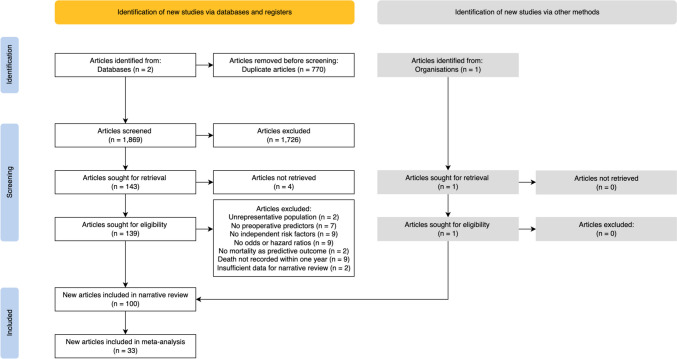
Hip fractures are a global health problem with a high postoperative mortality rate. Preoperative predictors for early mortality could be used to optimise and personalise healthcare strategies. This study aimed to identify predictors for early mortality following hip fracture surgery. Cohort studies examining independent preoperative predictors for mortality following hip fracture surgery were identified through a systematic search on Scopus and PubMed. Predictors for 30-day mortality were the primary outcome, and predictors for mortality within 1 year were secondary outcomes. Primary outcomes were analysed with random-effects meta-analyses. Confidence in the cumulative evidence was assessed using the GRADE criteria. Secondary outcomes were synthesised narratively. Thirty-three cohort studies involving 462,699 patients were meta-analysed. Five high-quality evidence predictors for 30-day mortality were identified: age per year (OR: 1.06, 95% CI: 1.04-1.07), ASA score ≥ 3 (OR: 2.69, 95% CI: 2.12-3.42), male gender (OR: 2.00, 95% CI: 1.85-2.18), institutional residence (OR: 1.81, 95% CI: 1.31-2.49), and metastatic cancer (OR: 2.83, 95% CI: 2.58-3.10). Additionally, six moderate-quality evidence predictors were identified: chronic renal failure, dementia, diabetes, low haemoglobin, heart failures, and a history of any malignancy. Weak evidence was found for non-metastatic cancer. This review found relevant preoperative predictors which could be used to identify patients who are at high risk of 30-day mortality following hip fracture surgery. For some predictors, the prognostic value could be increased by further subcategorising the conditions by severity.
髋部骨折是一个全球性的健康问题,术后死亡率很高。术前预测因子可用于优化和个性化医疗保健策略。本研究旨在确定髋部骨折手术后早期死亡的预测因子。通过在 Scopus 和 PubMed 上进行系统搜索,确定了检查髋部骨折手术后死亡的独立术前预测因子的队列研究。30 天死亡率是主要结局,1 年内死亡率是次要结局。主要结局采用随机效应荟萃分析进行分析。使用 GRADE 标准评估累积证据的可信度。次要结局以叙述性方式综合。荟萃分析了 33 项涉及 462699 名患者的队列研究。确定了 5 个 30 天死亡率的高质量证据预测因子:年龄每年(OR:1.06,95%CI:1.04-1.07),ASA 评分≥3(OR:2.69,95%CI:2.12-3.42),男性(OR:2.00,95%CI:1.85-2.18),机构居住(OR:1.81,95%CI:1.31-2.49)和转移性癌症(OR:2.83,95%CI:2.58-3.10)。此外,还确定了 6 个中等质量证据预测因子:慢性肾功能衰竭、痴呆、糖尿病、低血红蛋白、心力衰竭和任何恶性肿瘤病史。非转移性癌症的证据较弱。本综述发现了相关的术前预测因子,可用于识别髋部骨折手术后 30 天内死亡风险高的患者。对于一些预测因子,可以通过进一步按严重程度对病情进行细分来提高预测价值。