Bacterial Nucleotide-Binding Proteins Team, Molecular Microbiology and Structural Biochemistry (MMSB), UMR 5086 CNRS/University of Lyon, Lyon, France.
CNRS, Aix-Marseille Université, BIP, IMM, Marseille, France.
J Biol Chem. 2024 Jan;300(1):105546. doi: 10.1016/j.jbc.2023.105546. Epub 2023 Dec 9.
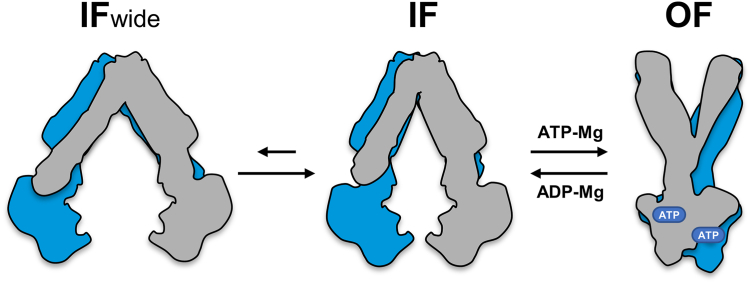
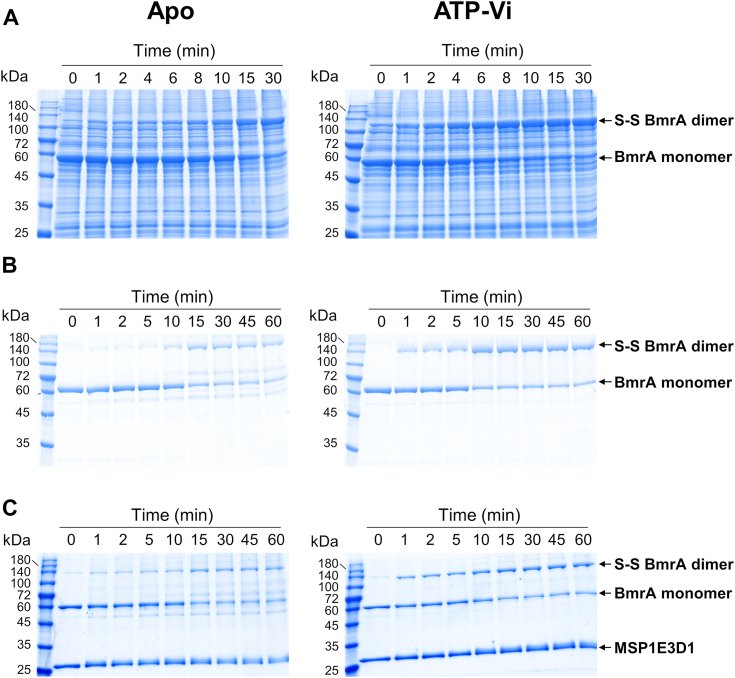
ATP-binding cassette (ABC) transporters are ubiquitous membrane proteins responsible for the translocation of a wide diversity of substrates across biological membranes. Some of them confer multidrug or antimicrobial resistance to cancer cells and pathogenic microorganisms, respectively. Despite a wealth of structural data gained in the last two decades, the molecular mechanism of these multidrug efflux pumps remains elusive, including the extent of separation between the two nucleotide-binding domains (NBDs) during the transport cycle. Based on recent outward-facing structures of BmrA, a homodimeric multidrug ABC transporter from Bacillus subtilis, we introduced a cysteine mutation near the C-terminal end of the NBDs to analyze the impact of disulfide-bond formation on BmrA function. Interestingly, the presence of the disulfide bond between the NBDs did not prevent the ATPase, nor did it affect the transport of Hoechst 33342 and doxorubicin. Yet, the 7-amino-actinomycin D was less efficiently transported, suggesting that a further opening of the transporter might improve its ability to translocate this larger compound. We solved by cryo-EM the apo structures of the cross-linked mutant and the WT protein. Both structures are highly similar, showing an intermediate opening between their NBDs while their C-terminal extremities remain in close proximity. Distance measurements obtained by electron paramagnetic resonance spectroscopy support the intermediate opening found in these 3D structures. Overall, our data suggest that the NBDs of BmrA function with a tweezers-like mechanism distinct from the related lipid A exporter MsbA.
三磷酸腺苷结合盒(ABC)转运蛋白是广泛存在的膜蛋白,负责将各种底物跨生物膜转运。其中一些使癌细胞和病原微生物分别具有多药或抗微生物耐药性。尽管在过去二十年中获得了大量结构数据,但这些多药外排泵的分子机制仍然难以捉摸,包括在运输循环过程中两个核苷酸结合域(NBD)之间的分离程度。基于枯草芽孢杆菌同源二聚体多药 ABC 转运蛋白 BmrA 的最近外向构象结构,我们在 NBD 的 C 末端附近引入了一个半胱氨酸突变,以分析二硫键形成对 BmrA 功能的影响。有趣的是,NBD 之间的二硫键的存在既不妨碍 ATP 酶的活性,也不影响 Hoechst 33342 和阿霉素的转运。然而,7-氨基放线菌素 D 的转运效率较低,这表明转运体的进一步开放可能会提高其转运这种较大化合物的能力。我们通过冷冻电镜解析了交联突变体和 WT 蛋白的apo 结构。这两种结构非常相似,在它们的 NBD 之间显示出中间开放,而它们的 C 末端仍保持接近。电子顺磁共振波谱学获得的距离测量结果支持在这些 3D 结构中发现的中间开放。总体而言,我们的数据表明,BmrA 的 NBD 以不同于相关脂 A 外排蛋白 MsbA 的镊子样机制发挥作用。