Department of Psychology, Faculty of Psychology and Educational Sciences, University of Geneva, Geneva, Switzerland.
Division of Psychiatry, Faculty of Brain Sciences, University College London, London, United Kingdom.
PLoS One. 2023 Dec 15;18(12):e0295175. doi: 10.1371/journal.pone.0295175. eCollection 2023.
Older adults with subjective cognitive decline (SCD) recruited from memory clinics have an increased risk of developing dementia and regularly experience reduced psychological well-being related to memory concerns and fear of dementia. Research on improving well-being in SCD is limited and lacks non-pharmacological approaches. We investigated whether mindfulness-based and health education interventions can enhance well-being in SCD.
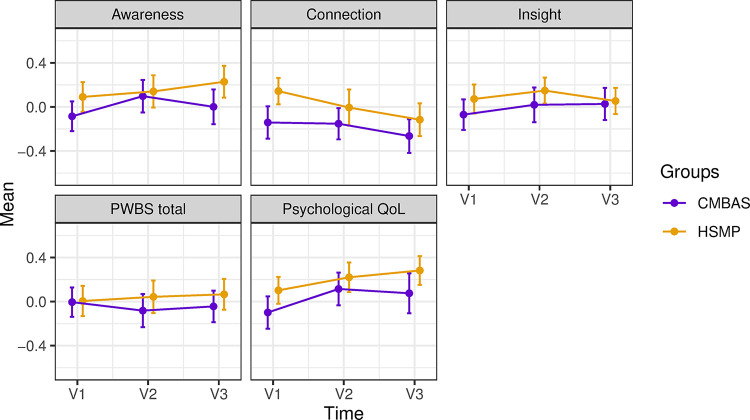
The SCD-Well trial (ClinicalTrials.gov: NCT03005652) randomised 147 older adults with SCD to an 8-week caring mindfulness-based approach for seniors (CMBAS) or an active comparator (health self-management programme [HSMP]). Well-being was assessed at baseline, post-intervention, and 6-month post-randomisation using the Psychological Well-being Scale (PWBS), the World Health Organisation's Quality of Life (QoL) Assessment psychological subscale, and composites capturing meditation-based well-being dimensions of awareness, connection, and insight. Mixed effects models were used to assess between- and within-group differences in change.
CMBAS was superior to HSMP on changes in connection at post-intervention. Within both groups, PWBS total scores, psychological QoL, and composite scores did not increase. Exploratory analyses indicated increases in PWBS autonomy at post-intervention in both groups.
Two non-pharmacological interventions were associated with only limited effects on psychological well-being in SCD. Longer intervention studies with waitlist/retest control groups are needed to assess if our findings reflect intervention brevity and/or minimal base rate changes in well-being.
从记忆诊所招募的有主观认知下降(SCD)的老年人患痴呆症的风险增加,并且经常因记忆问题和对痴呆症的恐惧而导致心理健康状况下降。有关改善 SCD 患者幸福感的研究有限,并且缺乏非药物干预措施。我们研究了基于正念和健康教育的干预措施是否可以提高 SCD 患者的幸福感。
SCD-Well 试验(ClinicalTrials.gov:NCT03005652)将 147 名 SCD 老年人随机分为 8 周关爱正念 seniors(CMBAS)组或活性对照组(健康自我管理计划 [HSMP])。使用心理幸福感量表(PWBS)、世界卫生组织生活质量评估心理子量表以及捕捉基于冥想的幸福感维度(意识、联系和洞察力)的综合指标,在基线、干预后和随机分组后 6 个月评估幸福感。使用混合效应模型评估组间和组内变化的差异。
在干预后,CMBAS 在联系方面优于 HSMP。在两组中,PWBS 总分、心理生活质量和综合评分均未增加。探索性分析表明,两组的 PWBS 自主性在干预后均有所增加。
两种非药物干预措施仅对 SCD 患者的心理幸福感产生有限影响。需要进行更长时间的干预研究,并设立等待/重测对照组,以评估我们的发现是否反映了干预的短暂性和/或幸福感的基础率变化很小。