Department of Pharmacognosy, Faculty of Pharmacy, Cairo University, Kasr-El-Ainy Street, Cairo, 11562, Egypt.
Department of Pharmacognosy, Faculty of Pharmacy, Menoufia University, Gamal Abd El Nasr St., Shibin Elkom, 32511, Menoufia, Egypt.
BMC Complement Med Ther. 2023 Dec 16;23(1):465. doi: 10.1186/s12906-023-04294-0.
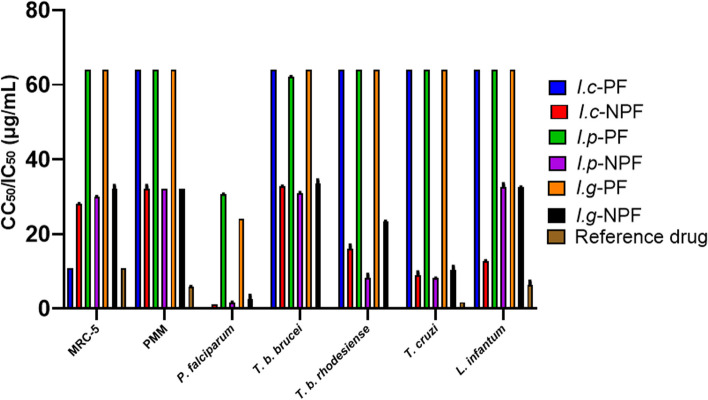
In the last few decades, the use of plant extracts and their phytochemicals as candidates for the management of parasitic diseases has increased tremendously. Irises are aromatic and medicinal plants that have long been employed in the treatment of different infectious diseases by traditional healers in many cultures. This study aims to explore the potential of three common Iris species (I. confusa Sealy, I. pseudacorus L. and I. germanica L.) against infectious diseases. Their in vitro antiprotozoal potency against Plasmodium falciparum, Trypanosoma brucei brucei, T. b. rhodesiense, T. cruzi and Leishmania infantum beside their cytotoxicity on MRC-5 fibroblasts and primary peritoneal murine macrophages were examined.
The secondary metabolites of the tested extracts were characterized by UPLC-HRMS/MS and Pearsons correlation was used to correlate them with the antiprotozoal activity.
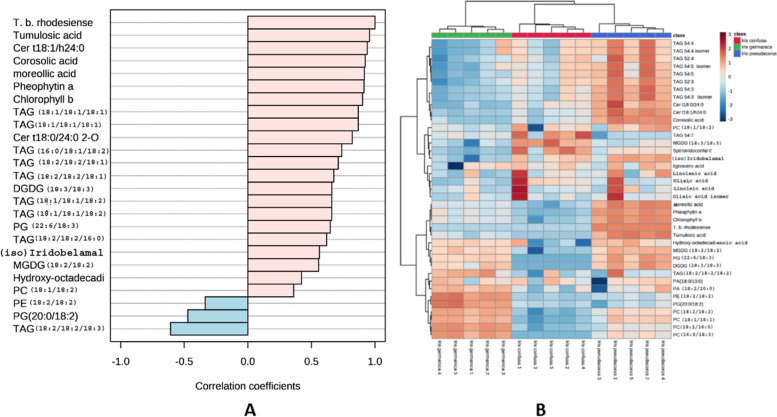
Overall, the non-polar fractions (NPF) showed a significant antiprotozoal activity (score: sc 2 to 5) in contrast to the polar fractions (PF). I. confusa NPF was the most active extract against P. falciparum [IC of 1.08 μg/mL, selectivity index (S.I. 26.11) and sc 5] and L. infantum (IC of 12.7 μg/mL, S.I. 2.22 and sc 2). I. pseudacorus NPF was the most potent fraction against T. b. rhodesiense (IC of 8.17 μg/mL, S.I. 3.67 and sc 3). Monogalactosyldiacylglycerol glycolipid (18:3/18:3), triaceylglycerol (18:2/18:2/18:3), oleic acid, and triterpenoid irridals (spirioiridoconfal C and iso-iridobelamal A) were the top positively correlated metabolites with antiplasmodium and antileishmanial activities of I. confusa NPF. Tumulosic acid, ceramide sphingolipids, corosolic, maslinic, moreollic acids, pheophytin a, triaceylglycerols, mono- and digalactosyldiacylglycerols, phosphatidylglycerol (22:6/18:3), phosphatidylcholines (18:1/18:2), and triterpenoid irridal iso-iridobelamal A, were highly correlated to I. pseudacorus NPF anti- T. b. rhodesiense activity. The ADME study revealed proper drug likeness properties for certain highly corelated secondary metabolites.
This study is the sole map correlating I. confusa and I. pseudacorus secondary metabolites to their newly explored antiprotozoal activity.
在过去的几十年里,植物提取物及其植物化学成分作为寄生虫病管理候选物的使用大大增加。鸢尾属植物是芳香型药用植物,长期以来一直被许多文化中的传统治疗师用于治疗各种传染病。本研究旨在探索三种常见鸢尾属植物(Sealy 鸢尾、L. 鸢尾和 L. 鸢尾)对抗传染病的潜力。研究了它们对疟原虫、布氏锥虫布鲁斯、布鲁斯锥虫罗得西亚、克氏锥虫和婴儿利什曼原虫的体外抗原生动物活性,以及它们对 MRC-5 成纤维细胞和原代腹腔鼠巨噬细胞的细胞毒性。
用 UPLC-HRMS/MS 对测试提取物中的次生代谢物进行了表征,并使用 Pearson 相关性将其与抗原生动物活性相关联。
总体而言,非极性部分(NPF)显示出显著的抗原生动物活性(评分:sc2 至 5),而极性部分(PF)则没有。I. confusa NPF 是最有效的抗疟原虫提取物[IC 为 1.08μg/mL,选择性指数(S.I.26.11)和 sc5]和婴儿利什曼原虫(IC 为 12.7μg/mL,S.I.2.22 和 sc2]。I. pseudacorus NPF 是最有效的对抗 T.b.rhodesiense 的部分[IC 为 8.17μg/mL,S.I.3.67 和 sc3]。单半乳糖二酰基甘油甘油脂(18:3/18:3)、三酰基甘油(18:2/18:2/18:3)、油酸和三萜类异伊丽达因(螺旋异伊丽达因 C 和异伊丽达因 A)是与 I.confusa NPF 抗疟原虫和抗利什曼原虫活性相关性最高的代谢物。马托罗酸、神经酰胺神经鞘脂、柯罗索酸、齐墩果酸、莫罗利酸、叶绿素 a、三酰基甘油、单半乳糖二酰基甘油、磷脂酰甘油(22:6/18:3)、磷脂酰胆碱(18:1/18:2)和三萜类异伊丽达因 iso-iridobelamal A 与 I.pseudacorus NPF 抗 T.b.rhodesiense 活性高度相关。ADME 研究表明,某些高度相关的次生代谢物具有适当的药物相似性。
本研究是唯一将 I.confusa 和 I.pseudacorus 次生代谢物与其新探索的抗原生动物活性相关联的图谱。