Awasthi Samir, Sachdeva Nikhil, Gupta Yash, Anto Ausath G, Asfahan Shahir, Abbou Ruben, Bade Sairam, Sood Sanyam, Hegstrom Lars, Vellanki Nirupama, Alger Heather M, Babu Melwin, Medina-Inojosa Jose R, McCully Robert B, Lerman Amir, Stampehl Mark, Barve Rakesh, Attia Zachi I, Friedman Paul A, Soundararajan Venky, Lopez-Jimenez Francisco
Anumana, Inc, One Main Street, Cambridge, MA, USA.
nference, Inc, One Main Street, Cambridge, MA, USA.
EClinicalMedicine. 2023 Oct 24;65:102259. doi: 10.1016/j.eclinm.2023.102259. eCollection 2023 Nov.
Atherosclerotic cardiovascular disease (ASCVD) is the leading cause of death worldwide, driven primarily by coronary artery disease (CAD). ASCVD risk estimators such as the pooled cohort equations (PCE) facilitate risk stratification and primary prevention of ASCVD but their accuracy is still suboptimal.
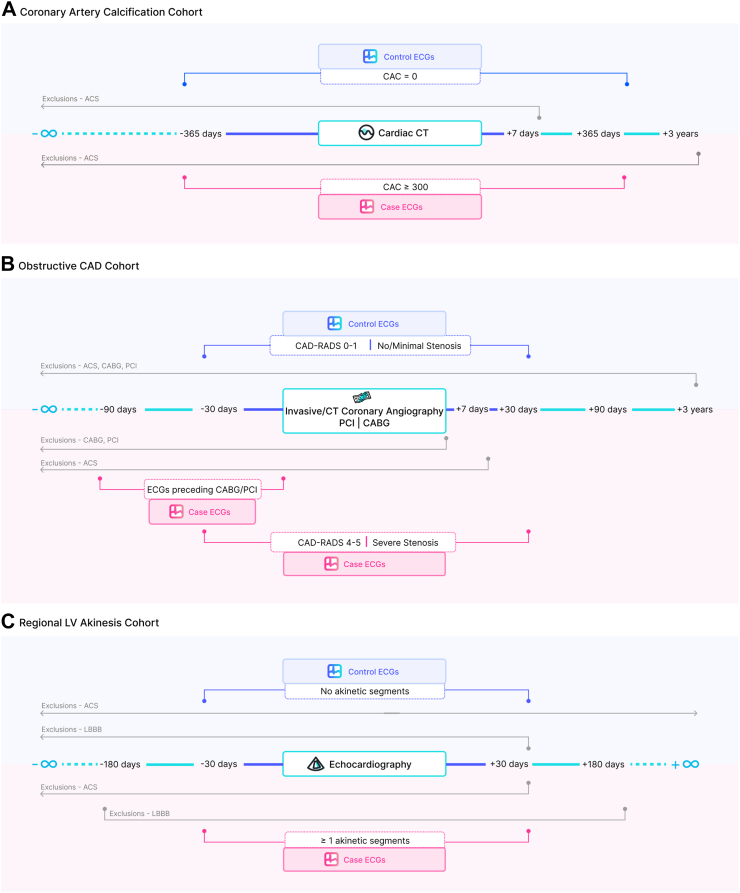
Using deep electronic health record data from 7,116,209 patients seen at 70+ hospitals and clinics across 5 states in the USA, we developed an artificial intelligence-based electrocardiogram analysis tool (ECG-AI) to detect CAD and assessed the additive value of ECG-AI-based ASCVD risk stratification to the PCE. We created independent ECG-AI models using separate neural networks including subjects without known history of ASCVD, to identify coronary artery calcium (CAC) score ≥300 Agatston units by computed tomography, obstructive CAD by angiography or procedural intervention, and regional left ventricular akinesis in ≥1 segment by echocardiogram, as a reflection of possible prior myocardial infarction (MI). These were used to assess the utility of ECG-AI-based ASCVD risk stratification in a retrospective observational study consisting of patients with PCE scores and no prior ASCVD. The study period covered all available digitized EHR data, with the first available ECG in 1987 and the last in February 2023.
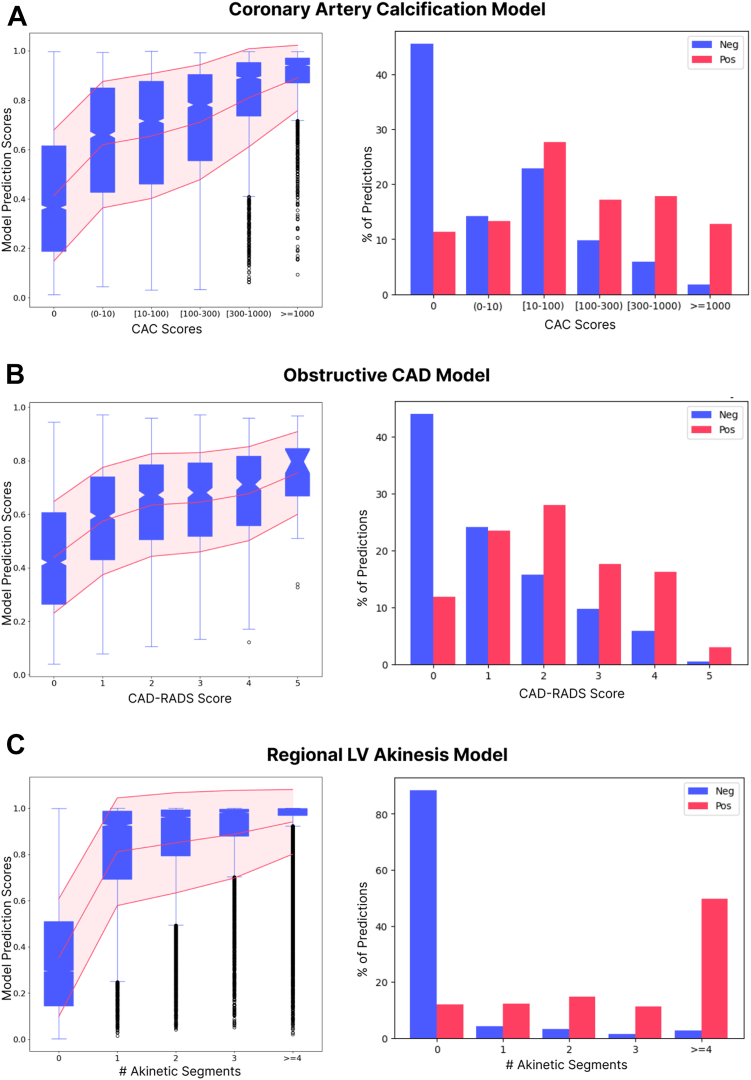
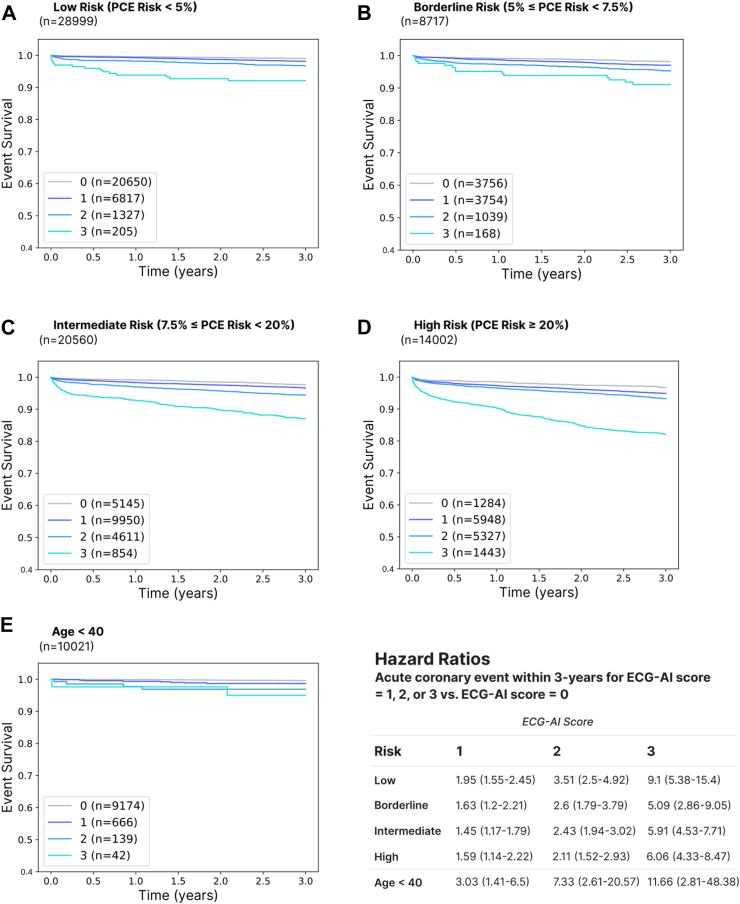
ECG-AI for identifying CAC ≥300, obstructive CAD, and regional akinesis achieved area under the receiver operating characteristic (AUROC) values of 0.88, 0.85, and 0.94, respectively. An ensembled ECG-AI identified 3, 5, and 10-year risk for acute coronary events and mortality independently and additively to PCE. Hazard ratios for acute coronary events over 3-years in patients without ASCVD that tested positive on 1, 2, or 3 versus 0 disease-specific ECG-AI models at cohort entry were 2.41 (2.14-2.71), 4.23 (3.74-4.78), and 11.75 (10.2-13.52), respectively. Similar stratification was observed in cohorts stratified by PCE or age.
ECG-AI has potential to address unmet need for accessible risk stratification in patients in whom PCE under, over, or insufficiently estimates ASCVD risk, and in whom risk assessment over time periods shorter than 10 years is desired.
Anumana.
动脉粥样硬化性心血管疾病(ASCVD)是全球主要的死亡原因,主要由冠状动脉疾病(CAD)驱动。ASCVD风险评估工具,如合并队列方程(PCE),有助于ASCVD的风险分层和一级预防,但其准确性仍不理想。
利用美国5个州70多家医院和诊所7116209例患者的深度电子健康记录数据,我们开发了一种基于人工智能的心电图分析工具(ECG-AI)来检测CAD,并评估基于ECG-AI的ASCVD风险分层对PCE的附加价值。我们使用包括无ASCVD已知病史受试者的单独神经网络创建独立的ECG-AI模型,以通过计算机断层扫描识别冠状动脉钙化(CAC)评分≥300阿加斯顿单位、通过血管造影或介入手术确定的阻塞性CAD,以及通过超声心动图确定≥1个节段的局部左心室运动减弱,作为可能既往心肌梗死(MI)的反映。这些用于在一项回顾性观察研究中评估基于ECG-AI的ASCVD风险分层的效用,该研究由具有PCE评分且无既往ASCVD的患者组成。研究期间涵盖了所有可用的数字化电子健康记录数据,最早的可用心电图记录于1987年,最晚的记录于2023年2月。
用于识别CAC≥300、阻塞性CAD和局部运动减弱的ECG-AI在受试者工作特征曲线下面积(AUROC)值分别为0.88、0.85和0.94。一个综合的ECG-AI独立且附加于PCE识别了急性冠状动脉事件和死亡的3年、5年和10年风险。在队列入组时,在1、2或3个与0个疾病特异性ECG-AI模型检测呈阳性的无ASCVD患者中,3年急性冠状动脉事件的风险比分别为2.41(2.14-2.71)、4.23(3.74-4.78)和11.75(10.2-13.52)。在按PCE或年龄分层的队列中观察到类似的分层。
ECG-AI有潜力满足PCE对ASCVD风险估计不足、过高或不准确的患者以及需要在短于10年的时间段内进行风险评估的患者对可及风险分层的未满足需求。
Anumana。