HLA Laboratory, Instituto Nacional de Enfermedades Respiratorias Ismael Cosío Villegas, Mexico City, Mexico.
Interstitial Lung Disease and Rheumatology Unit, Instituto Nacional de Enfermedades Respiratorias Ismael Cosío Villegas, Mexico City, Mexico.
Front Cell Infect Microbiol. 2023 Dec 5;13:1321315. doi: 10.3389/fcimb.2023.1321315. eCollection 2023.
To characterize the lung microbiome in the bronchoalveolar lavage fluid (BALF) of patients with Antisynthetase Syndrome (ASSD) according to anti-Jo1 autoantibody positivity and evaluate the correlation with differential cell count and other bacterial genera in BALF.
We sequenced the 16S ribosomal RNA gene in the BALF of anti-Jo1-positive (JoP, n=6) and non-Jo1-positive (NJo, n=17) patients, and the differential cell count in BALF was evaluated. The Spearman's correlation was calculated for the quantitative variables and abundance of bacterial species.
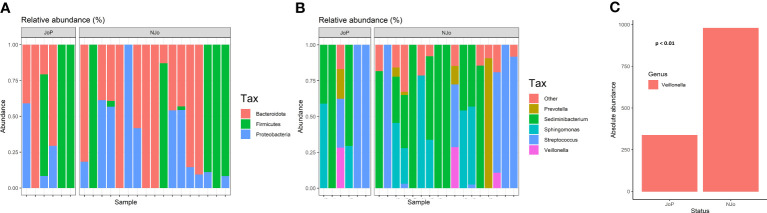
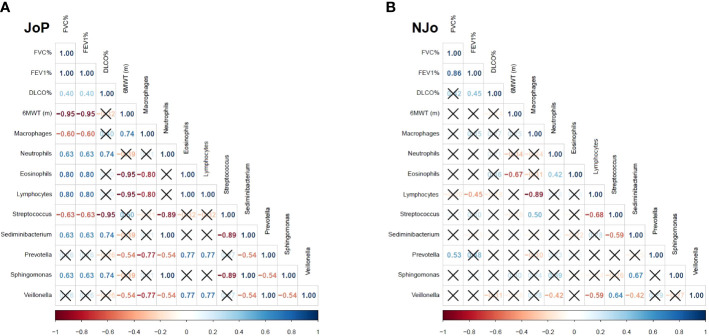
The genus showed a significant decrease (p<0.01) in JoP (2.2%) in comparison to NJo (4.1%) patients. The correlation analysis showed several high (rho ≥ ± 0.7) and significant (p < 0.05) correlations. We analyzed the results obtained for the genera and other study variables. The JoP group showed that the abundance of had a high negative correlation with macrophages (rho = - 0.77) and a positive correlation with eosinophils (rho = 0.77), lymphocytes (rho = 0.77), and (rho = 1).
The lung microbiome in ASSD patients differs and may affect cell composition, contributing to lung damage mechanisms. The presence of anti-Jo1 autoantibodies showed a low abundance of . This genus had a strong and positive correlation with abundance and levels of eosinophils and lymphocytes, and it showed a strong negative correlation with the percentage of macrophages.
根据抗 Jo1 自身抗体阳性与否,对抗合成酶综合征(ASSD)患者支气管肺泡灌洗液(BALF)中的肺部微生物组进行特征描述,并评估其与 BALF 中差异细胞计数和其他细菌属的相关性。
我们对抗 Jo1 阳性(JoP,n=6)和非抗 Jo1 阳性(NJo,n=17)患者的 BALF 中的 16S 核糖体 RNA 基因进行了测序,并评估了 BALF 中的差异细胞计数。对定量变量和细菌属丰度进行了 Spearman 相关性分析。
与 NJo 患者(4.1%)相比,JoP 患者(2.2%)的属显著减少(p<0.01)。相关性分析显示了几个高(rho≥±0.7)和显著(p<0.05)的相关性。我们分析了属和其他研究变量的结果。JoP 组显示,属的丰度与巨噬细胞呈强负相关(rho=-0.77),与嗜酸性粒细胞(rho=0.77)、淋巴细胞(rho=0.77)和呈正相关(rho=1)。
ASSD 患者的肺部微生物组存在差异,可能影响细胞组成,从而促进肺部损伤机制。抗 Jo1 自身抗体的存在显示属的丰度较低。该属与属的丰度和嗜酸性粒细胞及淋巴细胞水平呈强正相关,与巨噬细胞百分比呈强负相关。