Key Laboratory of Xinjiang Phytomedicine Resource and Utilization of Ministry of Education, Key Laboratory of Oasis Town and Mountain-Basin System Ecology of Xinjiang Production and Construction Corps, College of Life Sciences, Shihezi University, Shihezi, 832003, China.
BMC Genomics. 2023 Dec 21;24(1):795. doi: 10.1186/s12864-023-09717-3.
GDSL esterase/lipases (GELPs) play important roles in plant growth, development, and response to biotic and abiotic stresses. Presently, an extensive and in-depth analysis of GELP family genes in cotton is still not clear enough, which greatly limits the further understanding of cotton GELP function and regulatory mechanism.
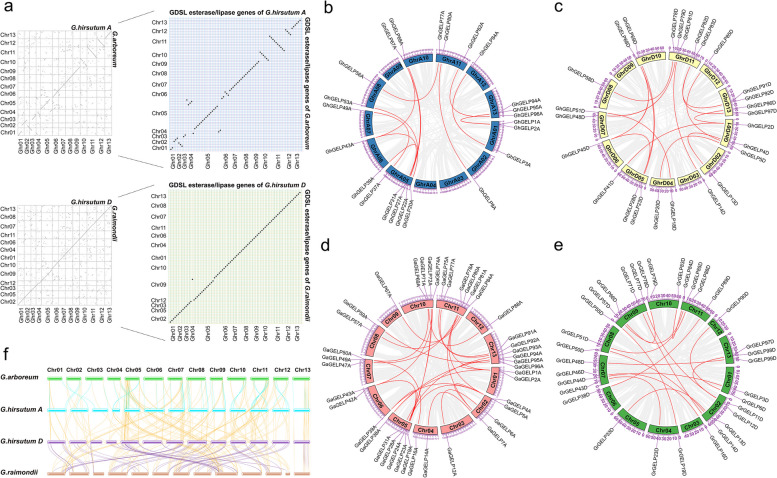
A total of 389 GELP family genes were identified in three cotton species of Gossypium hirsutum (193), G. arboreum (97), and G. raimondii (99). These GELPs could be classified into three groups and eight subgroups, with the GELPs in same group to have similar gene structures and conserved motifs. Evolutionary event analysis showed that the GELP family genes tend to be diversified at the spatial dimension and certain conservative at the time dimension, with a trend of potential continuous expansion in the future. The orthologous or paralogous GELPs among different genomes/subgenomes indicated the inheritance from genome-wide duplication during polyploidization, and the paralogous GELPs were derived from chromosomal segment duplication or tandem replication. GELP genes in the A/D subgenome underwent at least three large-scale replication events in the evolutionary process during the period of 0.6-3.2 MYA, with two large-scale evolutionary events between 0.6-1.8 MYA that were associated with tetraploidization, and the large-scale duplication between 2.6-9.1 MYA that occurred during diploidization. The cotton GELPs indicated diverse expression patterns in tissue development, ovule and fiber growth, and in response to biotic and abiotic stresses, combining the existing cis-elements in the promoter regions, suggesting the GELPs involvements of functions to be diversification and of the mechanisms to be a hormone-mediated manner.
Our results provide a systematic and comprehensive understanding the function and regulatory mechanism of cotton GELP family, and offer an effective reference for in-depth genetic improvement utilization of cotton GELPs.
GDSL 酯酶/脂肪酶(GELP)在植物的生长、发育以及对生物和非生物胁迫的响应中发挥着重要作用。目前,棉花 GELP 家族基因的广泛而深入的分析还不够清楚,这极大地限制了对棉花 GELP 功能和调控机制的进一步理解。
在三种棉花物种(陆地棉 193 个、亚洲棉 97 个和雷蒙德氏棉 99 个)中鉴定出了总共 389 个 GELP 家族基因。这些 GELPs 可以分为三组和八个亚组,同组的 GELPs 具有相似的基因结构和保守基序。进化事件分析表明,GELP 家族基因在空间维度上趋于多样化,而在时间维度上具有一定的保守性,未来有潜在的连续扩张趋势。不同基因组/亚基因组之间的同源或旁系同源 GELPs 表明,在多倍化过程中基因组范围的复制发生了遗传,而旁系同源 GELPs 则来源于染色体片段复制或串联复制。在进化过程中,A/D 亚基因组中的 GELP 基因至少经历了三次大规模复制事件,在 0.6-3.2 百万年前的四倍体化过程中发生了两次大规模进化事件,与 0.6-1.8 百万年前的四倍体化相关,而在 2.6-9.1 百万年前的二倍体化过程中发生了大规模复制。棉花 GELP 在组织发育、胚珠和纤维生长以及对生物和非生物胁迫的响应中表现出不同的表达模式,结合启动子区域中现有的顺式元件,表明 GELP 涉及功能的多样化和激素介导的机制。
我们的研究结果提供了对棉花 GELP 家族功能和调控机制的系统而全面的认识,并为棉花 GELP 的深入遗传改良利用提供了有效的参考。